Pull Requests and Code Review
Overview
Pull requests (PRs) propose integrating a branch into a protected target (usually main). They bundle diff, discussion, CI status, and approval records — the audit trail regulators expect. CODEOWNERS routes reviews to platform or security teams for sensitive paths. Branch protection enforces reviews and green checks before merge.
This is Tutorial 1 in Module 10: Collaboration of the REBASH Academy Git & GitHub for Cloud & DevOps Engineers series — written for Cloud, DevOps, Platform, and SRE engineers.
Prerequisites
Learning Objectives
By the end of this tutorial, you will be able to:
- Describe the PR lifecycle from branch push to merge
- Author CODEOWNERS for Terraform and pipeline paths
- Build branch protection YAML for
main - Simulate PR review with local merge --no-ff and review notes file
- Store artefacts under
~/rebash-git/module-10
Architecture
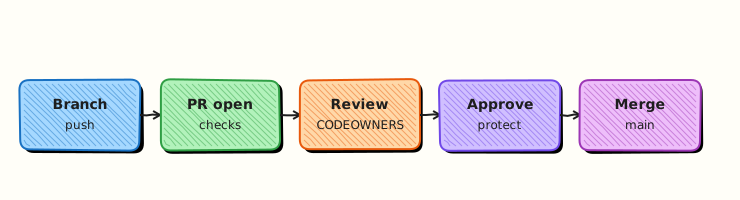
Feature branch pushes to origin; PR opens against main; reviewers comment; CI runs; merge updates main; branch deleted.
Theory
What it is
A pull request is a forge object linking source branch, target branch, diff, and metadata. Code review is human (or bot) validation of correctness, security, and operability before merge. CODEOWNERS (.github/CODEOWNERS) assigns required reviewers by file pattern. Branch protection rules block direct pushes and require status checks, review count, and signed commits if configured.
Why it matters
IaC mistakes merged to main deploy automatically in GitOps repos. PRs force terraform plan visibility, peer review of IAM changes, and documented approval. SOC2-style controls map to "who approved what on main."
How it works
- Push
feature/add-s3-bucketto origin. - Open PR: base
main, compare feature branch. - CODEOWNERS requests
@platform-teamfor*.tf. - CI runs plan/lint; reviewers approve.
- Squash merge (or merge commit per policy); delete branch.
- CD/GitOps picks up new main SHA.
Key concepts and comparisons
| Element | Purpose |
|---|---|
| Draft PR | WIP signal; skip review noise |
| Required reviewers | CODEOWNERS + count |
| Status checks | CI must pass |
| Review comments | Line-level feedback |
| Merge queue | Serial merges at scale |
| Review focus (DevOps) | Question |
|---|---|
| IaC | Blast radius? Rollback? |
| Pipelines | Secrets scoped? |
| Manifests | Prod values isolated? |
Common pitfalls
- Giant PRs — reviewers skim; defects slip through.
- Approving without reading plan output attached to CI.
- CODEOWNERS typo — wrong team never notified.
- Merging with failing optional checks that were actually required.
Hands-on Lab
Objective
Create repo with CODEOWNERS and branch-protection.yaml; simulate feature PR via branch, generate review-findings.txt from git commands, and local merge representing approved integration.
Prerequisites
- Git 2.x
Lab environment
Workspace: ~/rebash-git/module-10
Real-world scenario
Terraform change adds S3 bucket module. Platform team must review all *.tf via CODEOWNERS; branch protection requires one approval and CI green (simulated locally).
Step-by-step tasks
Task 1 – Main, CODEOWNERS, branch protection YAML
Create .github/CODEOWNERS:
Create branch-protection.yaml:
protected_branches:
  main:
    require_pull_request: true
    required_reviews: 1
    require_codeowners: true
    required_checks:
      - terraform-validate
    block_force_push: true
    block_deletions: true
Create validate-branch-protection.sh:
#!/usr/bin/env bash
set -euo pipefail
grep -q 'require_codeowners: true' branch-protection.yaml
grep -q 'terraform-validate' branch-protection.yaml
grep -q 'block_force_push: true' branch-protection.yaml
echo 'protection_ok'
Create README.md:
Bootstrap the PR lab repo:
cd ~/rebash-git/module-10
set -euo pipefail
rm -rf pr-lab
mkdir -p pr-lab/.github
cd pr-lab
git init -b main
git config user.email 'lab@rebash.local'
git config user.name 'REBASH Lab'
chmod +x validate-branch-protection.sh
./validate-branch-protection.sh | tee ../protection-validate.txt
grep -q 'protection_ok' ../protection-validate.txt
git add .
git commit -m 'chore: add CODEOWNERS and branch protection YAML'
grep -q 'platform-team' .github/CODEOWNERS
cd ..
Expected output
CODEOWNERS and branch protection YAML validated on main.
Task 2 – Feature branch and review findings from git commands
Create s3.tf:
Commit the feature and capture review findings:
cd ~/rebash-git/module-10/pr-lab
set -euo pipefail
git switch -c feature/add-s3-module
git add s3.tf
git commit -m 'feat: add S3 logs bucket module'
{
  echo 'branch=feature/add-s3-module'
  echo 'commits_ahead_of_main:'
  git log --oneline main..HEAD
  echo 'files_changed:'
  git diff --name-only main..HEAD
  echo 'diff_stat:'
  git diff --stat main..HEAD
  echo 'codeowners_match:'
  grep -E '\.tf|platform-team' .github/CODEOWNERS || true
  echo 'simulated_ci=terraform-validate:PASS'
} > review-findings.txt
grep -q 'feat: add S3 logs bucket module' review-findings.txt
grep -q 's3.tf' review-findings.txt
git add review-findings.txt
git commit -m 'chore: capture PR review findings'
git log --oneline main..HEAD | tee ../pr-commits.txt
test "$(git rev-list --count main..HEAD)" -eq 2
cd ..
Expected output
Two commits ahead of main; review-findings.txt generated from git log/diff.
Task 3 – Simulated approved merge
cd ~/rebash-git/module-10/pr-lab
set -euo pipefail
git switch main
git merge --no-ff feature/add-s3-module -m 'merge: PR #42 add S3 module (approved)'
test -f s3.tf
grep -q 'platform-team' .github/CODEOWNERS
git log --oneline --graph | tee ../pr-merge-graph.txt
grep -q 'merge: PR' ../pr-merge-graph.txt
tar -czf ../module-10-pr-evidence.tgz -C .. pr-commits.txt pr-merge-graph.txt review-findings.txt protection-validate.txt
ls -l ../module-10-pr-evidence.tgz | tee ../pr-evidence.txt
cd ..
Expected output
Merge commit on main; S3 tf present; graph shows merge node.
Validation steps
- CODEOWNERS assigns *.tf to platform-team
-
branch-protection.yamlpasses validation script - Feature branch merged with --no-ff
-
review-findings.txtpresent on branch history
Common errors and fixes
| Error | Cause | Fix |
|---|---|---|
| CODEOWNERS ignored on GitHub | Wrong path | Must be .github/CODEOWNERS or root |
| Merge without review | Local lab only | On GitHub enable protection |
| Conflict on merge | main moved | Rebase feature; re-run CI |
| Wrong base branch | PR target | Retarget to main |
Challenge exercise
Add CODEOWNERS line for **/production/** @sre-oncall and extend review-findings.txt generation to include rollback command terraform destroy -target=aws_s3_bucket.logs — commit on new branch docs/codeowners-sre.
Learning outcomes
- Authored CODEOWNERS for IaC paths
- Defined branch protection rules in validated YAML
- Simulated approved merge workflow locally with git-generated review findings
Cleanup
Validation
- Lab under module-10
- Can narrate PR lifecycle stages
- Can explain CODEOWNERS syntax
- Can list three branch protection rules
Code Walkthrough
- Small PRs — one concern; easier plan review.
- Attach plan output — CI artefact or comment bot.
- Draft until ready — reduce premature review load.
- Fix CI before re-request review — respect reviewer time.
- Link Issue —
Fixes #123closes loop.
Security Considerations
- Require review for workflow file changes (supply chain).
- Restrict who can dismiss reviews.
- Enforce signed commits if policy demands.
- Scan PR diffs for secrets in CI (gitleaks).
- Limit auto-merge to trusted bots with checks.
Common Mistakes
Rubber-stamp approval
Approving without reading IaC plan. Fix: Mandatory plan in CI; checklist in PR template.
Direct push to main
Bypasses all controls. Fix: Branch protection; admin bypass only break-glass.
Stale PR after long idle
Base branch drift breaks CI. Fix: Update branch; re-run checks before merge.
Best Practices
- PR template with rollback and test sections
- Size labels (S/M/L) for queue management
- Required
terraform plancomment on IaC repos - Auto-assign CODEOWNERS reviewers
- Delete head branch after merge
Troubleshooting
| Symptom | Likely cause | Fix |
|---|---|---|
| Cannot merge — reviews pending | Missing approval | Request CODEOWNERS |
| Required check missing | CI not reported | Fix workflow; re-run |
| CODEOWNERS not requested | Pattern mismatch | Fix glob; file path |
| Merge button grey | Draft or conflict | Ready for review; resolve |
Summary
Pull requests encode review, CI, and approval before changes hit main. Next: GitHub Actions for DevOps.
Interview Questions
1. Purpose of pull request vs direct merge locally?
Reveal answer
PR adds review gate, discussion, CI status, and audit record on the forge — direct local merge skips collaboration and compliance controls expected in production repos.
2. How CODEOWNERS works?
Reveal answer
File pattern lines map paths to teams/users; when those files change in a PR, GitHub requests reviews from listed owners — often required before merge.
3. Branch protection vs rulesets?
Reveal answer
Both enforce policies on branches; rulesets are newer org-level flexible policy engine — branch protection is classic per-branch rules (reviews, checks, push restrictions).
4. Squash merge trade-off?
Reveal answer
Cleaner main history with one commit per PR — loses granular commit messages from feature branch unless preserved in PR body or squash message edited.
5. What should IaC PR reviewer verify?
Reveal answer
Plan output, blast radius, IAM changes, secrets not in diff, rollback path, environment targeting, and alignment with module versioning policy.
6. Draft PR when?
Reveal answer
Work in progress — signals reviewers to wait; CI may still run for early feedback without merge eligibility.
7. Required status check fails — merge?
Reveal answer
No — protection blocks merge until checks pass or admin bypass (discouraged); fix root cause or flaky test first.
8. PR lifecycle after merge for GitOps?
Reveal answer
Main SHA updates; GitOps controller or CD pipeline detects change and syncs cluster desired state — PR merge is the approval gate before deploy automation runs.