Testing with pytest
Overview
pytest is the usual Python test runner for libraries and automation. You write functions named test_*, use plain assert, and share setup with fixtures. For DevOps code, tests prove parsers, exit codes, and “given this API JSON, we classify healthy” — without a live cluster on every commit.
Untested automation breaks on release day. Unit tests with mocked HTTP or cloud clients run in seconds on every pull request. Integration tests (Docker, kind) run in dedicated jobs. Coverage reports show which failure branches you never exercised — often the ones that fail at 02:00.
This is Tutorial 22 in Module 22: Testing of the REBASH Academy Python for Cloud & DevOps Engineers series. It is written for DevOps, Platform, and Site Reliability Engineering (SRE) engineers. By the end you will have a small inventory module with a green pytest -q run under ~/rebash-python/lab22.
Prerequisites
- Concurrency — Threads, asyncio, and Futures
- Functions — Parameters and Scope
- Error Handling and Exceptions
- Python 3.10+ and permission to install pytest in a venv
Learning Objectives
By the end of this tutorial, you will be able to:
- Write pytest functions and clear assertions for ops logic
- Use fixtures for temporary paths and sample inventory data
- Mock external calls so unit tests need no live network
- Run
pytest -qto green in CI style - Separate unit tests from optional integration tests
- Explain when coverage reports help (and when they become theatre)
Architecture
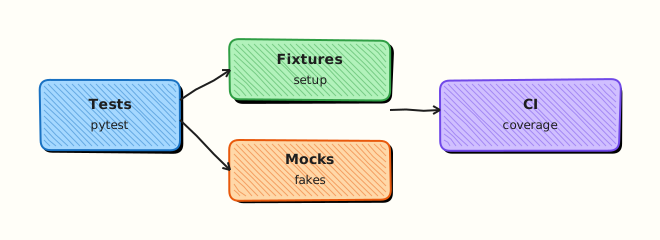
pytest collects tests, injects fixtures, runs assertions, and reports failures. Mocks replace network and cloud edges so the inventory logic stays under test.
Theory
What it is
pytest discovers tests in files matching test_*.py (and classes named Test*). Fixtures inject temporary paths (tmp_path), sample configs, or fake clients. monkeypatch / unittest.mock.patch replace urllib or SDK calls so tests return fixture JSON. Markers such as @pytest.mark.integration skip unless you opt in. pytest can still collect unittest.TestCase classes; prefer plain functions for new code.
Why it matters
A one-line change to severity mapping can open a Sev-1 alert path or hide outages. Fast unit tests give confidence on every pull request. Integration tests prove the real edges. Coverage should focus on parsers and failure paths — not chasing 100% for show.
How it works
- Arrange — fixtures build sample inventory files or fake responses.
- Act — call the function under test.
- Assert — check return values, raised errors, and side effects on temp paths.
- Mock edges — patch where the name is looked up (usually where used).
- Gate CI —
pytest -qmust be green; mark slow tests separately.
def test_healthy_host() -> None:
    assert classify({"status": "up"}) == "healthy"

@pytest.fixture
def sample_json(tmp_path: Path) -> Path:
    p = tmp_path / "hosts.json"
    p.write_text('[{"name": "web1", "status": "up"}]\n', encoding="utf-8")
    return p
Key concepts and comparisons
| Layer | Talks to | When |
|---|---|---|
| Unit | Mocks / fixtures | Every PR |
| Integration | Real Docker / kind / API sandbox | Nightly or labelled jobs |
| End-to-end | Full stack | Sparse; expensive |
| Tool | Role |
|---|---|
| Fixtures | Reusable setup/teardown |
| monkeypatch / mock | Fake I/O and SDKs |
| Markers | Opt-in slow tests |
| Coverage | Find untested exit branches |
Common pitfalls
- Hitting real cloud APIs in unit tests (flaky, costly, credential-dependent).
- Asserting exact log strings that change every refactor.
- Skipping tests for the hard error paths that matter most.
- Sharing mutable global state between tests.
- Importing modules that call the network at collection time.
Hands-on Lab
Objective
Under ~/rebash-python/lab22, implement a small host inventory module and pytest tests (including a mock) so pytest -q is green. Coverage is optional.
Prerequisites
- Python 3.10+
- pip available for a local venv
Lab environment
Workspace: ~/rebash-python/lab22
mkdir -p ~/rebash-python/lab22 && cd ~/rebash-python/lab22
set -euo pipefail
python3 -m venv .venv
# shellcheck disable=SC1091
source .venv/bin/activate
python -m pip install -q --upgrade pip
python -m pip install -q pytest
python -c 'import pytest; print(pytest.__version__)' | tee pytest-version.txt
Expected output
pytest-version.txt shows a pytest version.
Real-world scenario
Your team maintains a tiny inventory helper that loads host JSON and classifies health. Last month a bad status string slipped through and paging fired wrongly. You add unit tests with fixtures and a mocked fetch so every pull request proves the classifier — without calling production APIs.
Step-by-step tasks
Task 1 – Inventory module
cd ~/rebash-python/lab22
set -euo pipefail
# shellcheck disable=SC1091
source .venv/bin/activate

mkdir -p inventory tests
Create inventory/__init__.py:
"""Small host inventory helpers for the pytest lab."""
from .hosts import classify, load_hosts, summarise

__all__ = ["classify", "load_hosts", "summarise"]
Create inventory/hosts.py:
from __future__ import annotations

import json
import urllib.request
from pathlib import Path
from typing import Any


def classify(host: dict[str, Any]) -> str:
    status = str(host.get("status", "")).lower().strip()
    if status in {"up", "healthy", "ok"}:
        return "healthy"
    if status in {"down", "unhealthy", "failed"}:
        return "unhealthy"
    return "unknown"


def load_hosts(path: Path) -> list[dict[str, Any]]:
    data = json.loads(path.read_text(encoding="utf-8"))
    if not isinstance(data, list):
        raise ValueError("inventory root must be a JSON list")
    return data


def summarise(hosts: list[dict[str, Any]]) -> dict[str, int]:
    counts = {"healthy": 0, "unhealthy": 0, "unknown": 0}
    for host in hosts:
        counts[classify(host)] += 1
    return counts


def fetch_remote_status(url: str, timeout: float = 5.0) -> dict[str, Any]:
    with urllib.request.urlopen(url, timeout=timeout) as resp:
        return json.loads(resp.read().decode("utf-8"))
Create sample-hosts.json:
[
  {"name": "web1", "status": "up"},
  {"name": "web2", "status": "down"},
  {"name": "db1", "status": "degraded"}
]
Run:
python - << 'PY'
from pathlib import Path
from inventory import load_hosts, summarise
print(summarise(load_hosts(Path("sample-hosts.json"))))
PY
Expected output
A dict similar to {'healthy': 1, 'unhealthy': 1, 'unknown': 1}.
Task 2 – pytest suite with fixture and mock
cd ~/rebash-python/lab22
set -euo pipefail
# shellcheck disable=SC1091
source .venv/bin/activate
Create tests/test_hosts.py:
from __future__ import annotations

import json
from pathlib import Path
from unittest.mock import MagicMock, patch

import pytest

from inventory.hosts import classify, fetch_remote_status, load_hosts, summarise


@pytest.fixture
def hosts_file(tmp_path: Path) -> Path:
    path = tmp_path / "hosts.json"
    path.write_text(
        json.dumps(
            [
                {"name": "a", "status": "healthy"},
                {"name": "b", "status": "failed"},
                {"name": "c", "status": "maybe"},
            ]
        )
        + "\n",
        encoding="utf-8",
    )
    return path


@pytest.mark.parametrize(
    ("status", "expected"),
    [
        ("up", "healthy"),
        ("OK", "healthy"),
        ("down", "unhealthy"),
        ("weird", "unknown"),
    ],
)
def test_classify(status: str, expected: str) -> None:
    assert classify({"status": status}) == expected


def test_load_and_summarise(hosts_file: Path) -> None:
    hosts = load_hosts(hosts_file)
    assert summarise(hosts) == {"healthy": 1, "unhealthy": 1, "unknown": 1}


def test_load_rejects_object(tmp_path: Path) -> None:
    bad = tmp_path / "bad.json"
    bad.write_text('{"no": "list"}\n', encoding="utf-8")
    with pytest.raises(ValueError, match="list"):
        load_hosts(bad)


def test_fetch_remote_status_mocked() -> None:
    payload = {"name": "edge1", "status": "up"}
    fake_resp = MagicMock()
    fake_resp.read.return_value = json.dumps(payload).encode("utf-8")
    fake_resp.__enter__.return_value = fake_resp
    fake_resp.__exit__.return_value = False
    with patch("inventory.hosts.urllib.request.urlopen", return_value=fake_resp) as mocked:
        data = fetch_remote_status("http://example.invalid/status")
    assert data == payload
    mocked.assert_called_once()
    assert classify(data) == "healthy"
Run:
Expected output
pytest -q reports all tests passed (for example 5 passed or similar count).
Task 3 – Evidence (optional coverage)
cd ~/rebash-python/lab22
set -euo pipefail
# shellcheck disable=SC1091
source .venv/bin/activate

# Optional coverage — skip if install fails offline
if python -m pip install -q pytest-cov 2>/dev/null; then
  python -m pytest -q --cov=inventory --cov-report=term-missing | tee coverage.txt || true
else
  echo "coverage_skipped" | tee coverage.txt
fi

tar -czf pytest-lab-evidence.tgz \
  pytest-version.txt pytest-q.txt coverage.txt \
  sample-hosts.json inventory tests
ls -l pytest-lab-evidence.tgz | tee evidence-ls.txt
test -s pytest-lab-evidence.tgz
Expected output
Evidence archive exists; pytest-q.txt shows a green run.
Validation steps
-
inventory/hosts.pyclassifies healthy / unhealthy / unknown -
python -m pytest -qexits 0 - Fixture-based load/summarise test passes
- Mocked
fetch_remote_statusnever hits the network - Evidence archive exists under
~/rebash-python/lab22
Common errors and fixes
| Error | Cause | Fix |
|---|---|---|
ModuleNotFoundError: inventory | Wrong cwd / no package | Run pytest from ~/rebash-python/lab22 with inventory/ present |
fixture 'tmp_path' not found | Old pytest / wrong import | Reinstall pytest in the venv |
| Tests hit the network | Mock patched wrong target | Patch inventory.hosts.urllib.request.urlopen |
| Parametrize count surprises | Extra cases added | Re-read pytest-q.txt for the new total |
| Coverage plugin missing | Offline pip | Leave coverage_skipped — unit tests still count |
Challenge exercise
Add @pytest.mark.integration test that starts a tiny http.server (or uses the concurrency lab pattern) and calls fetch_remote_status for real on localhost. Make it skip unless RUN_INTEGRATION=1. Prove with:
RUN_INTEGRATION=1 python -m pytest -q -m integration
python -m pytest -q   # must still be green without the env var (integration skipped)
Learning outcomes
- Built a testable inventory module
- Used fixtures, parametrize, and mocks
- Achieved a green
pytest -qsuitable for CI - Know how optional coverage fits without blocking the lab
Cleanup
cd ~/rebash-python/lab22
set -euo pipefail
rm -rf .venv .pytest_cache .coverage htmlcov
# Keep evidence if you want it; otherwise:
# rm -f pytest-lab-evidence.tgz *.txt
Validation
- Lab finished under
~/rebash-python/lab22/with a green pytest run - You can explain fixtures vs mocks in your own words
- You know why unit tests must not need cloud credentials
- You can describe one flaky-test failure mode and how to avoid it
Code Walkthrough
Production test practice usually follows this order:
- Pure functions first — classifiers and parsers are easy to unit test
- Fixtures for files —
tmp_path, never touch production paths - Mock at the boundary — HTTP/SDK only
- Markers for slow tests — keep default CI fast
- Assert behaviour — not brittle log string snapshots
Automate pytest -q on every pull request; keep humans for test design.
Security Considerations
- Never embed live production tokens in test fixtures committed to Git
- Prefer fake credentials clearly marked (
test-only-not-a-secret) - Do not disable TLS verify in tests that later get copied to prod code
- Limit who can read CI logs if tests print inventory hostnames
- Review mocks so they cannot hide auth failures you still need to handle
Common Mistakes
Calling real cloud APIs in unit tests
Flaky, slow, and credential-dependent. Fix: mock SDK/HTTP; mark true integration tests separately.
Asserting exact log line text
Refactors break CI without behaviour changes. Fix: assert structured return values and error types.
Shared mutable globals between tests
Order-dependent failures. Fix: fixtures with fresh data; no module-level caches without reset.
Chasing 100% coverage theatre
Useless tests that assert nothing real. Fix: cover failure paths and classifiers that page humans.
Best Practices
- Name tests after behaviour (
test_classify_down_is_unhealthy) - Parametrize clear matrices of input → output
- Keep unit tests under a few seconds total
- Document
RUN_INTEGRATION=1in the README - Fail CI on unit test failure; keep coverage gates modest and meaningful
Troubleshooting
| Symptom | Likely cause | Fix |
|---|---|---|
| Import errors | PYTHONPATH / package layout | Run from lab root; ensure inventory/__init__.py |
| Tests hit network | Forgot mock or wrong patch path | Patch where the name is used |
| Flaky integration | Shared cluster state | Isolate; mark/skip by default |
| Collection errors | Syntax error in test module | Run pytest --collect-only |
| Wrong assertion count | Parametrize expansion | Check parametrize rows |
Summary
pytest plus fixtures and mocks keeps DevOps Python honest in CI. This lab built an inventory module, proved a green pytest -q, and kept network out of unit tests. Next, ship the tool as a wheel in Packaging — pyproject.toml and Wheels.
Interview Questions
1. Why prefer pytest over writing only unittest.TestCase classes for new DevOps tools?
Reveal answer
pytest offers plain assert, fixtures, parametrize, and a large plugin ecosystem with less boilerplate. It still runs many unittest classes if you must. Teams pick pytest for speed of writing and clearer failure diffs — interviewers want practical reasons, not religion.
2. What belongs in a unit test versus an integration test for an inventory CLI?
Reveal answer
Unit: classifiers, JSON parsing, exit-code mapping, with mocked HTTP/SDK. Integration: real localhost server, Docker, or sandbox API with credentials from CI secrets. Unit tests run on every PR; integration tests are labelled or nightly.
3. Where should you patch urlopen — and why does the import location matter?
Reveal answer
Patch the name as looked up by the code under test (for example inventory.hosts.urllib.request.urlopen), not a random global. If the module did from urllib.request import urlopen, patch inventory.hosts.urlopen. Wrong targets silently call the real network.
4. How do fixtures improve inventory tests?
Reveal answer
Fixtures build fresh temp files and sample data per test, then clean up. That avoids editing shared fixtures on disk and keeps tests isolated. tmp_path is ideal for JSON inventories and config snippets.
5. When is a coverage gate helpful, and when is it harmful?
Reveal answer
Helpful when it forces tests on paging paths and parsers. Harmful when teams write empty tests to hit a percentage. Prefer meaningful coverage on critical modules over a global 100% rule.
6. A test passes locally but fails in CI only. What do you check first?
Reveal answer
Timezone/locale, filesystem case sensitivity, missing env vars, reliance on home-directory files, and accidental network access. Also check dependency versions pinned in CI images. Re-run with pytest -q inside the same container image.
7. How would you test code that must call a cloud SDK without spending money?
Reveal answer
Inject a protocol/interface or patch the client methods to return fixture payloads; assert the code called the right API with the right arguments. Use a sandbox account only in marked integration jobs with spend limits.
8. What makes a good assertion for a health classifier?
Reveal answer
Assert the returned category (and maybe structured error type), not the full log line. Use parametrize for a table of statuses. Include unknown/default cases — those often cause false pages in production.
Related Tutorials
- Python for Cloud & DevOps – Overview
- Concurrency — Threads, asyncio, and Futures (previous)
- Packaging — pyproject.toml and Wheels (next)
- CLI Applications — argparse, Click, and Typer
- Error Handling and Exceptions
References
- pytest documentation
unittest.mock— Python docs- Track index: Python for Cloud & DevOps Engineers