OOP — Classes and Dataclasses
Overview
You do not need a deep enterprise class hierarchy for a short shell helper. You do need clear types when a tool grows: a host, a health check, a cloud account. Object-Oriented Programming (OOP) gives you classes, methods, and inheritance. For data-shaped records, Python dataclasses reduce boilerplate and keep field lists obvious.
In DevOps work, a Host with name, env, and ip is easier to validate and serialise than a loose dict that may miss keys. Methods hold behaviour (is_prod(), to_dict()). __post_init__ runs after a dataclass is created so you can reject bad values early. Inheritance and simple polymorphism help when several check types share a run() interface — without over-engineering.
This is Tutorial 9 in Module 9: OOP of the REBASH Academy Python for Cloud & DevOps Engineers series. It is written for DevOps, Cloud, Platform, and Site Reliability Engineering (SRE) engineers. By the end, you will have a validated Host dataclass and dict serialisation under ~/rebash-python/lab09.
Prerequisites
- Error Handling and Exceptions
- Comfort with functions and dicts from earlier modules
Learning Objectives
By the end of this tutorial, you will be able to:
- Define a class with methods and a clear public API
- Model config-like records with
@dataclass - Validate fields in
__post_init__ - Serialise a dataclass to a
dictfor JSON/YAML - Explain when a plain function is enough instead of a class
Architecture
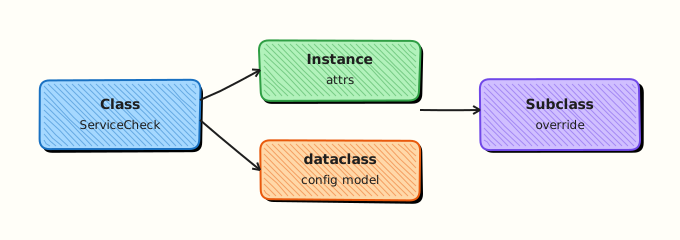
Ops concepts become types. A Host holds data and small methods. Validation runs at construction. Serialisation turns objects into dicts for files and APIs. Optional subclasses share a check interface.
Theory
What it is
A class is a blueprint. An object (instance) is one concrete value. Methods are functions on the class. A constructor in Python is __init__.
A dataclass generates __init__, __repr__, and comparison methods from annotated fields:
from dataclasses import dataclass, asdict

@dataclass
class Host:
    name: str
    env: str
    ip: str

    def __post_init__(self) -> None:
        if not self.name:
            raise ValueError("name is required")
        if self.env not in {"dev", "stage", "prod"}:
            raise ValueError(f"bad env: {self.env}")

    def is_prod(self) -> bool:
        return self.env == "prod"

    def to_dict(self) -> dict:
        return asdict(self)
Inheritance shares behaviour (class HttpCheck(BaseCheck):). Encapsulation means keeping a clear public API and treating internal helpers as private by convention (_validate). Polymorphism means different objects share a method name (check.run()) so a runner can loop without caring about the exact type (duck typing is common in Python).
Why it matters
Dicts are flexible but error-prone: missing ip, wrong env, or nested shape drift. Types at the boundary catch mistakes when config is loaded. Serialisation to dict keeps JSON/YAML easy. Over-deep inheritance trees slow reviews — prefer composition and dataclasses for data.
How it works
- Model the record — fields with types.
- Validate early —
__post_init__or a factory method. - Add behaviour — small methods, not god classes.
- Serialise —
asdict()/to_dict()for files and APIs. - Stop when a function is enough — one-off scripts do not need a class tax.
h = Host(name="web-01", env="prod", ip="10.0.1.11")
assert h.is_prod()
payload = h.to_dict()  # {"name": "web-01", "env": "prod", "ip": "10.0.1.11"}
Key concepts and comparisons
| Idea | Meaning | DevOps example |
|---|---|---|
| Class / object | Blueprint / instance | Host, one server |
| Method | Behaviour on the instance | is_prod(), to_dict() |
| Inheritance | Share / extend behaviour | BaseCheck → DiskCheck |
| Dataclass | Data-focused class | Inventory rows, settings |
| Encapsulation | Clear public surface | Validate in __post_init__ |
| Pattern | Prefer when | Avoid when |
|---|---|---|
@dataclass | Config/inventory records | Heavy mutable services with many deps |
Plain class + __init__ | Complex setup / resources | Simple 3-field records |
| Inheritance | Shared check interface | Deep trees for every variant |
| Function module | Stateless helpers | Forcing a class with no state |
Common pitfalls
- Building deep inheritance when a function and a dict would do.
- Skipping validation and discovering bad
envin production. - Mutable default fields (
list/dict) withoutfield(default_factory=list). - Putting network I/O inside
__init__/__post_init__(hard to test). - Treating private attributes as a security boundary — they are a convention only.
Hands-on Lab
Objective
Create a Host dataclass with methods, __post_init__ validation, and to_dict() serialisation. Prove good hosts work and bad hosts raise. Save evidence under ~/rebash-python/lab09.
Prerequisites
- Python 3.12+ (dataclasses are in the standard library)
- Write access under your home directory
Lab environment
Workspace: ~/rebash-python/lab09
mkdir -p ~/rebash-python/lab09 && cd ~/rebash-python/lab09
set -euo pipefail
python3 -m venv .venv
source .venv/bin/activate
python -c "from dataclasses import dataclass; print('ok')"
Expected output
ok; .venv exists.
Real-world scenario
Your inventory CLI will soon accept YAML hosts. Before wiring files, you model a Host type with validation so bad environments (prd typo) fail at construction, and you can dump clean dicts into JSON for a ticket attachment.
Step-by-step tasks
Task 1 – Define Host dataclass with validation and methods
Create host_model.py:
from __future__ import annotations
from dataclasses import asdict, dataclass
ALLOWED_ENVS = frozenset({"dev", "stage", "prod"})
@dataclass
class Host:
name: str
env: str
ip: str
def __post_init__(self) -> None:
self.name = self.name.strip()
self.env = self.env.strip().lower()
self.ip = self.ip.strip()
if not self.name:
raise ValueError("name is required")
if self.env not in ALLOWED_ENVS:
raise ValueError(f"env must be one of {sorted(ALLOWED_ENVS)}, got {self.env!r}")
parts = self.ip.split(".")
if len(parts) != 4 or not all(p.isdigit() and 0 <= int(p) <= 255 for p in parts):
raise ValueError(f"ip looks invalid: {self.ip!r}")
def is_prod(self) -> bool:
return self.env == "prod"
def label(self) -> str:
return f"{self.name}.{self.env}"
def to_dict(self) -> dict[str, str]:
return asdict(self)
Run:
Expected output
web-01.prod
Task 2 – Serialise good hosts and reject bad ones
cd ~/rebash-python/lab09
set -euo pipefail
source .venv/bin/activate
python << 'PY'
import json
from pathlib import Path
from host_model import Host
root = Path.home() / "rebash-python" / "lab09"
hosts = [
Host(name="web-01", env="prod", ip="10.0.1.11"),
Host(name="web-02", env="stage", ip="10.0.1.12"),
Host(name="db-01", env="PROD", ip="10.0.2.11"), # normalised to prod
]
assert hosts[0].is_prod()
assert not hosts[1].is_prod()
assert hosts[2].env == "prod"
payload = {"hosts": [h.to_dict() for h in hosts]}
out = root / "hosts.json"
out.write_text(json.dumps(payload, indent=2) + "\n", encoding="utf-8")
# Negative tests
errors: list[str] = []
for bad in (
dict(name="", env="prod", ip="10.0.1.11"),
dict(name="x", env="prd", ip="10.0.1.11"),
dict(name="x", env="dev", ip="10.0.1"),
):
try:
Host(**bad)
except ValueError as exc:
errors.append(str(exc))
else:
raise SystemExit(f"expected ValueError for {bad}")
(root / "validation-errors.txt").write_text("\n".join(errors) + "\n", encoding="utf-8")
assert len(errors) == 3
print("wrote", out)
print("errors", len(errors))
PY
Expected output
hosts.json written; three validation errors recorded.
Task 3 – Reload dicts into Host objects
cd ~/rebash-python/lab09
set -euo pipefail
source .venv/bin/activate

python << 'PY'
import json
from pathlib import Path
from host_model import Host

root = Path.home() / "rebash-python" / "lab09"
raw = json.loads((root / "hosts.json").read_text(encoding="utf-8"))
reloaded = [Host(**row) for row in raw["hosts"]]
assert len(reloaded) == 3
assert all(isinstance(h, Host) for h in reloaded)
assert reloaded[0].to_dict()["name"] == "web-01"

(root / "reload-ok.txt").write_text(
    "\n".join(h.label() for h in reloaded) + "\n",
    encoding="utf-8",
)
print((root / "reload-ok.txt").read_text(encoding="utf-8"))
PY
Expected output
reload-ok.txt lists three labels including web-01.prod.
Validation steps
-
Hostrejects empty name, bad env, and bad IP -
envvalues are normalised (for examplePROD→prod) -
hosts.jsonmatchesto_dict()output - Reloading JSON into
Hostsucceeds
Common errors and fixes
| Error | Cause | Fix |
|---|---|---|
mutable default TypeError | tags: list = [] | Use field(default_factory=list) |
| Validation never runs | Plain class without __post_init__ | Use @dataclass + __post_init__ or validate in __init__ |
asdict includes unwanted fields | Extra attributes | Keep only declared fields; or write a custom to_dict |
| Case typos in env | No normalisation | Strip/lower in __post_init__ |
Challenge exercise
Add an optional field tags: list[str] with field(default_factory=list). Reject unknown tags outside {"web","db","cache"}. Create Host("cache-01","prod","10.0.3.11", tags=["cache"]), serialise to challenge-host.json, and prove reload works.
Learning outcomes
- Built a dataclass with methods and validation
- Serialised to dict/JSON and reloaded
- Rejected invalid host records with clear errors
Cleanup
cd ~/rebash-python/lab09
set -euo pipefail
# rm -rf .venv __pycache__ *.py *.json *.txt
deactivate 2>/dev/null || true
Validation
- Lab finished under
~/rebash-python/lab09/ - You can explain dataclass vs plain class
- You validate at construction time
- You know when a function is enough
Code Walkthrough
Production habits for OOP in ops tools:
- Start with data — dataclass fields that match YAML/JSON
- Validate once —
__post_init__or a factory - Keep methods small — no hidden network calls in constructors
- Serialise explicitly —
to_dict()/asdict()at the boundary - Prefer composition — a runner holding checks, not deep inheritance
Security Considerations
- Validation is not a substitute for auth — it only checks shape
- Do not store secrets as dataclass fields that get logged via
__repr__ - Be careful dumping full objects into logs (use allow-listed fields)
- Treat private
_fieldsas convention only, not access control - Reject unexpected keys when loading from external JSON if you need strict schemas
Common Mistakes
God classes that deploy, log, and page
Hard to test and review. Fix: keep Host as data; put I/O in separate functions/modules.
Mutable default arguments on fields
Shared list across instances. Fix: field(default_factory=list).
Skipping __post_init__ validation
Bad config reaches production. Fix: validate enums, IPs, and required strings early.
Deep inheritance for every cloud provider
Slow and brittle. Fix: shared protocol/duck typing + composition.
Best Practices
- One dataclass per document shape (Host, Service, Alert)
- Normalise strings (strip, case) in one place
- Freeze dataclasses (
frozen=True) when values should not change after load - Add a short
label()for human-readable logs - Write unit tests for invalid env/IP cases
Troubleshooting
| Symptom | Likely cause | Fix |
|---|---|---|
TypeError on construct | Wrong field types / missing args | Match JSON keys to fields |
| Validation passes bad IP | Weak check | Improve __post_init__ rules |
| JSON reload fails | Extra/missing keys | Align to_dict with constructor |
| Unexpected shared tags list | Mutable default | default_factory |
| Hard to mock Host | I/O in __init__ | Move I/O out of the model |
Summary
Classes and dataclasses turn loose dicts into validated ops models. Keep data objects small, validate in __post_init__, and serialise to dict for files and APIs. Next, emit useful diagnostics in Logging and Debugging.
Interview Questions
1. When do you choose a dataclass over a plain dict for inventory hosts?
Reveal answer
Choose a dataclass when you have a stable set of fields, want validation, methods like is_prod(), and clear serialisation. Dicts are fine for throwaway scripts. Interviewers look for “validate once at the boundary” rather than checking keys in every function.
2. What is __post_init__ for, and what should you avoid putting in it?
Reveal answer
It runs after the dataclass __init__ to normalise and validate fields. Avoid network calls, file I/O, and heavy side effects there — those make objects hard to test and slow to construct. Keep __post_init__ about data quality.
3. How do inheritance and duck typing show up in a health-check runner?
Reveal answer
A runner can call check.run() on any object that has that method. You may use a small base class or just a shared method name (duck typing). Prefer a shallow hierarchy: shared helpers, not five levels of subclasses.
4. Why is tags: list = [] as a dataclass field dangerous?
Reveal answer
Mutable defaults are shared across instances if handled incorrectly. Dataclasses require field(default_factory=list) so each instance gets its own list. Shared mutables cause confusing cross-host tag bugs.
5. How do you serialise a dataclass for JSON without leaking internal fields?
Reveal answer
Use asdict() when all fields are public and JSON-safe, or write an explicit to_dict() that allow-lists keys. Do not dump objects that contain secrets. Round-trip test: dict → JSON → construct dataclass again.
6. A colleague builds a 12-level class hierarchy for cloud resources. What do you suggest instead?
Reveal answer
Prefer composition: a client object plus small resource models (dataclasses). Share behaviour with functions or a thin base only where it removes real duplication. Deep hierarchies are hard to change and review in ops codebases.
7. How would you prove in a PR that Host validation works?
Reveal answer
Show unit tests (or a lab script) that construct valid hosts successfully and assert ValueError for empty name, bad env, and bad IP. Attach sample to_dict() JSON. Evidence of both allow and deny paths matters — same idea as sudo allow/deny tests on Linux.
Related Tutorials
- Python for Cloud & DevOps – Overview
- Error Handling and Exceptions (previous)
- Logging and Debugging (next)
- CLI Applications — argparse, Click, and Typer
References
- Classes — Python tutorial
- dataclasses — Data Classes — Python docs
- Track index: Python for Cloud & DevOps Engineers