Error Handling and Exceptions
Overview
Automation fails: networks drop, files go missing, APIs return 500, credentials expire. Good DevOps Python catches specific exceptions, cleans up in finally, raises clear errors, and returns a non-zero exit code so Continuous Integration (CI) can see the problem.
Silent except Exception: pass hides outages. Use try / except / else / finally, custom exception types for tool boundaries, and a retry helper with a hard limit for flaky calls — then prove the intentional fail path still exits non-zero.
This is Tutorial 8 in Module 8: Error Handling of the REBASH Academy Python for Cloud & DevOps Engineers series. It is written for DevOps, Cloud, Platform, and Site Reliability Engineering (SRE) engineers. By the end, you will have a working retry helper and evidence under ~/rebash-python/lab08.
Prerequisites
- File Handling — pathlib, JSON, YAML, CSV
- Python 3.12+ with a project virtual environment (venv)
Learning Objectives
By the end of this tutorial, you will be able to:
- Use
try/except/else/finallycorrectly - Catch specific exceptions instead of bare
Exceptionby default - Define a small custom exception type and raise it with context
- Build a retry helper that fails after N attempts
- Map failures to non-zero process exit codes
Architecture
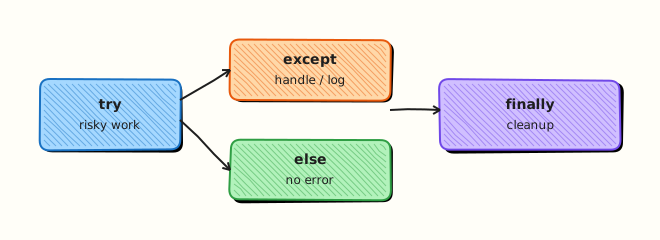
Risky operations sit inside a guarded block. Handlers map exceptions to messages and exit codes. Cleanup always runs. Optional retries wrap the same call with a limit.
Theory
What it is
An exception is an error object that interrupts normal flow. You raise it with raise, and catch it with except.
try:
    data = Path("missing.json").read_text(encoding="utf-8")
except FileNotFoundError as exc:
    raise SystemExit(f"inventory missing: {exc}") from exc
else:
    print("loaded", len(data))
finally:
    print("cleanup runs either way")
elseruns only if no exception was raised intry.finallyalways runs (success, failure, orreturn).raise ... from excchains the original cause for better tracebacks.
Why it matters
CI needs clear exit codes: 0 success, non-zero failure. Operators need messages that say which host or which file failed. Broad catches hide bugs. Infinite retries hide outages and can hammer a failing API.
How it works
- Validate early — check inputs before the risky call (defensive programming).
- Catch narrow types —
FileNotFoundError,TimeoutError,ValueError. - Translate — map to a custom exception or a clear
SystemExit/ return code. - Clean up — close files, temp dirs, or locks in
finally. - Retry only when useful — transient network errors; not for “file permanently missing”.
Custom exceptions mark a tool boundary (InventoryError). Retries wrap only transient failures with a hard attempt limit.
Key concepts and comparisons
| Construct | Runs when | Typical use |
|---|---|---|
try / except SpecificError | Risky work / that error | Recover or re-raise clearly |
else / finally | Success only / always | Success logging / cleanup |
raise X from e | You choose | Keep the cause chain |
| Retry with limit | Transient network/API errors | Not for missing local files |
| Exit code mapping | CLIs and CI jobs | Never swallow and exit 0 |
Common pitfalls
- Broad
except Exception:without a non-zero exit - Retrying forever (or retrying permanent errors such as missing files)
- Bare
except:catchingKeyboardInterrupt/SystemExit - Raising without
fromand losing the root cause
Hands-on Lab
Objective
Implement try/except/else/finally, a custom InventoryError, and a retry helper with an intentional fail path. Save evidence under ~/rebash-python/lab08.
Prerequisites
- Python 3.12+ and write access under your home directory
Lab environment
Workspace: ~/rebash-python/lab08
mkdir -p ~/rebash-python/lab08 && cd ~/rebash-python/lab08
set -euo pipefail
python3 -m venv .venv
source .venv/bin/activate
python -c "import sys; print(sys.version)"
Expected output
Python 3.12+ version string; .venv exists.
Real-world scenario
Inventory fetch is flaky. You need retries for transient errors, a custom exception for permanent problems, and a non-zero exit when retries are exhausted so CI turns red instead of going green with empty data.
Step-by-step tasks
Task 1 – Custom exception with try/except/else/finally
Create inventory_errors.py:
from __future__ import annotations

from pathlib import Path


class InventoryError(Exception):
    """Inventory could not be loaded or validated."""


def load_inventory(path: Path, cleanup_log: Path | None = None) -> str:
    handle = None
    try:
        handle = path.open(encoding="utf-8")
        text = handle.read()
    except FileNotFoundError as exc:
        raise InventoryError(f"missing inventory: {path}") from exc
    else:
        if not text.strip():
            raise InventoryError(f"empty inventory: {path}")
        return text
    finally:
        if handle is not None:
            handle.close()
        if cleanup_log is not None:
            cleanup_log.write_text("finally-ran\n", encoding="utf-8")
Run:
python << 'PY'
from pathlib import Path
from inventory_errors import InventoryError, load_inventory

root = Path.home() / "rebash-python" / "lab08"
finally_log = root / "finally-log.txt"
(root / "hosts.txt").write_text("web-01\nweb-02\n", encoding="utf-8")
assert "web-01" in load_inventory(root / "hosts.txt", finally_log)
assert finally_log.read_text(encoding="utf-8") == "finally-ran\n"

for label, path, setup in (
    ("missing", root / "no-such-hosts.txt", None),
    ("empty", root / "empty.txt", ""),
):
    if setup is not None:
        path.write_text(setup, encoding="utf-8")
    try:
        load_inventory(path, finally_log)
    except InventoryError as exc:
        (root / f"task1-{label}.txt").write_text(str(exc) + "\n", encoding="utf-8")
    else:
        raise SystemExit(f"expected InventoryError for {label}")
print("task1 ok")
PY
Expected output
task1 ok; finally-log.txt says finally-ran; missing/empty error files exist.
Task 2 – Retry helper with intentional fail path
Create retry_helper.py:
from __future__ import annotations

import time
from collections.abc import Callable
from typing import TypeVar

T = TypeVar("T")


class RetryError(Exception):
    """Raised when all retry attempts fail."""


def retry(
    fn: Callable[[], T],
    *,
    attempts: int = 3,
    delay_sec: float = 0.05,
    retry_on: tuple[type[BaseException], ...] = (TimeoutError,),
) -> T:
    last: BaseException | None = None
    for i in range(1, attempts + 1):
        try:
            return fn()
        except retry_on as exc:
            last = exc
            if i == attempts:
                break
            time.sleep(delay_sec)
    raise RetryError(f"failed after {attempts} attempts: {last}") from last
Run:
python << 'PY'
from pathlib import Path
from retry_helper import RetryError, retry

root = Path.home() / "rebash-python" / "lab08"
state = {"n": 0}

def flaky_ok():
    state["n"] += 1
    if state["n"] < 3:
        raise TimeoutError(f"transient #{state['n']}")
    return "ready"

result = retry(flaky_ok, attempts=3, delay_sec=0.01)
assert result == "ready"
(root / "task2-retry-ok.txt").write_text(f"result={result}\ncalls={state['n']}\n", encoding="utf-8")

def always_fail():
    raise TimeoutError("still down")

try:
    retry(always_fail, attempts=3, delay_sec=0.01)
except RetryError as exc:
    (root / "task2-retry-fail.txt").write_text(str(exc) + "\n", encoding="utf-8")
else:
    raise SystemExit("expected RetryError")
print("task2 ok")
PY
Expected output
task2 ok; task2-retry-ok.txt shows result=ready; task2-retry-fail.txt mentions failed attempts.
Task 3 – CLI-style exit codes
Create run_check.py:
from __future__ import annotations

import sys
from pathlib import Path

from inventory_errors import InventoryError, load_inventory
from retry_helper import RetryError, retry


def main(argv: list[str]) -> int:
    root = Path.home() / "rebash-python" / "lab08"
    mode = argv[1] if len(argv) > 1 else "ok"
    if mode == "ok":
        text = load_inventory(root / "hosts.txt")
        print(f"hosts_loaded={len(text.splitlines())}")
        return 0
    if mode == "missing":
        try:
            load_inventory(root / "no-such-hosts.txt")
        except InventoryError as exc:
            print(exc, file=sys.stderr)
            return 2
        return 0
    if mode == "retry-fail":
        def boom() -> None:
            raise TimeoutError("down")

        try:
            retry(boom, attempts=2, delay_sec=0.01)
        except RetryError as exc:
            print(exc, file=sys.stderr)
            return 3
        return 0
    print("unknown mode", mode, file=sys.stderr)
    return 1


if __name__ == "__main__":
    raise SystemExit(main(sys.argv))
Run:
python run_check.py ok | tee task3-ok.txt
test "$(python run_check.py ok >/dev/null; echo $?)" -eq 0
test "$(python run_check.py missing >/dev/null 2>task3-missing.err; echo $?)" -eq 2
test "$(python run_check.py retry-fail >/dev/null 2>task3-retry.err; echo $?)" -eq 3
echo "exit-codes-ok" | tee task3-summary.txt
Expected output
task3-ok.txt shows host count; exit code 2 for missing; exit code 3 for retry-fail; task3-summary.txt says exit-codes-ok.
Validation steps
-
InventoryErroris raised for missing and empty files - Retry succeeds on the third call for the flaky function
- Retry raises
RetryErrorwhen all attempts fail -
run_check.pyreturns 0 / 2 / 3 for the three modes
Common errors and fixes
| Error | Cause | Fix |
|---|---|---|
| Exit code always 0 | Exception caught and ignored | Re-raise or return non-zero in main |
RetryError never raised | attempts too high / function succeeds | Use the intentional always_fail path |
| File left open | No finally / context manager | Use with or close in finally |
| Lost root cause | raise X without from | Use raise X(...) from exc |
Challenge exercise
Extend retry_helper.py with a on_retry callback that appends one line per attempt to retry-log.txt (attempt number + exception type). Prove three lines appear for the always_fail path. Do not change the successful flaky path behaviour.
Learning outcomes
- Used
try/except/else/finallywith a custom exception - Built a bounded retry helper and proved success and fail paths
- Mapped errors to CI-friendly exit codes
Cleanup
cd ~/rebash-python/lab08
set -euo pipefail
# rm -rf .venv __pycache__ *.py *.txt *.err
deactivate 2>/dev/null || true
Validation
- Lab finished under
~/rebash-python/lab08/with evidence files - You can explain
elsevsfinally - You catch specific exceptions for ops tools
- You can describe when retries help and when they hide outages
Code Walkthrough
Production habits for errors:
- Validate inputs before the network or file call
- Catch narrow types at the boundary
- Chain causes with
raise ... from exc - Clean up in
finallyorwith - Exit non-zero from CLI
mainwhen work failed
Security Considerations
- Do not put secrets in exception messages that may appear in CI logs
- Do not catch and ignore TLS/certificate errors to “make it work”
- Limit retries so failing auth does not look like a hang
- Fail closed when inventory or policy files are missing
- Avoid bare
except:(can swallowKeyboardInterrupt)
Common Mistakes
Catching Exception and continuing
Bugs disappear and CI stays green. Fix: catch specific types and exit non-zero when the job cannot succeed.
Retrying permanent errors
Missing files will not appear after ten sleeps. Fix: retry only transient types (TimeoutError, selected HTTP 5xx).
Raising without chaining
Operators lose the original traceback. Fix: raise InventoryError(...) from exc.
Cleanup only on the success path
Temp files and locks leak on failure. Fix: use finally or context managers.
Best Practices
- One custom exception family per tool boundary (
InventoryError,DeployError) - Document exit codes in
--helpor README - Keep retry delay small in tests; configurable in production
- Prefer
withfor files over manualfinallywhen possible - Unit-test both the success path and the fail path
Troubleshooting
| Symptom | Likely cause | Fix |
|---|---|---|
| CI green but no work done | Swallowed exception | Fail the job; assert exit code |
| Traceback too short | Exception converted poorly | Chain with from |
| Too many API calls | High attempts / no backoff | Cap attempts; add delay |
| File descriptor leak | Open without close | Use with path.open(...) |
SystemExit caught | Broad except Exception | Do not catch BaseException |
Summary
Clear exceptions, bounded retries, and honest exit codes make automation trustworthy. Catch what you can handle, clean up always, and fail loudly when you cannot succeed. Next, model hosts and checks with classes in OOP — Classes and Dataclasses.
Interview Questions
1. What is the difference between else and finally on a try block?
Reveal answer
else runs only when try completes without an exception. finally always runs. Use else for success-only work; use finally (or with) for cleanup.
2. Why is bare except: or broad except Exception: pass dangerous in DevOps scripts?
Reveal answer
They hide bugs, keep CI green, and can mask interrupts. Prefer specific types, log context, and exit non-zero when the job cannot finish.
3. When should you write a custom exception class?
Reveal answer
At a tool boundary so callers catch InventoryError without caring about FileNotFoundError vs empty content. Group by meaning — not one tiny type per line.
4. How do you design retries for a flaky HTTP call without hiding a real outage?
Reveal answer
Retry only transient failures, cap attempts, use backoff, log each try, and raise when exhausted so CI fails. Do not retry auth or validation errors.
5. What does raise NewError("msg") from exc give you that raise NewError("msg") does not?
Reveal answer
Chaining keeps the cause in the traceback, so operators see both the high-level failure and the original timeout or missing file.
6. How should a CLI map exceptions to process exit codes?
Reveal answer
Catch expected errors in main, print to stderr, return a documented non-zero code (for example 2 bad input, 3 retries exhausted). Reserve 0 for success.
7. A junior engineer wraps an entire deploy script in try/except Exception and emails “failed”. What do you change in review?
Reveal answer
Require traceback logging, preserved exit codes, and stop-after-failure behaviour. Ask for fail-path tests. Vague catches are a review reject.
Related Tutorials
- Python for Cloud & DevOps – Overview
- File Handling — pathlib, JSON, YAML, CSV (previous)
- OOP — Classes and Dataclasses (next)
- Logging and Debugging
References
- Errors and Exceptions — Python tutorial
- Built-in Exceptions — Python docs
- Track index: Python for Cloud & DevOps Engineers