REST APIs — requests, Auth, and Resilience
Overview
Most cloud control planes, Git forges, and chat tools speak HTTP (Hypertext Transfer Protocol). In Python, the requests library sends methods (GET, POST, …), headers, and JSON bodies, then returns a status code and a body you can parse. Resilience means every call has a timeout, you retry only safe cases (429 / 5xx), and you never hang a Continuous Integration (CI) runner waiting forever.
Authentication usually means a Bearer token or API key from the environment — not hard-coded in the repo. Pagination means following Link headers or page / cursor fields until the list ends. Rate limits (HTTP 429) need backoff, not a tight loop. Logging must never print the full Authorization header.
Without timeouts, a slow API freezes deploy jobs. Without status checks, a 404 looks like “success” if you ignore raise_for_status. Production clients treat 401/403 as config bugs, 404 as missing resources, and 429/503 as temporary — with a clear give-up point.
This is Tutorial 14 in Module 14: REST APIs of the REBASH Academy Python for DevOps Engineers series. It is written for Cloud, DevOps, Platform, and Site Reliability Engineering (SRE) engineers. By the end you will call a public test API (or a mocked file offline), assert statuses, and save evidence JSON.
Prerequisites
- Linux Automation — subprocess and psutil
- Configuration and Secrets — tokens via environment variables
- Python 3.10+ and a virtual environment
- Outbound HTTPS preferred; the lab includes an offline mock if the network is blocked
Learning Objectives
By the end of this tutorial, you will be able to:
- Perform GET (and a simple POST) with
requestsand JSON - Set connect and read timeouts on every call
- Retry transient failures with a simple loop or urllib3 Retry adapter
- Assert HTTP status codes deliberately (200/404/429 patterns)
- Pass auth headers from the environment without logging secrets
- Fall back to a mocked response file when offline
Architecture
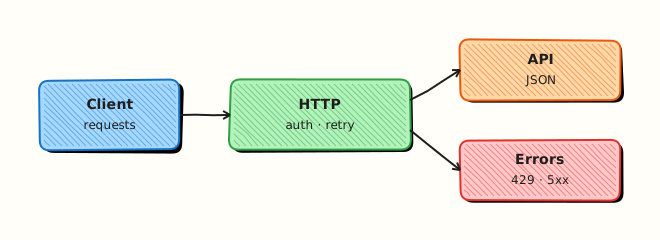
Your script uses a Session with timeouts and optional retries. Auth headers come from the environment. Success and failure become structured evidence — live HTTP or a local mock file.
Theory
What it is
A REST (Representational State Transfer) style API exposes resources over HTTP. requests.get(url, timeout=…) returns a Response with .status_code, .headers, and .json(). Auth is usually Authorization: Bearer <token> or a vendor header. Resilience is timeouts + limited retries + clear errors — not infinite loops.
import requests

r = requests.get(
    "https://httpbin.org/get",
    timeout=(3.05, 10),  # (connect, read) seconds
)
r.raise_for_status()
print(r.json()["url"])
Why it matters
Platform automation is API automation: create tickets, list repos, check deploy status, post Slack alerts. Forgotten timeouts hang runners. Ignored 429s burn quotas. Leaked tokens in logs become incidents. Teams that standardise Session + timeout + retry spend less time on “flaky scripts”.
How it works
- Build a Session — reuse TCP connections; attach default headers.
- Always timeout — tuple
(connect, read)or a single float. - Check status —
raise_for_status()or explicit asserts for expected codes. - Retry carefully — GET/HEAD/PUT idempotent cases; avoid blind POST retries unless the API is idempotent.
- Paginate — loop until empty page or no
nextlink. - Auth from env —
os.environ["API_TOKEN"]; never commit tokens.
from requests.adapters import HTTPAdapter
from urllib3.util import Retry
import requests

retry = Retry(total=3, backoff_factor=0.5, status_forcelist=(429, 500, 502, 503, 504))
session = requests.Session()
session.mount("https://", HTTPAdapter(max_retries=retry))
Key concepts and comparisons
| Concern | Approach |
|---|---|
| Timeout | (connect, read) on every request |
| Auth | Env var → header; short-lived tokens when possible |
| 429 / 5xx | Limited retries with backoff |
| 401 / 403 | Fail fast — fix credentials / RBAC |
| Pagination | Follow vendor next / cursor until done |
| Pattern | Prefer when | Avoid when |
|---|---|---|
| Simple retry loop | Tiny scripts, few calls | Complex APIs needing jitter budgets |
urllib3 Retry on Session | Shared client for many calls | POSTs that create duplicates |
| Mock JSON file | Offline CI / air-gapped labs | Pretending mock proves live auth |
Common pitfalls
- No timeout → hung job.
- Retrying non-idempotent POST forever → duplicate resources.
- Logging
Authorizationheaders. - Assuming JSON always parses (check
Content-Type/ empty body). - Treating every non-200 as retryable (404 is usually final).
Hands-on Lab
Objective
Call httpbin.org (or example.com) with timeouts and retries, assert statuses, write api-evidence.json, and prove an offline path using a mocked response file under ~/rebash-python/lab14.
Prerequisites
- Python 3.10+
pipin a venv- Network optional — mock path works offline
Lab environment
Workspace: ~/rebash-python/lab14
mkdir -p ~/rebash-python/lab14 && cd ~/rebash-python/lab14
set -euo pipefail
python3 -m venv .venv
# shellcheck disable=SC1091
source .venv/bin/activate
python -m pip install -U pip
python -m pip install 'requests>=2.31,<3'
python -c "import requests; print(requests.__version__)" | tee requests-version.txt
Expected output
requests-version.txt shows a 2.x version.
Real-world scenario
You are writing a small uptime helper for an internal admin API. Security wants timeouts and no secrets in logs. CI agents sometimes have no egress, so the same code must accept a fixture file. You practise against httpbin and a local mock.
Step-by-step tasks
Task 1 – GET with timeout and status assert
Create fetch_status.py:
#!/usr/bin/env python3
"""GET with explicit timeout and status handling."""
from __future__ import annotations

import json
import sys
from pathlib import Path

import requests

URL = "https://httpbin.org/get"
FALLBACK_URL = "https://example.com/"


def fetch(url: str) -> dict:
    try:
        response = requests.get(url, timeout=(3.05, 15))
    except requests.RequestException as exc:
        return {"ok": False, "url": url, "error": type(exc).__name__, "detail": str(exc)}
    body_preview = (response.text or "")[:200]
    return {
        "ok": response.status_code == 200,
        "url": url,
        "status_code": response.status_code,
        "content_type": response.headers.get("Content-Type", ""),
        "body_preview": body_preview,
    }


def main() -> int:
    result = fetch(URL)
    if not result.get("ok"):
        result = fetch(FALLBACK_URL)
    path = Path("live-get.json")
    path.write_text(json.dumps(result, indent=2) + "\n", encoding="utf-8")
    print(json.dumps(result, indent=2))
    if not result.get("ok") and "error" in result:
        # Network blocked — still write file; Task 3 covers mock
        print("live fetch failed (will use mock in Task 3)", file=sys.stderr)
        return 0
    assert result.get("status_code") == 200, result
    return 0


if __name__ == "__main__":
    raise SystemExit(main())
Run:
cd ~/rebash-python/lab14
set -euo pipefail
# shellcheck disable=SC1091
source .venv/bin/activate
python fetch_status.py | tee live-get-run.txt
test -s live-get.json
Expected output
live-get.json exists; status 200 when online, or a recorded error when offline (lab continues).
Task 2 – Simple retry loop for transient failures
Create fetch_with_retry.py:
#!/usr/bin/env python3
"""Retry GET on 429/5xx with bounded attempts (safe for idempotent GET)."""
from __future__ import annotations

import json
import time
from pathlib import Path

import requests

URL = "https://httpbin.org/status/200"
TRANSIENT = {429, 500, 502, 503, 504}


def get_with_retries(url: str, attempts: int = 4) -> dict:
    last: dict = {}
    for i in range(1, attempts + 1):
        try:
            response = requests.get(url, timeout=(3.05, 15))
        except requests.RequestException as exc:
            last = {"ok": False, "attempt": i, "error": type(exc).__name__, "detail": str(exc)}
            time.sleep(0.4 * i)
            continue
        last = {
            "ok": response.status_code == 200,
            "attempt": i,
            "status_code": response.status_code,
            "url": url,
        }
        if response.status_code == 200:
            return last
        if response.status_code not in TRANSIENT:
            return last
        time.sleep(0.4 * i)
    return last


def main() -> int:
    result = get_with_retries(URL)
    Path("retry-get.json").write_text(json.dumps(result, indent=2) + "\n", encoding="utf-8")
    print(json.dumps(result, indent=2))
    return 0


if __name__ == "__main__":
    raise SystemExit(main())
Run:
cd ~/rebash-python/lab14
set -euo pipefail
# shellcheck disable=SC1091
source .venv/bin/activate
python fetch_with_retry.py | tee retry-run.txt
test -s retry-get.json
Expected output
retry-get.json records attempt count; online runs end with status_code 200.
Task 3 – Offline mock fallback and evidence pack
Create mock-response.json:
{
  "args": {},
  "headers": {"User-Agent": "rebash-lab14"},
  "url": "https://httpbin.org/get"
}
Create api_client.py:
#!/usr/bin/env python3
"""Live GET or offline mock — never log secrets."""
from __future__ import annotations

import json
import os
import sys
from pathlib import Path

import requests

MOCK_PATH = Path("mock-response.json")


def load_token() -> str | None:
    return os.environ.get("LAB14_API_TOKEN")


def fetch(*, force_mock: bool = False) -> dict:
    token = load_token()
    headers = {}
    if token:
        headers["Authorization"] = f"Bearer {token}"

    if force_mock or os.environ.get("LAB14_FORCE_MOCK") == "1":
        data = json.loads(MOCK_PATH.read_text(encoding="utf-8"))
        return {"mode": "mock", "ok": True, "status_code": 200, "json": data}

    try:
        response = requests.get(
            "https://httpbin.org/get",
            headers=headers,
            timeout=(3.05, 15),
        )
        # Do not log Authorization
        safe_headers = {k: v for k, v in response.request.headers.items() if k.lower() != "authorization"}
        return {
            "mode": "live",
            "ok": response.status_code == 200,
            "status_code": response.status_code,
            "request_headers_safe": safe_headers,
            "json": response.json() if response.headers.get("Content-Type", "").startswith("application/json") else None,
        }
    except requests.RequestException as exc:
        data = json.loads(MOCK_PATH.read_text(encoding="utf-8"))
        return {
            "mode": "mock-fallback",
            "ok": True,
            "status_code": 200,
            "error": type(exc).__name__,
            "json": data,
        }


def main() -> int:
    force = "--mock" in sys.argv
    result = fetch(force_mock=force)
    Path("api-evidence.json").write_text(json.dumps(result, indent=2) + "\n", encoding="utf-8")
    print(f"mode={result['mode']} ok={result['ok']} status={result.get('status_code')}")
    assert result["ok"] is True
    assert result.get("json") is not None
    return 0


if __name__ == "__main__":
    raise SystemExit(main())
Create pack_evidence.py:
import json
from pathlib import Path

files = ["live-get.json", "retry-get.json", "api-evidence.json", "mock-response.json"]
pack = {name: json.loads(Path(name).read_text(encoding="utf-8")) for name in files if Path(name).is_file()}
Path("lab14-evidence.json").write_text(json.dumps(pack, indent=2) + "\n", encoding="utf-8")
assert Path("api-evidence.json").stat().st_size > 0
print("evidence pack ok")
Run:
cd ~/rebash-python/lab14
set -euo pipefail
# shellcheck disable=SC1091
source .venv/bin/activate
python api_client.py --mock | tee mock-run.txt
LAB14_FORCE_MOCK=0 python api_client.py | tee api-run.txt || python api_client.py --mock | tee api-run.txt
python pack_evidence.py
Expected output
api-evidence.json shows mode of mock, live, or mock-fallback; lab14-evidence.json packs the artefacts.
Validation steps
- Every live call uses an explicit
timeout= - Retry helper bounds attempts (does not loop forever)
- Mock path works with
python api_client.py --mock - Evidence exists under
~/rebash-python/lab14
Common errors and fixes
| Error | Cause | Fix |
|---|---|---|
ConnectTimeout / ConnectionError | No egress | Use --mock or mock-fallback path |
JSONDecodeError | HTML body (example.com) | Check Content-Type before .json() |
| Retries take too long | High backoff / too many attempts | Keep lab attempts small (3–4) |
| Token visible in logs | Printed headers | Filter Authorization like the lab |
Challenge exercise
Add a POST to https://httpbin.org/post with a small JSON body {"source":"lab14"}, timeout, and status assert 200. Save post-evidence.json. If offline, write the intended request body to post-dry-run.json instead and exit 0. Do not retry POST in a tight loop.
Learning outcomes
- Called HTTP APIs with timeouts and status asserts
- Practised bounded retries for GET
- Used an offline mock fixture
- Packed API evidence without leaking tokens
Cleanup
cd ~/rebash-python/lab14
deactivate 2>/dev/null || true
# rm -rf .venv
# Keep *-evidence.json if you want portfolio proof
Validation
- Lab finished under
~/rebash-python/lab14/ - You can explain timeout vs retry vs fail-fast for 401/404
- You never log full Authorization headers
- You know when mock mode is honest vs misleading
Code Walkthrough
Production HTTP clients usually follow this order:
- Session + defaults — base URL, User-Agent, accept JSON
- Timeouts on every call — connect and read
- Status policy — raise or branch; do not ignore codes
- Retries only for transient, idempotent cases
- Evidence — status, latency, correlation IDs — never secrets
Security Considerations
- Load tokens from the environment or a secret store — never commit them
- Redact
Authorizationand cookie headers in logs - Prefer short-lived tokens / OAuth device flows over long-lived PATs when possible
- Validate TLS (do not disable
verify=Falsein production) - Treat 401/403 as security signals, not retry fuel
Common Mistakes
No timeout on requests
Runners hang until the job limit. Fix: always pass timeout= (tuple preferred).
Blind retries on POST
Duplicate tickets, charges, or deploys. Fix: retry only idempotent methods or APIs with idempotency keys.
Logging the full response headers
Tokens leak into CI logs. Fix: allow-list header names for logs.
Ignoring pagination
Scripts “work” on small accounts and miss data at scale. Fix: loop until empty / no next link.
Best Practices
- Centralise one Session factory for an app
- Map status codes to clear exceptions in your domain
- Honour
Retry-Afteron 429 when present - Use httpbin/mock servers in unit tests; contract-test staging
- Document required scopes next to env var names
Troubleshooting
| Symptom | Likely cause | Fix |
|---|---|---|
| Hang | Missing timeout | Add (connect, read) |
| 401 loop | Bad/expired token | Fail fast; rotate secret |
| 429 storm | No backoff | Sleep / Retry-After; reduce concurrency |
| SSL error | Corporate proxy / old CA | Install corp CA; do not disable verify casually |
| Empty JSON | Wrong URL / HTML error page | Log status + content-type |
Summary
Reliable DevOps HTTP clients use requests with timeouts, careful retries, explicit status handling, and env-based auth — with a mock path for offline CI. Next, apply the same discipline to cloud SDKs in Cloud Automation — AWS, Azure, and GCP.
Interview Questions
1. Why must every requests call set a timeout in CI?
Reveal answer
Without a timeout, a slow or black-holed TCP connection can block the worker until the whole job is killed. Explicit connect/read timeouts fail fast, free the runner, and make failures visible in logs. Interviewers expect timeouts as a default habit, not an optimisation.
2. Which HTTP statuses would you retry, and which must fail immediately?
Reveal answer
Commonly retry 429 and 5xx (502/503/504) with backoff and a maximum attempt count. Fail immediately on 401/403 (credentials/RBAC) and usually 404 (missing resource). Blind retries on auth errors waste time and can lock accounts.
3. How do you pass a Bearer token safely in Python automation?
Reveal answer
Read from an environment variable or secret store, set headers={"Authorization": f"Bearer {token}"}, never commit the token, and never print headers wholesale. Prefer short-lived tokens. In CI, inject secrets via the platform’s secret mechanism.
4. What is the risk of retrying POST without an idempotency key?
Reveal answer
Network timeouts can mean “request arrived” even when the client saw a failure. A naive retry may create duplicate resources (tickets, payments, deployments). Prefer idempotent methods, server idempotency keys, or explicit dedupe — and default mutating tools to dry-run.
5. How would you design an offline fallback for API tests?
Reveal answer
Keep a checked-in fixture JSON (or VCR-style cassette). When live calls fail or FORCE_MOCK=1, load the fixture and still assert parser logic. Be honest in evidence (mode: mock) so nobody thinks live auth was proven.
6. Explain connect timeout vs read timeout.
Reveal answer
Connect timeout bounds establishing the TCP/TLS session. Read timeout bounds waiting for bytes after the connection is up. A server that accepts then stalls needs a read timeout; a black hole needs a connect timeout. Using both (tuple) is best practice with requests.
7. How does pagination affect inventory scripts for GitHub or cloud APIs?
Reveal answer
List endpoints return pages. Stopping after page one under-reports repos, instances, or findings. Follow Link headers or cursor fields until empty, respect rate limits, and store page counts in evidence so reviewers see completeness.
Related Tutorials
- Python for DevOps Engineers – Overview
- Linux Automation — subprocess and psutil (previous)
- Cloud Automation — AWS, Azure, and GCP (next)
- Lab — REST API Monitoring Service (more practice)