Production Engineering Patterns
Overview
A script that works once on your laptop is not a production tool. Production automation must survive short network blips, emit logs that operators can search, avoid writing the same change twice, and stop calling a broken dependency when it is clearly down. That set of habits is what engineers mean by production engineering patterns in Python.
In this tutorial you will combine four building blocks that show up in almost every Cloud and DevOps job: structured logging (machine-readable fields, not random print lines), retries with backoff for temporary failures, a circuit-breaker-lite that opens after too many failures, and an idempotent write so a second run does not corrupt state. You will wrap them in a small Command-Line Interface (CLI) that supports --dry-run and prints a clear RESULT= line for CI parsers.
On Continuous Integration (CI) runners, Kubernetes jobs, and cron hosts, these patterns decide whether a flaky Application Programming Interface (API) becomes a paging incident or a quiet retry. Teams that skip them often get silent double-writes, log spam with no correlation fields, or jobs that hammer a failing endpoint forever. Big platforms add OpenTelemetry later; the ideas start with clear logs, capped retries, and proof of success or failure.
This is Tutorial 24 in Module 24: Production Engineering of the REBASH Academy Python for Cloud & DevOps Engineers series. It is written for DevOps, platform, and Site Reliability Engineering (SRE) engineers. By the end you will have a working CLI under ~/rebash-python/lab24 you can explain in a design review or interview.
Prerequisites
- Packaging — pyproject.toml and Wheels
- Logging and Debugging (helpful)
- REST APIs — requests, Auth, and Resilience (helpful)
- Python 3.10+ on a practice machine or Ubuntu virtual machine (VM)
- Do not point this lab at a real production API
Learning Objectives
By the end of this tutorial, you will be able to:
- Emit structured log lines with level, event, and attempt fields
- Implement capped retries with exponential backoff for temporary errors
- Open a simple circuit breaker after repeated failures and skip further calls
- Write state idempotently so a second run leaves a stable result
- Ship a CLI with
--dry-runthat prints a parseableRESULT=line
Architecture
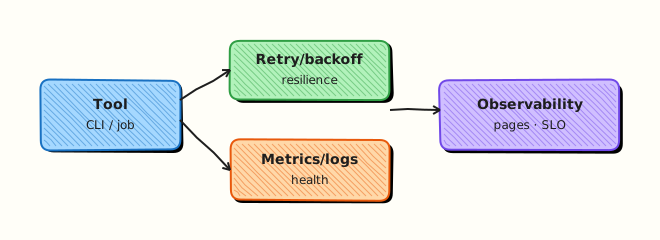
Resilience sits between your CLI and the outside world (APIs, disks, remote jobs). Logs leave for operators. Retries and the circuit breaker protect callers. Idempotent writes protect data.
Theory
What it is
Structured logging means each log line carries stable fields (for example event=retry attempt=2) so log tools can filter and alert. A retry re-runs a failing operation a limited number of times, usually with exponential backoff (wait 1s, then 2s, then 4s). A circuit breaker stops calling a dependency after a failure threshold, then optionally allows a probe later. Idempotent means “same request, same final state” — safe to run twice.
import logging
logging.basicConfig(level=logging.INFO, format="%(levelname)s %(message)s")
logging.getLogger("job").info("event=start job_id=lab24")
Why it matters
Cloud APIs return 429 (rate limit) and 5xx (server error). Disks fill. Remote hosts reboot. Without retries, CI fails for noise. Without a circuit breaker, one bad dependency floods logs and burns quotas. Without idempotent writes, a redeploy creates duplicate tickets or double charges. Operators need RESULT=ok or RESULT=fail in the last lines of a job so dashboards and pipelines can parse outcomes without reading novels.
How it works
- Log — configure
loggingonce; putevent=and key fields in the message (or JSON later). - Retry — catch only temporary errors; sleep with backoff; give up after
max_attempts. - Circuit — count consecutive failures; when open, fail fast without calling the dependency.
- Idempotent write — write to a temp file then
os.replace, or skip if a marker already matches the desired content. - CLI —
argparsewith--dry-run; always printRESULT=...before exit.
import time

def call_with_retry(fn, *, max_attempts=3, base_delay=0.05):
    last = None
    for attempt in range(1, max_attempts + 1):
        try:
            return fn()
        except TemporaryError as exc:
            last = exc
            if attempt == max_attempts:
                break
            time.sleep(base_delay * (2 ** (attempt - 1)))
    raise last
In production you may use libraries (tenacity, OpenTelemetry). Learn the ideas with a few dozen lines of clear code first.
Key concepts and comparisons
| Pattern | Prefer when | Avoid when |
|---|---|---|
| Retry + backoff | Temporary 429/5xx, brief timeouts | Permanent 403, bad config, schema errors |
| Circuit breaker | Dependency is clearly down | Single rare blip (retries are enough) |
| Idempotent write | Jobs can be re-run or overlap | Operations that must create unique side effects every time |
| Dry-run | Change tickets, CI plan stages | Hiding that dry-run skipped the real write |
| Signal | Good for operators |
|---|---|
Structured event= logs | Search and alert |
RESULT=ok / RESULT=fail | CI step parsers |
| Exit code 0 / non-zero | Shell pipelines |
Common pitfalls
- Retrying every exception, including
PermissionErrorand bad arguments. - Infinite retries with no cap (CI hangs until the job timeout).
- Logging secrets or full HTTP bodies in structured fields.
- Calling a “write” that appends forever instead of converging on one file state.
- Skipping
--dry-runso the only way to test is to change production.
Hands-on Lab
Objective
Build a small production-style CLI under ~/rebash-python/lab24 that uses structured logs, retries, a circuit-breaker-lite, and an idempotent state write. Prove dry-run and live runs with a RESULT= line and evidence files.
Prerequisites
- Python 3.10+ (
python3 --version) - Standard library only (no paid APIs)
- Writable home directory for the lab folder
Lab environment
Workspace: ~/rebash-python/lab24
mkdir -p ~/rebash-python/lab24 && cd ~/rebash-python/lab24
set -euo pipefail
python3 --version | tee python-version.txt
test -n "$(command -v python3)"
Expected output
python-version.txt shows Python 3.10 or newer.
Real-world scenario
Your team runs a nightly sync that writes a small status file used by a dashboard. The remote probe sometimes fails twice then succeeds. Security asks for dry-run in the change ticket. On-call asks for a single RESULT= line at the end of every run. You implement the patterns locally with a fake flaky probe so you can prove behaviour without touching production.
Step-by-step tasks
Task 1 – Resilience module (logging, retry, circuit, idempotent write)
Create the core module. The fake probe fails twice, then succeeds. The circuit opens if you force too many failures.
Create resilient_job.py:
"""Production patterns lab: structured logs, retry, circuit, idempotent write."""
from __future__ import annotations

import argparse
import json
import logging
import os
import sys
import time
from pathlib import Path

LOG = logging.getLogger("rebash.lab24")


class TemporaryError(Exception):
    """Retryable failure (simulated blip)."""


class CircuitOpenError(Exception):
    """Dependency circuit is open — fail fast."""


class CircuitBreaker:
    def __init__(self, failure_threshold: int = 3) -> None:
        self.failure_threshold = failure_threshold
        self.failures = 0
        self.open = False

    def before_call(self) -> None:
        if self.open:
            raise CircuitOpenError("circuit_open")

    def record_success(self) -> None:
        self.failures = 0
        self.open = False

    def record_failure(self) -> None:
        self.failures += 1
        if self.failures >= self.failure_threshold:
            self.open = True
            LOG.warning("event=circuit_open failures=%s", self.failures)


class FlakyProbe:
    """Fails the first `fail_times` calls, then returns ok."""

    def __init__(self, fail_times: int = 2) -> None:
        self.fail_times = fail_times
        self.calls = 0

    def __call__(self) -> str:
        self.calls += 1
        if self.calls <= self.fail_times:
            raise TemporaryError(f"blip call={self.calls}")
        return "probe_ok"


def setup_logging(verbose: bool) -> None:
    level = logging.DEBUG if verbose else logging.INFO
    logging.basicConfig(
        level=level,
        format="%(levelname)s %(name)s %(message)s",
        stream=sys.stderr,
        force=True,
    )


def call_with_retry(fn, *, max_attempts: int, base_delay: float, circuit: CircuitBreaker):
    last: Exception | None = None
    for attempt in range(1, max_attempts + 1):
        circuit.before_call()
        try:
            LOG.info("event=attempt n=%s", attempt)
            value = fn()
            circuit.record_success()
            LOG.info("event=attempt_ok n=%s", attempt)
            return value
        except TemporaryError as exc:
            last = exc
            circuit.record_failure()
            LOG.warning("event=retry n=%s error=%s", attempt, exc)
            if attempt == max_attempts or circuit.open:
                break
            time.sleep(base_delay * (2 ** (attempt - 1)))
        except CircuitOpenError:
            raise
    assert last is not None
    raise last


def idempotent_write(path: Path, payload: dict, *, dry_run: bool) -> str:
    """Write JSON atomically. Skip rewrite if content already matches."""
    text = json.dumps(payload, sort_keys=True, indent=2) + "\n"
    if path.exists() and path.read_text(encoding="utf-8") == text:
        LOG.info("event=idempotent_skip path=%s", path)
        return "unchanged"
    if dry_run:
        LOG.info("event=dry_run_write path=%s", path)
        return "dry_run"
    path.parent.mkdir(parents=True, exist_ok=True)
    tmp = path.with_suffix(path.suffix + ".tmp")
    tmp.write_text(text, encoding="utf-8")
    os.replace(tmp, path)
    LOG.info("event=write_ok path=%s", path)
    return "written"


def main(argv: list[str] | None = None) -> int:
    parser = argparse.ArgumentParser(description="REBASH lab24 resilient job")
    parser.add_argument("--state-file", default="state/status.json")
    parser.add_argument("--dry-run", action="store_true")
    parser.add_argument("--max-attempts", type=int, default=4)
    parser.add_argument("--fail-times", type=int, default=2)
    parser.add_argument("--force-open-circuit", action="store_true")
    parser.add_argument("-v", "--verbose", action="store_true")
    args = parser.parse_args(argv)

    setup_logging(args.verbose)
    state_path = Path(args.state_file)
    circuit = CircuitBreaker(failure_threshold=3)
    probe = FlakyProbe(fail_times=args.fail_times)

    if args.force_open_circuit:
        for _ in range(3):
            circuit.record_failure()

    try:
        value = call_with_retry(
            probe,
            max_attempts=args.max_attempts,
            base_delay=0.02,
            circuit=circuit,
        )
        action = idempotent_write(
            state_path,
            {"status": "ok", "probe": value},
            dry_run=args.dry_run,
        )
        print(f"RESULT=ok action={action}")
        return 0
    except (TemporaryError, CircuitOpenError) as exc:
        LOG.error("event=job_failed error=%s", exc)
        print(f"RESULT=fail error={exc}")
        return 1


if __name__ == "__main__":
    raise SystemExit(main())
Run:
Expected output
py_compile exits 0 with no traceback.
Task 2 – Dry-run, live run, and idempotent second run
cd ~/rebash-python/lab24
set -euo pipefail

python3 resilient_job.py --dry-run -v 2>run-dry.stderr | tee run-dry.stdout
grep -F 'RESULT=ok action=dry_run' run-dry.stdout
test ! -f state/status.json

python3 resilient_job.py -v 2>run-live.stderr | tee run-live.stdout
grep -F 'RESULT=ok action=written' run-live.stdout
test -f state/status.json
grep -F '"status": "ok"' state/status.json

python3 resilient_job.py -v 2>run-idem.stderr | tee run-idem.stdout
grep -F 'RESULT=ok action=unchanged' run-idem.stdout
grep -F 'event=idempotent_skip' run-idem.stderr
Expected output
dry-run does not create the file; first live run writes; second live run reports unchanged.
Task 3 – Circuit open path and evidence pack
cd ~/rebash-python/lab24
set -euo pipefail

set +e
python3 resilient_job.py --force-open-circuit --state-file state/circuit.json \
  2>run-circuit.stderr | tee run-circuit.stdout
rc=$?
set -e
test "$rc" -ne 0
grep -F 'RESULT=fail' run-circuit.stdout
grep -E 'circuit_open|CircuitOpenError|circuit open' run-circuit.stderr run-circuit.stdout || true
grep -F 'RESULT=fail error=circuit_open' run-circuit.stdout

tar -czf lab24-evidence.tgz \
  python-version.txt resilient_job.py state/status.json \
  run-dry.stdout run-dry.stderr \
  run-live.stdout run-live.stderr \
  run-idem.stdout run-idem.stderr \
  run-circuit.stdout run-circuit.stderr
ls -l lab24-evidence.tgz | tee evidence-ls.txt
Expected output
circuit run exits non-zero with RESULT=fail; lab24-evidence.tgz is non-empty.
Validation steps
-
resilient_job.pycompiles - Dry-run prints
RESULT=ok action=dry_runand creates no state file - Live run writes
state/status.jsonthen second run printsaction=unchanged - Forced circuit path prints
RESULT=failand non-zero exit -
lab24-evidence.tgzexists under~/rebash-python/lab24
Common errors and fixes
| Error | Cause | Fix |
|---|---|---|
RESULT=fail on first live run | fail_times ≥ max_attempts | Keep defaults (fail_times=2, max_attempts=4) |
| State file missing after live run | Ran only --dry-run | Run without --dry-run |
| No retry lines in stderr | Forgot -v / logging level | Use -v and read *.stderr |
FileNotExists in tar | Skipped a task | Re-run Task 2 then Task 3 |
| Sleep feels slow | Large base_delay | Lab uses 0.02 seconds on purpose |
Challenge exercise
Add a --job-id CLI flag. Include job_id in every structured log line and inside state/status.json. Prove with a run that greps job_id=change-42 in stderr and in the JSON file. Keep --dry-run working.
Learning outcomes
- Structured logs with
event=fields for operators - Retries with backoff around a flaky probe
- Circuit-breaker-lite fail-fast path
- Idempotent state file write and dry-run CLI with
RESULT=
Cleanup
cd ~/rebash-python/lab24
set -euo pipefail
# Keep evidence if you want it for a portfolio; otherwise:
# rm -rf state __pycache__ *.stdout *.stderr lab24-evidence.tgz
rm -rf __pycache__
Validation
- Lab finished under
~/rebash-python/lab24/with evidence archive - You can explain retry vs circuit breaker vs idempotent write in plain English
- You know which errors must not be retried
- You can describe what a CI parser should look for (
RESULT=and exit code)
Code Walkthrough
In real DevOps Python services, production patterns usually follow this order:
- Inspect — dry-run or read-only probe before a mutating write
- Bound failure — timeouts, max attempts, circuit thresholds in config
- Log for humans and machines — levels plus stable field names
- Converge state — idempotent writes / upserts, not blind appends
- Signal outcome — exit codes and a final machine-readable result line
Libraries help later. Clear contracts (dry-run, RESULT, evidence) help on day one.
Security Considerations
- Never put tokens or passwords in structured log fields
- Treat dry-run as a safety control, not as a substitute for least privilege
- Cap retries so a stolen credential cannot hammer an API forever from your job
- Write state files with restrictive permissions on shared hosts (
0o600when sensitive) - Keep circuit and retry settings in reviewable config, not hard-coded secrets
Common Mistakes
Retrying permanent errors
A 403 or bad argument will not heal with sleep. Fix: retry only temporary classes; fail fast on auth and validation errors.
No result line for CI
Pipelines that scrape free-text logs break easily. Fix: print RESULT=ok or RESULT=fail and a non-zero exit on failure.
Non-idempotent writes in cron
Every run appends or creates duplicates. Fix: compare desired state, use atomic replace, store a content hash or natural key.
Circuit never opens
Unlimited retries look like a circuit but still overload the dependency. Fix: track consecutive failures and fail fast when open.
Best Practices
- Put retry/circuit settings next to the job in config or flags, and document defaults
- Prefer stderr for logs and stdout for
RESULT=/ machine data - Use atomic file replace (
write temp+os.replace) for local state - Add one integration test that forces failure and expects non-zero exit
- Promote dry-run in change tickets before the first production enablement
Troubleshooting
| Symptom | Likely cause | Fix |
|---|---|---|
| Job hangs | Sleep too large or unbounded retries | Cap attempts; keep lab delays tiny |
| Double write in monitoring | Not idempotent | Compare content before write |
| CI green but no side effect | Only dry-run in pipeline | Separate plan and apply stages |
| Logs useless in search | Free-text only | Add event= and stable keys |
| Circuit stuck open | Threshold too low / no reset | Reset on success; document probe policy |
Summary
Production Python for DevOps is about bounded failure and clear signals: structured logs, capped retries, a simple circuit breaker, idempotent state, and a CLI that supports dry-run plus RESULT=. Next, harden secrets and supply-chain checks in Security for DevOps Python.
Interview Questions
1. What is the difference between a retry policy and a circuit breaker?
Reveal answer
A retry policy re-runs a failed call a limited number of times, usually with backoff, hoping the failure was temporary. A circuit breaker tracks recent failures and, when a threshold is crossed, stops calling the dependency for a period (fail fast). Retries handle blips; breakers protect both sides when the dependency is clearly down.
2. Which failures should you never retry in a DevOps CLI?
Reveal answer
Do not retry permanent client errors: bad configuration, validation failures, 401/403 authentication or authorisation problems, and most 404 cases when the resource identity is wrong. Retry timeouts, 429, and many 5xx responses — with a cap. Interviewers want a clear split, not “retry everything”.
3. How do you make a local state-file update idempotent?
Reveal answer
Compute the desired file content, compare it to the current file, and skip if equal. When writing, use a temporary file and os.replace so readers never see a half-written file. Running the job twice should end in the same bytes and an unchanged (or equivalent) outcome.
4. Why print RESULT=ok on stdout while sending structured logs to stderr?
Reveal answer
Separating streams lets CI capture a single parseable outcome on stdout while humans and log agents consume stderr. Mixing free-text logs with the result line makes fragile scraping. Exit codes still matter; RESULT= helps dashboards and wrappers.
5. What does --dry-run prove in a change ticket, and what does it not prove?
Reveal answer
Dry-run proves the job can load config, reach the decision point, and report what it would do without mutating state. It does not prove production credentials, real API quotas, or locking behaviour under concurrency. Use dry-run for review, then a controlled apply with evidence.
6. How would you explain exponential backoff to a junior engineer?
Reveal answer
After each temporary failure, wait longer before the next try (for example 0.05s, 0.1s, 0.2s) so you do not stampede a recovering service. Always set a maximum attempts so the job still fails clearly. Optional jitter (random small delay) reduces synchronised retries from many workers.
7. A job retries forever and pages the on-call — what did the author miss?
Reveal answer
Missing max attempts, missing a circuit breaker, or retrying a permanent error. Fix by capping retries, failing fast on auth/config errors, opening a circuit after repeated failures, and emitting RESULT=fail with logs that include attempt counts and the final error.
Related Tutorials
- Python for Cloud & DevOps – Overview
- Packaging — pyproject.toml and Wheels (previous)
- Security for DevOps Python (next)
- Logging and Debugging
- REST APIs — requests, Auth, and Resilience
References
- logging — Logging facility for Python — Python docs
- argparse — Parser for command-line options — Python docs
- os.replace — atomic file replace
- Track index: Python for Cloud & DevOps Engineers