URL shortener
Overview
A URL shortener maps a long URL to a short code and redirects quickly. It looks simple; the hard parts are uniqueness, read-heavy scale, and not slowing the redirect for analytics.
This is the first Part C case study: apply the design process, storage, cache, messaging, and APIs you already learned.
Prerequisites
- Observability and resilience (Part B complete)
- How to design a system
Learning Objectives
By the end of this tutorial, you will be able to:
- Write scoped requirements and capacity numbers for a shortener
- Compare hash, counter, and random code generation
- Design a redirect path that stays fast under read load
- Place cache and async analytics correctly
- Implement create + redirect with collision handling in Python
Requirements sketch
Business goal
Let marketers and apps share short, trackable links.
Functional (v1)
| ID | Requirement |
|---|---|
| F1 | Authenticated create: long HTTPS URL → short code |
| F2 | Redirect GET /{code} → 302/301 to long URL |
| F3 | Optional basic click count for owner |
| F4 | Codes unique; reject malformed URLs |
Out of scope (v1)
Custom domains, A/B tests, QR, SSO, link editing UI polish.
Non-functional targets (example)
- p95 redirect < 100 ms in-region
- 99.9% availability on redirect
- Read:write ≈ 100:1
- Year-one: 10M redirects/day
Capacity sketch
- Avg RPS ≈ 10M / 86 400 ≈ 116; peak ≈ 2× → ~230 RPS
- Storage: if 100k new links/day × 500 B × 5 years ≈ tens of GB — one primary is fine early
Theory
Code generation options
| Approach | Pros | Cons |
|---|---|---|
| Hash(URL) truncate | Deterministic | Collisions; same URL → same code (sometimes wanted) |
| Global counter → Base62 | Compact, unique | Counter becomes a hotspot; needs allocation ranges |
| Random Base62 | Simple, shard-friendly | Must check uniqueness; slightly longer for low collision |
Production tip: pre-allocate counter ranges per instance, or use random + insert-if-absent.
Data model (minimal)
Indexes: owner_id for listing. Clicks may live in a separate counter/store updated async.
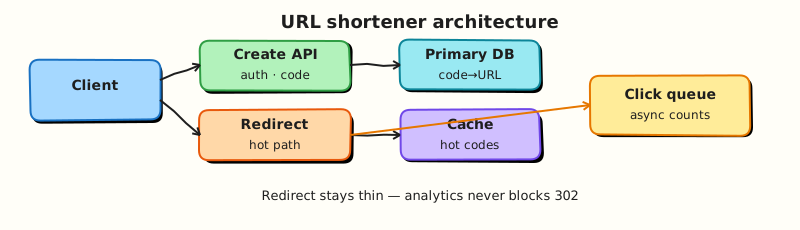
Redirect path (hot)
- Prefer cache-aside on
code → url - Do not wait on analytics
- Enqueue click event after (or alongside) issuing redirect
Create path
Idempotency-Key prevents duplicate creates on mobile retries (Module 8).
Consistency choices
- Redirect may use replica/cache → accept rare stale 404 after create for seconds, or read-your-writes on primary for N seconds after create
- Click counts: eventual via workers is usually fine
Scaling story
- Vertical scale + replicas + Redis
- Shard
linksby hash(code) if needed - Separate redirect service from management API
Architecture
Hands-on Lab
Objective
Implement an in-memory shortener with Base62-ish codes, collision retry, redirect, and async-style click counting via a queue.
Lab environment
Local Python 3.10+.
Real-world scenario
You must demo a correct create/redirect loop and show that click recording does not block the redirect response.
Step-by-step tasks
1. Workspace
mkdir -p ~/rebash-system-design/module-10-shortener
cd ~/rebash-system-design/module-10-shortener
2. Shortener service
#!/usr/bin/env python3
"""URL shortener: create, redirect, async click counts."""

from __future__ import annotations

import queue
import threading
import time
import secrets


ALPHABET = "0123456789abcdefghijklmnopqrstuvwxyzABCDEFGHIJKLMNOPQRSTUVWXYZ"


def encode_random(n_bytes: int = 5) -> str:
    raw = secrets.token_bytes(n_bytes)
    num = int.from_bytes(raw, "big")
    chars = []
    while num:
        num, rem = divmod(num, 62)
        chars.append(ALPHABET[rem])
    return "".join(reversed(chars)) or "0"


class Shortener:
    def __init__(self) -> None:
        self.links: dict[str, str] = {}
        self.clicks: dict[str, int] = {}
        self.click_q: queue.Queue[str] = queue.Queue()
        self._stop = threading.Event()
        self.worker = threading.Thread(target=self._consume, daemon=True)
        self.worker.start()

    def _consume(self) -> None:
        while not self._stop.is_set():
            try:
                code = self.click_q.get(timeout=0.05)
            except queue.Empty:
                continue
            self.clicks[code] = self.clicks.get(code, 0) + 1
            self.click_q.task_done()

    def create(self, url: str) -> str:
        if not url.startswith("https://"):
            raise ValueError("https only")
        for _ in range(8):
            code = encode_random()
            if code not in self.links:
                self.links[code] = url
                return code
        raise RuntimeError("collision storm")

    def redirect(self, code: str) -> str | None:
        url = self.links.get(code)
        if url is None:
            return None
        self.click_q.put(code)  # async — do not wait for counter
        return url

    def close(self) -> None:
        self.click_q.join()
        self._stop.set()
        self.worker.join(timeout=1)


def main() -> None:
    s = Shortener()
    code = s.create("https://example.com/docs")
    url = s.redirect(code)
    url2 = s.redirect(code)
    missing = s.redirect("nope")
    time.sleep(0.05)
    s.close()

    lines = [
        f"code={code}",
        f"redirect_url={url}",
        f"second_redirect_ok={'yes' if url2 == url else 'no'}",
        f"missing_is_none={'yes' if missing is None else 'no'}",
        f"click_count={s.clicks.get(code, 0)}",
        f"async_clicks_ok={'yes' if s.clicks.get(code) == 2 else 'no'}",
    ]
    report = "\n".join(lines) + "\n"
    print(report, end="")
    open("shortener-report.txt", "w", encoding="utf-8").write(report)


if __name__ == "__main__":
    main()
3. Run and verify
cd ~/rebash-system-design/module-10-shortener
python3 shortener_lab.py | tee shortener-run.txt
grep async_clicks_ok shortener-report.txt
Expected output
async_clicks_ok=yes and click_count=2.
Validation steps
- Create returns a code; redirect returns the URL
- Two redirects increment clicks without blocking the return path conceptually
- Unknown code returns
None
Challenge exercise
Add a cache dict with TTL in front of links and count cache hits on redirect.
Cleanup
cd ~/rebash-system-design/module-10-shortener
rm -f shortener-run.txt shortener-report.txt 2>/dev/null || true
Interview Questions
1. How do you generate unique short codes at scale?
Reveal answer
Common options: range-allocated counters encoded in Base62, or secure random codes with insert-if-absent and rare retry. Avoid a single hot global counter without ranges. Hash truncation needs a collision strategy.
2. Why is the redirect path separated from create?
Reveal answer
Redirects dominate traffic and need minimal dependencies (cache + datastore). Create needs auth, validation, and writes. Separating them lets you scale and deploy independently and keep p95 redirect low.
3. Where do click analytics go?
Reveal answer
Off the critical path: enqueue an event after (or while) issuing the redirect, then aggregate asynchronously. Sync counter updates on every redirect add latency and write load.
4. Cache redirect mappings — what do you invalidate?
Reveal answer
On update/disable of a link, delete code → url from cache. For immutable links, TTL alone may suffice. Beware caching 404s forever for codes that are created moments later.
Common Mistakes
Blocking redirect on analytics writes
Users feel every millisecond; marketers can wait seconds for counts.
Predictable sequential codes
Enables enumeration and abuse. Prefer unguessable codes or rate limits + auth on create.
Summary
A shortener is a read-optimised key-value problem with careful uniqueness and an async side path for analytics. Get the redirect path ruthlessly simple.
What's Next
News feed / timeline — fan-out on write vs read for social timelines.