Capstone — realtime collaboration board
Overview
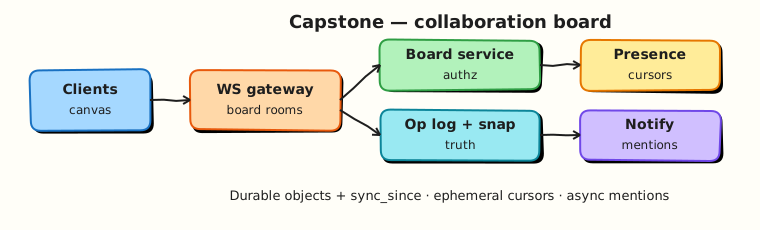
Build the design (and a miniature implementation) of a realtime collaboration board: multiple users place sticky notes and shapes, see each other’s cursors, and catch up after reconnect. This capstone stitches Parts A–D into one product surface.
Prerequisites
Learning Objectives
By the end of this capstone, you will be able to:
- Write a full design brief for a realtime board
- Draw gateway, op log, snapshot, and presence paths
- Choose merge strategy for board objects vs cursors
- List failure modes and resilience controls
- Run a multi-user in-process board lab with reconnect sync
Product brief
Goal: Teams brainstorm on a shared infinite canvas during meetings.
Functional requirements
| ID | Requirement |
|---|---|
| F1 | Create/move/delete sticky notes and boxes |
| F2 | Live updates to all users in the board room |
| F3 | Live cursors with display names |
| F4 | Reconnect sync since last op |
| F5 | Board history snapshot for late joiners |
| F6 | Optional @mention notification if mentioned user is offline |
Non-functional
- Interactive op latency p95 < 150 ms in-region for online peers
- Cursor updates may drop under load
- Durable objects never rely on LWW alone for concurrent creates
- AuthZ: only board members can write
Out of scope (v1)
CRDT text editing inside stickies, video chat, offline-first mobile CRDT sync across days.
Architecture
Clients ⇄ WS Gateway ⇄ Board service
                          ├─ Op log (durable)
                          ├─ Snapshot store
                          ├─ Presence / cursors (ephemeral)
                          └─ Notify service (mentions)
                 ↕ pub/sub board:{id}
Object model
board(board_id, …)
object(object_id, board_id, type, x, y, text, version, deleted)
op(op_id, board_id, actor, type, payload, ts)
Op types
object.upsert— create/move/edit (idempotent byobject_id+versionor merge fields)object.delete— tombstonecursor.move— ephemeral, not in op log
Sync protocol
- Connect + auth
- Receive snapshot (
objectsmap) +last_op_id - Apply live ops with
op_id > last_op_id - On reconnect:
GET /ops?since=last_op_idthen resume WS
Trade-offs to state
| Decision | Choice | Accept |
|---|---|---|
| Cursors | Ephemeral, throttled | Occasional jumps |
| Object moves | Versioned upsert / merge by field | Rare conflicts on same field |
| Fan-out | Pub/sub per board | Hot boards need sharding later |
| Mentions | Async notify | Seconds of lag OK |
Hands-on Lab
Objective
Implement a miniature board server: upsert objects, broadcast to online members, ignore durable storage for cursors, and sync ops after reconnect.
Lab environment
Local Python 3.10+.
Real-world scenario
Two users edit one board; one disconnects briefly and must catch up without losing the other’s creates.
Step-by-step tasks
1. Workspace
mkdir -p ~/rebash-system-design/module-17-capstone
cd ~/rebash-system-design/module-17-capstone
2. Board runtime
#!/usr/bin/env python3
"""Miniature collaboration board with op log sync."""

from __future__ import annotations

from dataclasses import dataclass, field


@dataclass
class Op:
    op_id: int
    actor: str
    kind: str
    payload: dict


@dataclass
class Board:
    objects: dict[str, dict] = field(default_factory=dict)
    ops: list[Op] = field(default_factory=list)
    online: set[str] = field(default_factory=set)
    cursors: dict[str, tuple[int, int]] = field(default_factory=dict)
    _seq: int = 0

    def connect(self, user: str) -> tuple[dict[str, dict], int]:
        """Return snapshot objects and current last_op_id."""
        self.online.add(user)
        last = self.ops[-1].op_id if self.ops else 0
        return dict(self.objects), last

    def disconnect(self, user: str) -> None:
        self.online.discard(user)
        self.cursors.pop(user, None)

    def _apply(self, op: Op) -> None:
        if op.kind == "upsert":
            self.objects[op.payload["id"]] = {
                "id": op.payload["id"],
                "type": op.payload["type"],
                "x": op.payload["x"],
                "y": op.payload["y"],
                "text": op.payload.get("text", ""),
            }
        elif op.kind == "delete":
            self.objects.pop(op.payload["id"], None)

    def upsert(self, actor: str, obj_id: str, typ: str, x: int, y: int, text: str = "") -> Op:
        self._seq += 1
        op = Op(self._seq, actor, "upsert", {"id": obj_id, "type": typ, "x": x, "y": y, "text": text})
        self.ops.append(op)
        self._apply(op)
        return op

    def cursor(self, user: str, x: int, y: int) -> None:
        if user in self.online:
            self.cursors[user] = (x, y)

    def sync_since(self, last_op_id: int) -> list[Op]:
        return [op for op in self.ops if op.op_id > last_op_id]


def main() -> None:
    board = Board()
    board.connect("alice")
    board.connect("bob")
    op1 = board.upsert("alice", "n1", "sticky", 10, 20, "Idea A")
    board.cursor("alice", 11, 21)
    bob_last = op1.op_id  # bob saw op1 live, then dropped
    board.disconnect("bob")
    board.upsert("alice", "n2", "sticky", 40, 50, "Idea B")
    objs, _last = board.connect("bob")
    caught_up = board.sync_since(bob_last)

    lines = [
        f"objects={len(objs)}",
        f"object_ids={','.join(sorted(objs))}",
        f"ops_total={len(board.ops)}",
        f"sync_since_bob_last={len(caught_up)}",
        f"missed_op_kind={caught_up[0].kind if caught_up else None}",
        f"cursor_alice={board.cursors.get('alice')}",
        f"bob_online={'yes' if 'bob' in board.online else 'no'}",
        f"capstone_ok={'yes' if len(objs) == 2 and len(caught_up) == 1 else 'no'}",
    ]
    report = "\n".join(lines) + "\n"
    print(report, end="")
    open("board-report.txt", "w", encoding="utf-8").write(report)


if __name__ == "__main__":
    main()
3. Run and verify
cd ~/rebash-system-design/module-17-capstone
python3 board_lab.py | tee board-run.txt
grep capstone_ok board-report.txt
Expected output
capstone_ok=yes, two objects, sync returns the missed op(s).
4. Design deliverable (written)
Create board-design-brief.md in the same folder covering:
- Requirements (copy/adapt table above)
- Capacity sketch (e.g. 50 users/board, 10 boards/sec ops peak)
- Component diagram (gateway, op log, snapshot, presence)
- Three failure modes + mitigations
- What you would build in week 1 vs later
cd ~/rebash-system-design/module-17-capstone
cat > board-design-brief.md <<'EOF'
# Collaboration board — design brief

## Requirements
- F1–F6 as in the tutorial
- p95 op fan-out < 150 ms in-region

## Capacity (assumptions)
- 20k MAU, 500 concurrent boards, 50 users hot board
- 10 ops/sec average hot board, 100 ops/sec peak
- Cursor events 5/sec/user (lossy)

## Components
- WS gateway + pub/sub board channels
- Op log + periodic snapshots
- Ephemeral presence/cursors
- Notification hook for mentions

## Failure modes
1. Gateway crash → clients reconnect + sync_since
2. Hot board fan-out → shard channel / sample cursors
3. Poison op → schema validate + DLQ

## Phased delivery
- Week 1: durable upsert/delete + sync + single region
- Later: CRDT text, multi-region, audit export
EOF
test -f board-design-brief.md && echo brief_ok=yes
Validation steps
- Lab report
capstone_ok=yes - Design brief file exists with failure modes
- You can narrate the architecture without notes
Challenge exercise
Add object.delete tombstones and ensure sync replays deletes after reconnect.
Cleanup
cd ~/rebash-system-design/module-17-capstone
rm -f board-run.txt board-report.txt 2>/dev/null || true
# keep board-design-brief.md if you want it for your portfolio
Interview Questions
1. Walk through a sticky-note create end-to-end.
Reveal answer
Client sends upsert op over WS → gateway authenticates → board service appends op log and updates materialised objects → pub/sub to board channel → other gateways push to online members → offline members catch up via sync/inbox. Cursors are not written to the op log.
2. How do late joiners initialise state?
Reveal answer
Load the latest snapshot of objects, then apply ops with IDs greater than the snapshot’s last_op_id. This bounds replay cost versus replaying the entire history.
3. What do you drop first under load?
Reveal answer
Ephemeral cursor/presence traffic, then aggregate notifications. Durable object ops stay highest priority with backpressure and load shedding at the edges.
4. How is this different from chat?
Reveal answer
Chat is mostly an append-only message stream. A board needs addressable objects, moves/deletes, snapshots, and merge/version rules for concurrent edits — plus a much hotter ephemeral cursor channel.
Common Mistakes
Treating the board as only in-memory WS broadcast
Without an op log, refresh and reconnect lose truth.
Same pipeline for cursors and durable ops
Cursor storms will starve real edits.
Summary
You have completed the System Design course arc: foundations → building blocks → classic systems → realtime. The collaboration board is the integration exam — durable ops, ephemeral presence, sync, and honest trade-offs.
What's Next
- Revisit the roadmap and tighten any weak modules
- Practise timed designs: shortener, feed, and this board
- Explore Academy projects and interview hubs as they grow
- Optional: add Docker/Redis to the chat and board labs for a portfolio demo