Observability and resilience
Overview
Production systems fail in pieces: slow dependencies, bad deploys, traffic spikes. Observability tells you what is broken; resilience patterns keep the blast radius small while you fix it.
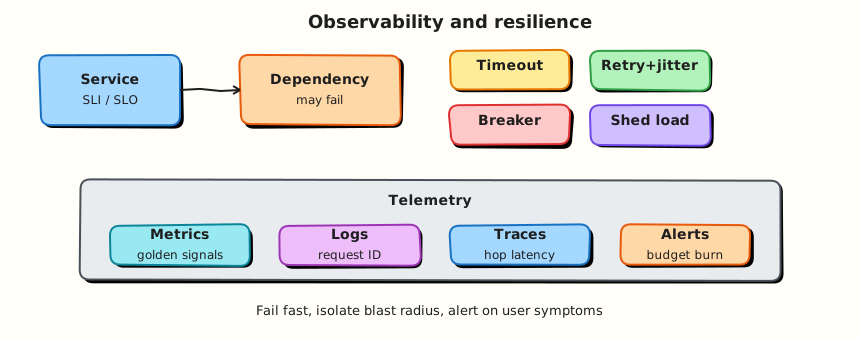
This tutorial closes Part B by connecting SLIs/SLOs to golden signals, traces, and practical resilience tools: timeouts, retries, circuit breakers, bulkheads, and load shedding.
Prerequisites
Learning Objectives
By the end of this tutorial, you will be able to:
- Name golden signals and map them to SLIs
- Explain metrics vs logs vs traces and when each helps
- Apply timeout, retry, and circuit-breaker rules safely
- Describe bulkheads and load shedding in a design
- Implement exponential backoff + a tiny circuit breaker in Python
Theory
Observability pillars
| Signal | Answers | Watch-outs |
|---|---|---|
| Metrics | Is it healthy? How bad? | Cardinality explosions |
| Logs | What happened on this request? | Cost, PII, noise |
| Traces | Where did time go across services? | Sampling bias |
You need all three eventually; start with RED/USE or golden signals on the user path.
Golden signals (SRE)
For a user-facing service:
- Latency — how long
- Traffic — how much
- Errors — how often failing
- Saturation — how full (CPU, queue depth, connection pools)
Tie at least latency + errors to SLOs from Module 2.
Correlation
Propagate a request ID / trace ID from edge → service → workers. Without it, multi-service incidents become archaeology.
Alerting that humans can survive
Alert on symptoms users feel (SLO burn, error rate), not every disk tick. Prefer:
- Multi-window error budget burn rates
- Runbooks linked from alerts
- Pages only when human action helps
Resilience building blocks
| Pattern | Idea |
|---|---|
| Timeout | Bound waiting; fail fast |
| Retry + backoff | Survive blips; add jitter |
| Circuit breaker | Stop calling a sick dependency; fail open/closed deliberately |
| Bulkhead | Isolate pools so one dependency cannot take all threads |
| Load shedding | Reject low-priority work to save critical paths |
| Graceful degradation | Serve stale/cached/partial results |
Circuit breaker states
- Closed — calls flow; failures counted
- Open — calls fail fast for a cool-down
- Half-open — trial requests; success closes, failure re-opens
Use on downstream calls (DB, HTTP, gRPC), not as a substitute for fixing the root cause.
Retries done safely
Retry only when:
- The operation is idempotent or has an idempotency key
- The error looks transient
- You still have deadline budget
Otherwise retries turn one overloaded service into a retry storm.
Chaos and game days (design talk)
Resilience is unverified hope until you practise failure: kill a replica, add latency, expire certs in staging. Mention failure injection as part of mature designs.
Architecture
Client → Service A → (timeouts/breaker) → Service B
                ↘ metrics / traces / logs → observability backend
Draw budgets: e.g. client 2s, A→B 500ms, leaving room for A’s own work.
Hands-on Lab
Objective
Simulate a flaky dependency with exponential backoff retries, then wrap it in a circuit breaker that opens after repeated failures.
Lab environment
Local Python 3.10+.
Real-world scenario
Your redirect service calls a metadata API that occasionally times out. Blind retries made an outage worse. You prototype backoff + breaker behaviour before changing production config.
Step-by-step tasks
1. Workspace
mkdir -p ~/rebash-system-design/module-09-resilience
cd ~/rebash-system-design/module-09-resilience
2. Backoff and circuit breaker
#!/usr/bin/env python3
"""Exponential backoff + simple circuit breaker."""

from __future__ import annotations

import random
import time
from dataclasses import dataclass


class FlakyDependency:
    def __init__(self, fail_times: int = 5) -> None:
        self.fail_times = fail_times
        self.calls = 0

    def call(self) -> str:
        self.calls += 1
        if self.calls <= self.fail_times:
            raise TimeoutError("dependency timeout")
        return "ok"


def retry_with_backoff(fn, attempts: int = 6, base: float = 0.01) -> tuple[str | None, int]:
    tries = 0
    for i in range(attempts):
        tries += 1
        try:
            return fn(), tries
        except TimeoutError:
            sleep = base * (2**i) + random.uniform(0, base)
            time.sleep(sleep)
    return None, tries


@dataclass
class CircuitBreaker:
    failure_threshold: int = 3
    cool_down: float = 0.05
    failures: int = 0
    opened_at: float | None = None
    state: str = "closed"
    rejected: int = 0

    def call(self, fn):
        now = time.time()
        if self.state == "open":
            if self.opened_at is not None and now - self.opened_at >= self.cool_down:
                self.state = "half_open"
            else:
                self.rejected += 1
                raise RuntimeError("circuit_open")

        try:
            result = fn()
        except Exception:
            self.failures += 1
            if self.failures >= self.failure_threshold:
                self.state = "open"
                self.opened_at = time.time()
            raise

        self.failures = 0
        self.state = "closed"
        self.opened_at = None
        return result


def main() -> None:
    dep = FlakyDependency(fail_times=4)
    result, tries = retry_with_backoff(dep.call)
    backoff_ok = result == "ok"

    dep2 = FlakyDependency(fail_times=100)
    breaker = CircuitBreaker(failure_threshold=3, cool_down=0.05)
    open_seen = False
    for _ in range(6):
        try:
            breaker.call(dep2.call)
        except TimeoutError:
            continue
        except RuntimeError as exc:
            if "circuit_open" in str(exc):
                open_seen = True

    # after cool-down, half-open allows a trial — force success path
    time.sleep(0.06)
    dep3 = FlakyDependency(fail_times=0)
    breaker.failures = 0
    recovered = breaker.call(dep3.call) == "ok"

    lines = [
        f"backoff_success={'yes' if backoff_ok else 'no'}",
        f"backoff_tries={tries}",
        f"circuit_opened={'yes' if open_seen else 'no'}",
        f"rejected_while_open={breaker.rejected}",
        f"recovered_after_cooldown={'yes' if recovered else 'no'}",
        f"final_state={breaker.state}",
    ]
    report = "\n".join(lines) + "\n"
    print(report, end="")
    open("resilience-report.txt", "w", encoding="utf-8").write(report)


if __name__ == "__main__":
    main()
3. Run and verify
cd ~/rebash-system-design/module-09-resilience
python3 resilience_lab.py | tee resilience-run.txt
grep -E 'backoff_success|circuit_opened|recovered' resilience-report.txt
Expected output
backoff_success=yes, circuit_opened=yes, recovered_after_cooldown=yes.
Validation steps
- Backoff eventually succeeds against temporary failures
- Breaker rejects calls while open
- Cool-down allows recovery
Common errors and fixes
| Error | Cause | Fix |
|---|---|---|
circuit_opened=no | Threshold too high / too few calls | Lower threshold or add iterations |
| No recovery | Cool-down not elapsed | sleep ≥ cool_down |
Challenge exercise
Add a bulkhead: two thread pools (critical vs best-effort) and show best-effort exhaustion does not block critical calls.
Learning outcomes
- Retries need backoff and budgets
- Circuit breakers protect callers from sick dependencies
- Resilience patterns are measurable behaviours, not slogans
Cleanup
cd ~/rebash-system-design/module-09-resilience
rm -f resilience-run.txt resilience-report.txt 2>/dev/null || true
Validation
- You can list golden signals for your service
- You can place timeouts on a sequence diagram
- You can explain when not to retry
Interview Questions
1. Metrics vs logs vs traces — when do you use each?
Reveal answer
Metrics for health and SLOs over time; logs for detailed event context on a request; traces to see latency across service hops. Use them together with a shared request/trace ID.
2. What is a circuit breaker?
Reveal answer
A wrapper that stops calling a failing dependency after a threshold, fails fast for a cool-down, then probes with half-open calls. It protects thread pools and reduces cascading load.
3. Why is retry without backoff dangerous?
Reveal answer
Synchronised clients retry immediately and amplify load on an already sick service (retry storm). Backoff, jitter, and idempotency limits are required.
4. What is load shedding?
Reveal answer
Deliberately rejecting or degrading lower-priority work (or excess traffic) so critical paths stay within SLO when the system is saturated.
5. How do SLOs connect to resilience design?
Reveal answer
SLOs define what “good” means; resilience patterns (timeouts, shedding, degradation) are how you stay inside the error budget when dependencies fail. Alerts should track budget burn, not vanity metrics alone.
Common Mistakes
Paging on every 5xx spike without a runbook
Alerts without action create fatigue. Symptom + owner + doc.
Infinite retries across the mesh
Each hop retries → combinatorial explosion. Prefer bounded retries at the edge or a single responsible layer.
Observability without request IDs
You will not stitch user pain to a root cause under pressure.
Best Practices
- Propagate trace/request IDs everywhere
- Budget timeouts end-to-end
- Retry only idempotent/transient paths
- Isolate pools (bulkheads) per dependency
- Practise failure in staging
Summary
Part B ends where production begins: measure what users feel, and design for partial failure. Observability without resilience is sightseeing; resilience without observability is superstition.
What's Next
URL shortener — first Part C case study: create, redirect, cache, and async analytics.