Application architecture styles
Overview
The same product can be shaped many ways. Architecture style is the large-scale shape: how you package code, deploy it, and let pieces talk.
This tutorial compares four styles you will meet constantly:
- Monolith
- Modular monolith
- Microservices
- Event-driven collaboration
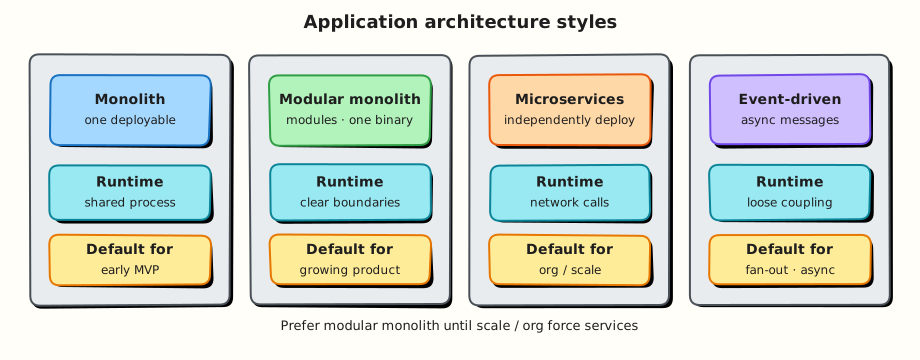
You will build a tiny modular monolith in Python so the idea is concrete — not slides-only.
Prerequisites
- Quality attributes and trade-offs
- Comfortable with functions/modules in Python
Learning Objectives
By the end of this tutorial, you will be able to:
- Describe each style and its deploy/runtime shape
- List strengths and failure modes for each
- Choose a default style for an MVP with reasons
- Implement module boundaries inside one Python process
- Explain when not to start with microservices
Theory
Monolith
What: One deployable unit. UI (sometimes), API, domain logic, and data access ship together.
Why teams choose it: Fast local development, simple transactions, easy refactor across features, one pipeline.
How it fails: Codebase becomes a ball of mud; one bug can take down everything; scaling requires scaling the whole app; ownership fights appear as the team grows.
When it fits: Early product, small team, unclear domain boundaries.
Modular monolith
What: Still one deployable, but code is organised into modules with clear boundaries (packages, ownership, allowed imports). Modules talk through well-defined interfaces — ideally not by reaching into each other’s databases freely.
Why: Keeps monolith simplicity while preparing for future extraction. Many successful companies stay here longer than Twitter threads suggest.
Rules that make it real:
- Module A must not import Module B’s private internals
- Shared kernel stays small
- Database tables owned by one module when possible
- Cross-module calls go through a public API (function/service interface)
When it fits: Default recommendation for most new products.
Microservices
What: Multiple independently deployable services, each owning a bounded context and usually its own data store. Collaborate over network (HTTP/gRPC/events).
Why: Independent scaling, independent release cadence, team autonomy, technology flexibility per service.
Cost you must pay:
- Network latency and partial failure
- Distributed transactions become sagas/outbox patterns
- Observability and local setup get harder
- Need mature platform (CI/CD, service discovery, auth, standards)
When it fits: Clear domain boundaries, multiple teams, proven scale pain that modular monolith cannot fix cheaply.
Anti-pattern: “Nano-services” — every function is a service. That is distributed monolith pain without benefits.
Event-driven style
What: Components communicate by emitting and reacting to events (order.placed, payment.captured) via a broker (queue/bus), instead of only synchronous request/response.
Why: Decouple producers from consumers; smooth traffic spikes; enable multiple subscribers (analytics, email, inventory) without changing the producer.
Challenges: Eventual consistency, ordering, idempotency, poison messages, replay.
Often combined with: Microservices or a modular monolith that publishes events outbound.
Choosing without fashion
| Situation | Sensible default |
|---|---|
| 2–8 engineers, finding product-market fit | Modular monolith |
| One hot read path needs different scaling | Modular monolith + extract that path later |
| Multiple teams blocking on one release train | Consider services along team boundaries |
| Heavy fan-out workflows | Add events even inside a monolith |
Evolution path (common)
Skipping steps is allowed only with clear organisational and operational readiness.
Key concepts
| Concept | Meaning |
|---|---|
| Bounded context | A model and language valid inside one domain area |
| Deployable unit | What you build, ship, and roll back together |
| Sync vs async | Call/wait vs emit/react later |
| Data ownership | Who may write which data |
Hands-on Lab
Objective
Implement a modular monolith for a tiny shop: catalog and orders modules in one process, with a rule that orders only talks to catalog through a public function.
Real-world scenario
A startup wants checkout quickly. You refuse a five-service mesh on day one, but you still want clean boundaries for later extraction.
Step-by-step tasks
1. Workspace layout
mkdir -p ~/rebash-system-design/module-03-styles/shop/{catalog,orders}
cd ~/rebash-system-design/module-03-styles
2. Catalog module
from __future__ import annotations

_PRODUCTS = {
    "sku-1": {"name": "Notebook", "price_cents": 499},
    "sku-2": {"name": "Pen", "price_cents": 99},
}


def get_product(sku: str) -> dict | None:
    """Public catalog API — other modules may call this."""
    product = _PRODUCTS.get(sku)
    return None if product is None else dict(product)
3. Orders module
from __future__ import annotations

from shop.catalog import get_product

_ORDERS: list[dict] = []


def place_order(sku: str, qty: int) -> dict:
    if qty < 1:
        raise ValueError("qty must be >= 1")
    product = get_product(sku)
    if product is None:
        raise KeyError(f"unknown sku: {sku}")
    total = product["price_cents"] * qty
    order = {"sku": sku, "qty": qty, "total_cents": total, "product_name": product["name"]}
    _ORDERS.append(order)
    return order


def list_orders() -> list[dict]:
    return list(_ORDERS)
from .service import list_orders, place_order

__all__ = ["place_order", "list_orders"]
4. App entrypoint
#!/usr/bin/env python3
from __future__ import annotations

from shop.orders import list_orders, place_order


def main() -> None:
    o1 = place_order("sku-1", 2)
    o2 = place_order("sku-2", 5)
    lines = [
        f"order1_total_cents={o1['total_cents']}",
        f"order2_total_cents={o2['total_cents']}",
        f"order_count={len(list_orders())}",
    ]
    report = "\n".join(lines) + "\n"
    print(report, end="")
    open("orders-report.txt", "w", encoding="utf-8").write(report)


if __name__ == "__main__":
    main()
5. Run from the module root
cd ~/rebash-system-design/module-03-styles
PYTHONPATH=. python3 app.py | tee orders-run.txt
grep order_count orders-report.txt
Expected output
Totals 998 and 495, order_count=2.
6. Document the boundary
Create boundaries.md describing: one deployable, two modules, catalog owns product data, orders calls get_product only.
Validation steps
- Orders imports catalog’s public API, not a private dict
- Report file proves two orders were placed
- You can explain how
orderscould become a separate service later (network call replacingget_product)
Challenge exercise
Add a third module payments that only accepts an order_id / total from orders via a public function — still in-process.
Common errors and fixes
| Error | Cause | Fix |
|---|---|---|
ModuleNotFoundError: shop | Wrong PYTHONPATH | Run with PYTHONPATH=. from module root |
Orders reads _PRODUCTS directly | Broken boundary | Only call get_product |
Interview Questions
1. Why might a modular monolith be better than microservices for an MVP?
Reveal answer
One deploy, simple transactions, faster iteration, lower ops cost — while still enforcing boundaries for later extraction.
2. What problem do microservices solve that a monolith cannot?
Reveal answer
Independent deploy/scale and team autonomy at organisational scale — not “cleaner code” by magic.
3. What is a distributed monolith?
Reveal answer
Many services that must be released together and share databases/tight sync calls — paying microservice cost without the benefit.
Summary
Style is a strategic choice. Prefer a modular monolith until boundaries and organisational scale demand services. Use events when fan-out and decoupling matter. Always connect the choice to quality attributes from Module 2.
What's Next
Client, edge, and service path — follow one HTTPS request through the internet to your code.