Collaborative and streaming patterns
Overview
Docs, whiteboards, and multiplayer cursors need concurrent edits without silent data loss. Live dashboards and feeds need server→client streams. This module gives the System Design vocabulary: operation logs, OT vs CRDT intuition, and fan-out patterns — without claiming you will invent Google Docs in one afternoon.
Prerequisites
Learning Objectives
By the end of this tutorial, you will be able to:
- Contrast last-write-wins with mergeable structures
- Explain OT vs CRDT at interview depth
- Sketch an operation log + snapshot store
- Place live cursor/presence updates on a cheap path
- Implement a tiny G-Counter and concurrent list merge in Python
Theory
The concurrency problem
Two users edit at once:
- Last-write-wins (LWW) — simple, loses work
- Pessimistic locks — safe, poor UX for docs
- Mergeable ops — OT or CRDT so both edits survive
Operational transformation (OT)
Clients send operations; a server transforms ops against concurrent ops so everyone converges. Classic in Google Docs–style systems. Requires a careful central ordering/transform function.
CRDTs (Conflict-free Replicated Data Types)
Data types that merge commutative/associative/idempotent updates so replicas converge without a single transform bottleneck. Examples: G-Counter, OR-Set, RGA for text.
Interview stance:
For many collaboration features we prefer CRDT libraries or OT services rather than inventing transforms. We still design op log, snapshots, authz, and fan-out.
Operation log + snapshots
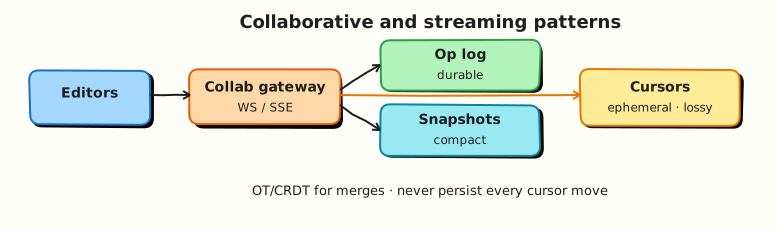
Client → apply locally → send op → server appends op log → broadcast
Periodically: compact log into snapshot; new joiners load snapshot + recent ops
- Ops are idempotent with
op_id - Snapshots bound replay cost
- AuthZ every op (who can edit which object)
Live cursors and selections
High-frequency, ephemeral, lossy-OK. Separate channel from durable ops. Sample/throttle. Do not write cursors to OLTP.
Streaming patterns (server → client)
| Pattern | Use |
|---|---|
| WebSocket | Interactive bi-directional |
| SSE | One-way event streams (dashboards) |
| Chunked HTTP | File/stream download |
| Kafka → gateway | Internal fan-out to sockets |
Backpressure: slow clients get dropped cursors before durable ops; bound buffers.
Consistency for users
Show “synced / pending / conflict” states. Prefer merge over mysterious overwrites. For binary blobs, use version checks (If-Match) instead of CRDTs.
Architecture
Editors ⇄ Collab gateway ⇄ Op service ⇄ Op log + snapshots
                 ↕
            Pub/sub room channel (ops + ephemeral cursors)
Hands-on Lab
Objective
Implement a grow-only counter CRDT merge and a toy concurrent “add item” set that converges after partition.
Lab environment
Local Python 3.10+.
Real-world scenario
You must explain convergence without slides-only hand-waving. A G-Counter and OR-ish set make the idea tangible.
Step-by-step tasks
1. Workspace
2. CRDT toys
#!/usr/bin/env python3
"""G-Counter and concurrent add-set merge."""

from __future__ import annotations

from dataclasses import dataclass, field


@dataclass
class GCounter:
    """Grow-only counter: each replica increments its own slot."""

    counts: dict[str, int] = field(default_factory=dict)

    def inc(self, replica: str, n: int = 1) -> None:
        self.counts[replica] = self.counts.get(replica, 0) + n

    def value(self) -> int:
        return sum(self.counts.values())

    def merge(self, other: "GCounter") -> "GCounter":
        keys = set(self.counts) | set(other.counts)
        return GCounter({k: max(self.counts.get(k, 0), other.counts.get(k, 0)) for k in keys})


@dataclass
class AddSet:
    """Add-only set with unique element ids (simplified OR-Set add)."""

    elements: dict[str, str] = field(default_factory=dict)  # elem_id -> value

    def add(self, elem_id: str, value: str) -> None:
        self.elements[elem_id] = value

    def merge(self, other: "AddSet") -> "AddSet":
        merged = dict(self.elements)
        merged.update(other.elements)
        return AddSet(merged)

    def values(self) -> set[str]:
        return set(self.elements.values())


def main() -> None:
    a, b = GCounter(), GCounter()
    a.inc("alice", 3)
    b.inc("bob", 2)
    c = a.merge(b)

    s1, s2 = AddSet(), AddSet()
    s1.add("e1", "sticky-note")
    s2.add("e2", "box")
    s2.add("e1", "sticky-note")  # same id concurrent
    s = s1.merge(s2)

    lines = [
        f"counter_value={c.value()}",
        f"counter_ok={'yes' if c.value() == 5 else 'no'}",
        f"set_values={','.join(sorted(s.values()))}",
        f"set_ok={'yes' if s.values() == {'sticky-note', 'box'} else 'no'}",
        f"collab_ok={'yes' if c.value() == 5 and s.values() == {'sticky-note', 'box'} else 'no'}",
    ]
    report = "\n".join(lines) + "\n"
    print(report, end="")
    open("collab-report.txt", "w", encoding="utf-8").write(report)


if __name__ == "__main__":
    main()
3. Run and verify
cd ~/rebash-system-design/module-16-collab
python3 collab_lab.py | tee collab-run.txt
grep collab_ok collab-report.txt
Expected output
collab_ok=yes with counter value 5.
Validation steps
- Merged counter sums both replicas
- Merged set contains both adds
- You can explain why LWW would risk losing an add
Challenge exercise
Add a version vector map replica → seq and reject stale snapshots.
Cleanup
cd ~/rebash-system-design/module-16-collab
rm -f collab-run.txt collab-report.txt 2>/dev/null || true
Interview Questions
1. OT vs CRDT — how do you talk about them in an interview?
Reveal answer
OT transforms concurrent operations via a (usually central) algorithm; CRDTs are mergeable types that converge by design. For System Design, emphasise op logs, snapshots, fan-out, and using proven libraries rather than inventing transforms live.
2. Why keep an operation log?
Reveal answer
It supports replay for new joiners, audit, conflict debugging, and compaction into snapshots. Clients can catch up after disconnect without transferring the entire document every time.
3. How are live cursors different from document ops?
Reveal answer
Cursors are ephemeral, high-frequency, and lossy-OK. They should not use the durable op log path; throttle and drop under load before failing durable edits.
4. When is last-write-wins acceptable?
Reveal answer
For low-contention fields where losing an edit is rare and UX tolerates it (e.g. last theme colour). Not acceptable for collaborative text or shared board objects users carefully placed.
Common Mistakes
Persisting every cursor move
You will invent a very expensive analytics system by accident.
Promising perfect conflict-free text without a real library
Interviewers prefer honest architecture over fake CRDT maths.
Summary
Collaboration needs mergeable updates, an op log with snapshots, and a cheap ephemeral channel for presence/cursors. Streaming fan-out reuses the gateway patterns from chat.
What's Next
Capstone — realtime collaboration board — assemble chat-grade fan-out, presence, and mergeable board objects into one design + lab.