APIs and communication
Overview
Services talk through contracts. A vague API becomes coupling, outages, and angry mobile clients. In System Design you must choose style (REST/RPC/events), shape resources, and define failure behaviour — timeouts, retries, and idempotency — as carefully as happy-path JSON.
Prerequisites
- Messaging and async
- HTTP methods and status codes
Learning Objectives
By the end of this tutorial, you will be able to:
- Choose REST-ish resources vs RPC-style operations for a use case
- Version and evolve an API without breaking clients overnight
- Specify pagination, filtering, and error shapes
- Set timeout/retry rules that do not amplify outages
- Implement a tiny in-process API with idempotent create
Theory
Sync API styles
| Style | Shape | Good for |
|---|---|---|
| REST-ish HTTP | Resources + verbs (GET /links/{code}) | Public/partner APIs, CRUD |
| RPC over HTTP | Actions (POST /CreateLink) | Internal services, clear operations |
| gRPC | Typed stubs, often HTTP/2 | Low-latency internal meshes |
| GraphQL | Client-shaped queries | Many clients, varied read shapes (careful with abuse) |
Pick for clients and change rate, not fashion. Public ecosystems often stay HTTP+JSON; internal meshes may add gRPC.
Resource design basics
For a shortener:
| Endpoint | Intent |
|---|---|
POST /v1/links | Create (auth) |
GET /v1/links/{code} | Metadata for owner |
GET /{code} | Redirect (hot path; may live on another host) |
Keep the redirect path minimal — fewer headers, fewer dependencies.
Versioning
Common options:
- URL prefix:
/v1/...(explicit, cache-friendly) - Header version (flexible, harder to discover)
Rules of evolution:
- Additive changes are safest (new optional fields)
- Never reuse field meanings
- Deprecate with dates; run dual versions during migration
Pagination and lists
Prefer cursor pagination over OFFSET for large lists (stable under inserts). Return:
Document max page size. Unbounded list endpoints become accidental DoS.
Errors
Return machine-readable errors:
Map to HTTP status honestly: 400 validation, 401/403 authz, 404 missing, 409 conflict, 429 rate limit, 5xx your fault.
Timeouts, retries, deadlines
Every sync call needs:
- Client timeout (fail fast)
- Server deadline (stop useless work)
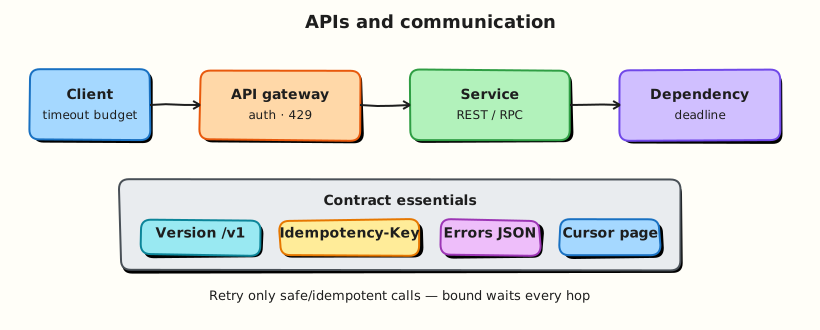
- Retry policy only for safe/idempotent operations
Retrying non-idempotent POST without an idempotency key causes duplicates. Prefer:
- Idempotency-Key header on creates
- Retries on
502/503/408with exponential backoff + jitter - No retry storms from every pod at once
Synchronous vs asynchronous APIs
| Need | Pattern |
|---|---|
| User waits for result | Sync request/response |
| Long work | 202 Accepted + job resource / webhook / poll |
| Fan-out side effects | Events (Module 7) after commit |
Contracts and compatibility
Treat OpenAPI/proto as product surface:
- Review breaking changes like migrations
- Contract tests between producer and consumer
- Avoid sharing databases as an “API” between teams
Architecture
Public contract stays stable; internals can evolve behind the gateway.
Hands-on Lab
Objective
Implement a tiny link API in-process: create with idempotency key, get by code, and reject unsafe retries that would double-create without keys.
Lab environment
Local Python 3.10+.
Real-world scenario
Mobile clients retry creates on flaky networks. Without idempotency keys you get duplicate short links. You prove the contract in a unit-sized service.
Step-by-step tasks
1. Workspace
2. Tiny API
#!/usr/bin/env python3
"""Minimal link API: idempotent create + get."""

from __future__ import annotations

import hashlib
from dataclasses import dataclass


@dataclass
class Link:
    code: str
    url: str


class LinkAPI:
    def __init__(self) -> None:
        self.links: dict[str, Link] = {}
        self.idem: dict[str, str] = {}  # key -> code

    def create(self, url: str, idempotency_key: str | None = None) -> tuple[int, dict]:
        if not url.startswith("https://"):
            return 400, {"error": {"code": "invalid_url", "message": "URL must be https"}}

        if idempotency_key:
            existing = self.idem.get(idempotency_key)
            if existing:
                link = self.links[existing]
                return 200, {"code": link.code, "url": link.url, "idempotent_replay": True}

        code = hashlib.sha256(url.encode()).hexdigest()[:8]
        # if same URL already exists, return it (natural idempotency)
        for link in self.links.values():
            if link.url == url:
                if idempotency_key:
                    self.idem[idempotency_key] = link.code
                return 200, {"code": link.code, "url": link.url, "idempotent_replay": True}

        # ensure unique code collision handling for demo
        while code in self.links:
            code = hashlib.sha256((code + url).encode()).hexdigest()[:8]

        self.links[code] = Link(code=code, url=url)
        if idempotency_key:
            self.idem[idempotency_key] = code
        return 201, {"code": code, "url": url, "idempotent_replay": False}

    def get(self, code: str) -> tuple[int, dict]:
        link = self.links.get(code)
        if not link:
            return 404, {"error": {"code": "not_found", "message": "unknown code"}}
        return 200, {"code": link.code, "url": link.url}


def main() -> None:
    api = LinkAPI()
    s1, b1 = api.create("https://example.com/a", idempotency_key="k1")
    s2, b2 = api.create("https://example.com/a", idempotency_key="k1")
    s3, b3 = api.create("http://insecure.example", idempotency_key="k2")
    sg, bg = api.get(b1["code"])

    lines = [
        f"create_status={s1}",
        f"replay_status={s2}",
        f"same_code={'yes' if b1['code'] == b2['code'] else 'no'}",
        f"replay_flag={b2.get('idempotent_replay')}",
        f"invalid_status={s3}",
        f"get_status={sg}",
        f"get_url={bg.get('url')}",
        f"links_stored={len(api.links)}",
    ]
    report = "\n".join(lines) + "\n"
    print(report, end="")
    open("api-report.txt", "w", encoding="utf-8").write(report)


if __name__ == "__main__":
    main()
3. Run and verify
cd ~/rebash-system-design/module-08-apis
python3 api_lab.py | tee api-run.txt
grep -E 'same_code|links_stored|invalid_status' api-report.txt
Expected output
same_code=yes, links_stored=1, invalid_status=400.
Validation steps
- Idempotent replay returns the same code
- Invalid URL yields 400
- Get returns the stored URL
Common errors and fixes
| Error | Cause | Fix |
|---|---|---|
| Two links stored | Idempotency key ignored | Check idem before insert |
| 201 on replay | Wrong status mapping | Return 200 on replay |
Challenge exercise
Add 429 when more than 5 creates occur per second from a fake client_id rate limiter.
Learning outcomes
- Idempotency keys make client retries safe
- Error codes are part of the contract
- Hot paths deserve smaller APIs
Cleanup
cd ~/rebash-system-design/module-08-apis
rm -f api-run.txt api-report.txt 2>/dev/null || true
Validation
- You can sketch public vs internal API choices
- You can explain timeout + retry + idempotency together
- You know when to return
202instead of blocking
Interview Questions
1. REST vs RPC — how do you choose for an internal service?
Reveal answer
Prefer resource-oriented HTTP when the model is naturally CRUD and shared with many clients. Prefer RPC/gRPC when operations are actions, payloads are typed, and you control both ends. Consistency of team conventions matters as much as theory.
2. Why use idempotency keys on POST?
Reveal answer
Clients retry when networks fail. Without a key, retries create duplicates. The server stores the key → result mapping and returns the original result on replay.
3. Why prefer cursor pagination over OFFSET?
Reveal answer
OFFSET becomes slow and unstable as tables grow and rows insert/delete. Cursors (keyset) stay efficient and give more stable pages under concurrency.
4. What should clients retry?
Reveal answer
Transient failures on idempotent or explicitly safe requests (GET, or POST with idempotency key), with backoff and jitter. Do not blindly retry non-idempotent writes or 400-level validation errors.
5. How do you version a breaking change?
Reveal answer
Ship /v2 (or a new proto package), migrate clients, keep /v1 until traffic drains, then sunset with a published date. Avoid silently changing field meanings in place.
Common Mistakes
Chatty APIs
Many small sync calls between services multiply latency and failure modes. Batch or redesign the boundary.
Infinite timeouts
A hung dependency holds threads and cascades. Always bound waits.
Using the database as the team API
Schema coupling freezes evolution. Publish an explicit service contract instead.
Best Practices
- Document status codes and error bodies
- Put budgets on timeouts end-to-end
- Make creates idempotent for mobile/flaky clients
- Keep redirect/hot paths minimal
- Contract-test breaking changes
Summary
APIs are product surfaces. Clear resources, honest errors, versioning, and disciplined timeouts/retries keep distributed systems operable — not just “connected.”
What's Next
Observability and resilience — see failures early and survive them with timeouts, bulkheads, and load shedding.