Search / autocomplete
Overview
Search finds documents by keywords; autocomplete suggests queries or entities as the user types. Both need secondary indexes — your primary OLTP database is rarely enough at scale.
This module closes Part C: indexing pipelines, inverted indexes, freshness vs cost, and prefix structures for suggest.
Prerequisites
Learning Objectives
By the end of this tutorial, you will be able to:
- Explain why search is not
SELECT … LIKE '%term%'at scale - Describe an inverted index and an indexing pipeline
- Trade off freshness, relevance, and p95 suggest latency
- Sketch autocomplete with prefix indexes / tries
- Implement a tiny inverted index + prefix autocomplete in Python
Requirements sketch
Search (v1)
| ID | Requirement |
|---|---|
| F1 | Index posts/docs with title + body |
| F2 | Keyword query returns top-N by simple relevance |
| F3 | Index updates within tens of seconds of publish (eventual) |
Autocomplete (v1)
| ID | Requirement |
|---|---|
| A1 | Prefix suggestions as user types (≥2 chars) |
| A2 | p95 suggest < 100 ms |
| A3 | Rank by popularity / recency |
Theory
Why not SQL LIKE?
- Leading-wildcard
%term%cannot use normal B-trees efficiently - Ranking, stemming, typo-tolerance need specialised structures
- Read load would crush OLTP
Use a search engine or inverted index service (OpenSearch/Elasticsearch, Typesense, meilisearch, etc.) fed from your system of record.
Inverted index (core idea)
For each term → list of document IDs (postings), often with positions/TF.
Query "system design":
- Tokenise / normalise
- Fetch postings for
systemanddesign - Intersect / score
- Return top-N docs
Indexing pipeline
- Sync index in API couples publish latency to search cluster health — usually avoid
- Near-real-time refresh intervals trade freshness for bulk efficiency
- Deletes/updates must be idempotent (index by
doc_id)
Relevance (interview depth)
Start simple: TF-IDF / BM25-style scoring. Later: field boosts (title > body), freshness, personalisation. Separate candidate retrieval from re-ranking.
Autocomplete structures
| Approach | Notes |
|---|---|
| Prefix trie / ternary search tree | Fast prefix walk in memory |
| Edge n-grams in search engine | sys, syst, system as terms |
Sorted set in Redis (ZRANGEBYLEX) | Popular for query suggest |
Cache hot prefixes at the edge carefully (personalised suggests often bypass shared CDN).
Query hygiene
- Rate limit and bound result sizes
- Escape/analyse user input
- Protect against expensive wildcard queries
- Observe suggest QPS separately from search QPS
Consistency language
Search may lag publish by up to 30 seconds. Autocomplete popularity updates every few minutes.
Architecture
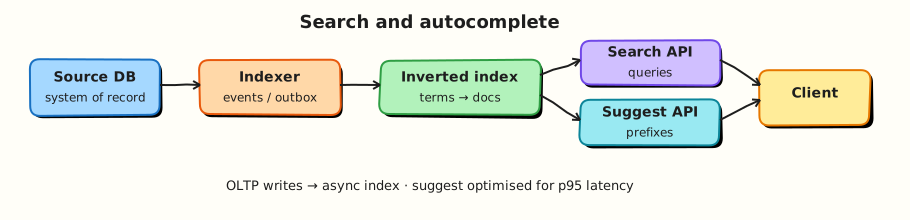
Client → Search API → Query service → Index replicas
Client → Suggest API → Prefix store / trie cache

Indexer ← events ← Post/Media services
Indexer → primary index → replicate to query nodes
Hands-on Lab
Objective
Build a minimal inverted index for documents and a prefix map for autocomplete suggestions.
Lab environment
Local Python 3.10+.
Real-world scenario
You need to explain inverted indexes without hand-waving. A 20-line indexer makes the idea concrete.
Step-by-step tasks
1. Workspace
2. Index + suggest
#!/usr/bin/env python3
"""Tiny inverted index + prefix autocomplete."""

from __future__ import annotations

import re
from collections import defaultdict


TOKEN = re.compile(r"[a-z0-9]+")


def tokenize(text: str) -> list[str]:
    return TOKEN.findall(text.lower())


class InvertedIndex:
    def __init__(self) -> None:
        self.postings: dict[str, set[str]] = defaultdict(set)
        self.docs: dict[str, str] = {}

    def add(self, doc_id: str, text: str) -> None:
        self.docs[doc_id] = text
        for term in set(tokenize(text)):
            self.postings[term].add(doc_id)

    def search(self, query: str) -> list[str]:
        terms = tokenize(query)
        if not terms:
            return []
        result = set(self.postings.get(terms[0], set()))
        for t in terms[1:]:
            result &= self.postings.get(t, set())
        # naive rank: more term occurrences in text wins
        def score(doc_id: str) -> int:
            text = self.docs[doc_id].lower()
            return sum(text.count(t) for t in terms)

        return sorted(result, key=score, reverse=True)


class Autocomplete:
    def __init__(self) -> None:
        self.prefix: dict[str, dict[str, int]] = defaultdict(lambda: defaultdict(int))

    def add_query(self, query: str, weight: int = 1) -> None:
        q = query.lower().strip()
        if len(q) < 2:
            return
        for i in range(2, len(q) + 1):
            self.prefix[q[:i]][q] += weight

    def suggest(self, typed: str, limit: int = 5) -> list[str]:
        key = typed.lower().strip()
        items = self.prefix.get(key, {})
        return [q for q, _ in sorted(items.items(), key=lambda kv: (-kv[1], kv[0]))[:limit]]


def main() -> None:
    idx = InvertedIndex()
    idx.add("d1", "System design interviews need practice")
    idx.add("d2", "Design caches and indexes carefully")
    idx.add("d3", "Gardening tips for spring")
    hits = idx.search("design system")

    ac = Autocomplete()
    for q, w in [("system design", 50), ("systemctl", 10), ("systemd", 20), ("design patterns", 15)]:
        ac.add_query(q, w)
    suggestions = ac.suggest("sys")

    lines = [
        f"search_hits={','.join(hits)}",
        f"top_hit={hits[0] if hits else None}",
        f"suggest={','.join(suggestions)}",
        f"suggest_top={suggestions[0] if suggestions else None}",
        f"search_ok={'yes' if hits and hits[0] == 'd1' else 'no'}",
        f"suggest_ok={'yes' if suggestions and suggestions[0] == 'system design' else 'no'}",
    ]
    report = "\n".join(lines) + "\n"
    print(report, end="")
    open("search-report.txt", "w", encoding="utf-8").write(report)


if __name__ == "__main__":
    main()
3. Run and verify
cd ~/rebash-system-design/module-13-search
python3 search_lab.py | tee search-run.txt
grep -E 'search_ok|suggest_ok' search-report.txt
Expected output
search_ok=yes and suggest_ok=yes.
Validation steps
- AND query returns the doc containing both terms
- Prefix
sysrankssystem designfirst by weight - Unrelated gardening doc is excluded
Challenge exercise
Add phrase search using term positions, or fuzzy suggest with edit-distance ≤ 1 for typos.
Cleanup
cd ~/rebash-system-design/module-13-search
rm -f search-run.txt search-report.txt 2>/dev/null || true
Interview Questions
1. What is an inverted index?
Reveal answer
A map from term → postings (document IDs, often with frequencies/positions). Queries intersect or score those lists instead of scanning every document.
2. How do you keep the index up to date?
Reveal answer
Publish events from the source of truth (outbox), and run indexer workers that upsert/delete by document ID. Accept near-real-time lag; avoid coupling the user write path to search cluster latency unless required.
3. How is autocomplete different from full-text search?
Reveal answer
Autocomplete optimises prefix matching and ultra-low latency, often with tries, edge n-grams, or sorted sets. Full-text search optimises recall/relevance over complete queries and richer analysis.
4. What do you cache for search?
Reveal answer
Hot query results and hot prefix suggestion lists, with short TTLs and careful personalisation keys. Do not cache rare unique queries aggressively — little reuse.
Common Mistakes
Using the primary DB as the search engine forever
It works for demos and fails for product search quality and load.
Promising zero lag between write and search
Indexing is eventually consistent unless you pay for synchronous, brittle designs.
Summary
Search systems are derived indexes fed by pipelines. Autocomplete is a specialised low-latency prefix problem. Part C ends here — you can now assemble classic product surfaces from Part B building blocks.
What's Next
Realtime chat — WebSockets, durable messages, and online fan-out (Part D begins).