How to design a system
Overview
System Design is not “draw boxes until it looks smart.” It is a repeatable thinking process that turns a vague idea (“build Instagram”) into something an engineer can build, review, and operate.
In this tutorial you learn the process used in production design reviews and strong interviews:
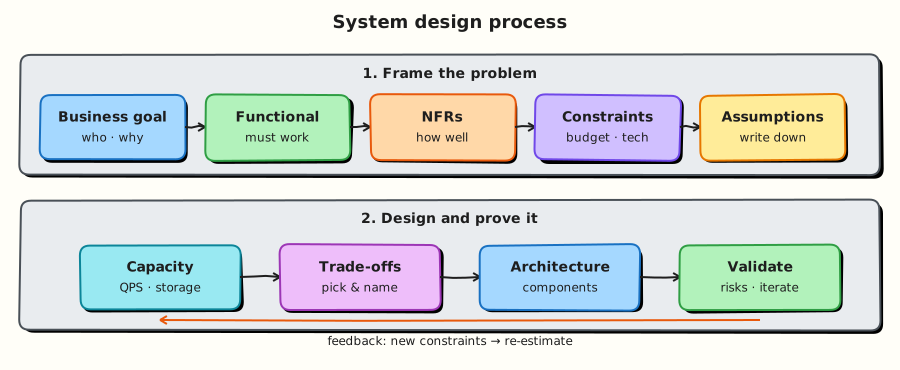
Business goals → Functional requirements → Non-functional requirements → Constraints → Assumptions → Capacity sketch → Trade-offs → Architecture → Validate
You will practise on a small but realistic example: a URL shortener design brief (we implement full shorteners later; here we only practise the process).
This is Module 1 of the REBASH Academy System Design course.
Prerequisites
- Can read JSON and HTTP status codes
- Can run Python 3 on your machine
- Curiosity about how large systems behave
Learning Objectives
By the end of this tutorial, you will be able to:
- Separate functional requirements from non-functional requirements
- List constraints and assumptions explicitly
- Perform a simple capacity estimate (requests/day, storage, bandwidth)
- Name at least two trade-offs before proposing components
- Produce a one-page design brief another engineer could challenge
Architecture
The process itself is an architecture of thinking. Keep this flow visible whenever you design:
Theory
What System Design really is
When someone says “design Twitter,” beginners jump to Kafka and Kubernetes. Experts ask:
- Who is the user and what do they need to succeed?
- What must work on day one vs later?
- How big is “big” — numbers, not adjectives?
- What are we willing to give up?
Technology choices come after those answers. If you reverse the order, you decorate a solution that does not match the problem.
Why a process beats improvisation
Without a process you get:
- Missing requirements discovered in production
- Over-engineering (“we might need multi-region”) with no traffic
- Under-engineering (single database) with no plan for growth
- Interviews that wander because neither side shares a frame
A shared process lets you and a reviewer argue about the same facts.
Step 1 — Business goals (why the system exists)
Start with outcomes, not features.
| Weak | Stronger |
|---|---|
| “Build a shortener” | “Let marketers share trackable short links so campaigns fit on SMS and billboards” |
| “Make it fast” | “Redirects must feel instant so users do not abandon the click” |
Ask: What decision or user success does this enable? If you cannot answer, you are not ready to design.
Step 2 — Functional requirements (what it must do)
Write behaviours as user stories or API capabilities. Prefer verbs.
For a URL shortener MVP:
| ID | Requirement |
|---|---|
| F1 | Authenticated user can create a short link for a long URL |
| F2 | Anyone with the short link can be redirected to the long URL |
| F3 | Owner can see click count (basic analytics) |
| F4 | Short codes are unique |
Also list out of scope for v1 (as important as in-scope):
- Custom domains
- A/B testing
- QR codes
- Enterprise SSO
Out-of-scope stops silent scope creep.
Step 3 — Non-functional requirements (how well)
Non-functional requirements (NFRs) are measurable qualities. Vague words become numbers.
| Quality | Vague | Measurable (example) |
|---|---|---|
| Latency | “Fast redirects” | p95 redirect < 100 ms in-region |
| Availability | “Always up” | 99.9% monthly for redirect path |
| Durability | “Don’t lose links” | Zero accepted writes lost after ACK |
| Scale | “Lots of users” | 10M redirects/day year-one |
| Security | “Safe” | HTTPS only; no open redirects to javascript: |
If you cannot measure it, you cannot know when you are done.
Step 4 — Constraints (hard walls)
Constraints are not preferences. Examples:
- Must launch in 6 weeks with 2 engineers
- Must stay under $X/month cloud spend at year-one load
- Must use company-approved languages (here: Python for labs)
- Must keep personally identifiable data in region Y
Design inside the walls. Fighting constraints wastes time.
Step 5 — Assumptions (beliefs you will revisit)
Assumptions fill gaps. Write them down so others can challenge them.
Examples:
- Average long URL length ≈ 100 bytes
- Read:write ratio ≈ 100:1 (many clicks, fewer creates)
- Peak traffic ≈ 2× average
- Short codes are 7 characters from a 62-char alphabet
Wrong assumptions are fine if visible. Hidden assumptions become outages.
Step 6 — Capacity sketch (back-of-envelope)
You are not predicting the future to three decimals. You are checking whether the design is plausible.
Worked example — 10 million redirects/day:
-
Requests/second (average)
\(10{,}000{,}000 / 86{,}400 ≈ 116\) redirects/s average.
With 2× peak ≈ 230 redirects/s. That is modest for a simple redirect service. -
New links/day (assume 100:1 read:write)
\(10{,}000{,}000 / 100 = 100{,}000\) creates/day ≈ 1.2 creates/s. -
Storage for 5 years of links
100k/day × 365 × 5 ≈ 182.5M links.
If each record is ~500 bytes (URL + metadata) → ≈ 90 GB. Fits on one large disk; plan for growth and backups. -
Bandwidth
Redirect responses are small (HTTP 302 + headers). Bandwidth is rarely the first bottleneck; lookup latency and availability usually are.
Numbers tell you: start simple (one primary DB + cache), but design the key and API so you can shard later.
Step 7 — Trade-offs before boxes
Before naming Redis or Kafka, name tensions:
| Tension | Option A | Option B |
|---|---|---|
| Short code length | Short (pretty) → fewer combinations | Longer → more capacity, uglier links |
| Analytics | Sync write on every click → accurate, slower | Async queue → fast redirect, eventual counts |
| Consistency of creates | Strong uniqueness in one DB | Distributed IDs → harder uniqueness |
You will deepen trade-offs in Module 2. Here, habit matters: trade-offs first, components second.
Step 8 — High-level architecture (only now)
For the shortener MVP, a honest first cut:
- API service — create short links (auth, validate URL, store)
- Redirect service — lookup code → 302 (can be same deploy unit at first)
- Datastore — map
code → long_url - Optional cache — hot codes in memory
- Async worker (later) — click events for analytics
Draw it. Label arrows with protocols (HTTPS, SQL). Mark what is sync vs async.
Step 9 — Validate and iterate
Ask:
- Does this meet F1–F4 and the NFRs?
- What fails first under 10× traffic?
- What is the blast radius if the DB dies?
- Can a new engineer implement the API from this brief?
If not, revise requirements or design — do not add random technology.
Key concepts
| Concept | Remember |
|---|---|
| Functional vs non-functional | What vs how well |
| Constraints vs assumptions | Hard walls vs revisable beliefs |
| Capacity sketch | Order-of-magnitude, not precision theatre |
| Trade-off | Explicit sacrifice, not accidental |
| MVP scope | Ship learning; defer fancy |
How it works in interviews
Strong candidates narrate the process out loud:
- Clarify goals and scope (2–3 minutes)
- Agree NFRs and rough numbers
- Propose API + data model
- Walk the critical path (redirect)
- Deep-dive bottlenecks
- Call out failures and next scale step
Weak candidates jump to buzzwords. Interviewers notice.
Hands-on Lab
Objective
Produce a design brief for a URL shortener MVP and a Python capacity sketch you can re-run when assumptions change.
Prerequisites
- Python 3.10+
- Terminal
Lab environment
Local machine only. No cloud account required.
Real-world scenario
Your product manager says: “We need short links for SMS campaigns. Year one we expect about ten million clicks a day. Keep it simple.” You must return a one-page brief before anyone opens a pull request.
Step-by-step tasks
1. Create a workspace
mkdir -p ~/rebash-system-design/module-01-process
cd ~/rebash-system-design/module-01-process
python3 --version | tee python-version.txt
Expected output
python-version.txt contains a Python 3.x version line.
2. Write the design brief template
Create design_brief.md:
# URL shortener — design brief (MVP)

## Business goal
Enable short, trackable links for SMS/billboard campaigns.

## Functional requirements
- F1: Create short link for a valid https URL (authenticated)
- F2: Redirect short code to long URL
- F3: Basic click count for owner
- F4: Unique short codes

## Out of scope (v1)
- Custom domains, A/B tests, QR codes, SSO

## Non-functional targets
- p95 redirect < 100 ms in-region
- 99.9% availability on redirect path
- 10M redirects/day year-one

## Constraints
- Small team; prefer one deployable Python service first
- Budget-conscious; avoid multi-region until needed

## Assumptions
- Read:write = 100:1
- Peak = 2 × average
- Avg long URL ≈ 100 bytes
- Record size ≈ 500 bytes

## Trade-offs (v1)
- Sync uniqueness in one primary DB vs distributed ID generators
- Async analytics vs slowing the redirect path

## High-level components
- API + redirect (same service OK for v1)
- Primary datastore for code → URL
- Cache for hot codes (optional day-one)
3. Capacity estimator in Python
Create capacity.py:
#!/usr/bin/env python3
"""Back-of-envelope capacity helpers for System Design briefs."""

from __future__ import annotations


def rps(daily_requests: float, peak_factor: float = 2.0) -> tuple[float, float]:
    avg = daily_requests / 86_400
    return avg, avg * peak_factor


def storage_gb(
    writes_per_day: float,
    years: float,
    bytes_per_record: float,
) -> float:
    total = writes_per_day * 365 * years * bytes_per_record
    return total / (1024**3)


def main() -> None:
    redirects_per_day = 10_000_000
    read_write_ratio = 100
    years = 5
    bytes_per_record = 500

    creates_per_day = redirects_per_day / read_write_ratio
    avg_rps, peak_rps = rps(redirects_per_day)
    store_gb = storage_gb(creates_per_day, years, bytes_per_record)

    lines = [
        f"redirects_per_day={redirects_per_day}",
        f"creates_per_day={creates_per_day:.0f}",
        f"avg_redirect_rps={avg_rps:.1f}",
        f"peak_redirect_rps={peak_rps:.1f}",
        f"storage_gb_{years}y={store_gb:.1f}",
    ]
    report = "\n".join(lines) + "\n"
    print(report, end="")
    with open("capacity-report.txt", "w", encoding="utf-8") as fh:
        fh.write(report)


if __name__ == "__main__":
    main()
4. Run the estimator
cd ~/rebash-system-design/module-01-process
python3 capacity.py | tee capacity-run.txt
grep -E 'peak_redirect_rps|storage_gb' capacity-report.txt
Expected output
Report shows peak redirect RPS around 231.5 and multi-year storage on the order of tens of GB (exact figures match the script).
5. Change an assumption and re-run
Edit capacity.py so read_write_ratio = 20 (more creates). Re-run and save:
Expected output
creates_per_day and storage_gb_* increase versus the 100:1 run — proving assumptions drive capacity.
Validation steps
-
design_brief.mdlists goals, FRs, NFRs, out-of-scope, constraints, assumptions, trade-offs -
capacity-report.txtexists with RPS and storage lines - You can explain why peak RPS matters more than average for sizing
Common errors and fixes
| Error | Cause | Fix |
|---|---|---|
| Division by zero / wrong RPS | Used hours instead of 86,400 seconds | Keep seconds/day explicit |
| Huge storage scare | Assumed kilobytes per click event forever | Separate link rows from analytics events |
| “Looks fine” without brief | Skipped writing requirements | No PR without a brief |
Challenge exercise
Add a function that estimates analytics event storage if every redirect writes a 200-byte event for 30 days retention. Append results to capacity-report.txt.
Learning outcomes
- Separated goals, functional, and non-functional requirements
- Made assumptions visible and re-ran maths when they changed
- Produced an engineer-ready MVP brief
Cleanup
cd ~/rebash-system-design/module-01-process
rm -f python-version.txt capacity-run.txt capacity-rw20.txt 2>/dev/null || true
# Keep design_brief.md and capacity.py as portfolio artefacts if you wish
Validation
- You can recite the design process without looking
- You wrote a brief another engineer could critique
- Your capacity numbers match your assumptions
Interview Questions
1. What do you clarify first in a System Design interview?
Reveal answer
Business goal and scope (in vs out), then functional requirements, then measurable NFRs and rough scale. Technology comes after the problem is shared.
2. Why write assumptions down?
Reveal answer
So reviewers can challenge them. Hidden assumptions become silent failures when traffic or product behaviour differs.
3. Is back-of-envelope maths supposed to be exact?
Reveal answer
No. It checks order of magnitude — whether a laptop DB might work, or whether you already need sharding and multi-region.
4. Give one trade-off for a URL shortener redirect path.
Reveal answer
Accurate sync analytics vs lowest latency redirect. Many systems ACK the redirect fast and enqueue the click event asynchronously.
Common Mistakes
Jumping to Kafka/Kubernetes before requirements
Fancy infrastructure cannot fix an unclear problem statement.
NFRs without numbers
“Highly available” is not a requirement until it has a target and a measurement method.
Treating the first architecture as final
Designs are hypotheses. Validate with load, failure drills, and product feedback.
Best Practices
- Time-box clarification; write the brief before coding
- Keep MVP brutal; schedule scale steps explicitly
- Revisit assumptions when metrics disagree with the model
- Prefer boring technology that meets NFRs
Summary
System Design starts with why and how well, not with product logos. You practised a full process: goals, requirements, constraints, assumptions, capacity, trade-offs, then architecture. The Python lab showed that changing one assumption changes the whole sizing story — which is exactly what good design reviews do.
What's Next
Next, go deeper on the language of quality: Quality attributes and trade-offs.