Production AI for DevOps
Overview
Production AI for DevOps is not a bigger prompt. It is an architecture: retrieval for truth, tools for evidence, gates for blast radius, audits for accountability, and rollouts with owners and Service Level Objectives (SLOs).
Plain problem: Demos skip approval flags and audit files. Interviewers and security reviewers ask for both. This capstone glues Modules 5–13 into one assistant under ~/rebash-ai/module-14.
This is Tutorial 14 in Module 14: Production of the REBASH Academy AI for DevOps Engineers series — practical AI for Cloud and DevOps work.
Prerequisites
- Security, Cost, and Governance
- Prior modules on RAG, tools, and agents (recommended)
- Python 3.10+
Learning Objectives
By the end of this tutorial, you will be able to:
- Assemble RAG + tool gate + audit into one CLI
- Require
--approvebefore any mutating action - Define a minimal SLO and ownership note for an assistant
- Produce a portfolio evidence pack
- Defend the end-to-end design in interview
Architecture
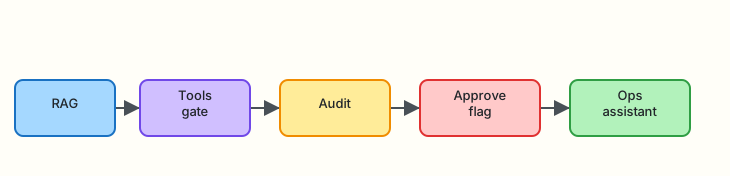
RAG → tools gate → audit → approve flag → ops assistant.
Theory
What it is
A production ops assistant combines:
| Layer | Role |
|---|---|
| Retrieval (RAG) | Ground answers in runbooks |
| Tools | Read-only evidence gathering |
| Policy gate | Deny mutate unless approved |
| Audit | Who/what/when |
| Ops wrapper | SLOs, owners, rollback |
Why it matters
Without these layers you have a chatbot. With them you have a service that platform and security can accept.
How it works
Key concepts and comparisons
| Maturity | Traits |
|---|---|
| Demo | Happy path, no audit |
| Pilot | Mock LLM, allowlists, audit file |
| Production | Gateway, budgets, on-call owner, SLO |
Common pitfalls
- Shipping without an owner
- No rollback (how to disable the bot)
- Mutate default-on
- Measuring vanity answer rates instead of time-to-understanding
Hands-on Lab
Objective
Build ops_assistant.py under ~/rebash-ai/module-14 that retrieves runbook chunks, runs allowlisted read-only tools, writes audits, and only runs a mock restart when --approve is passed.
Prerequisites
- Python 3.10+
Lab environment
mkdir -p ~/rebash-ai/module-14/{runbooks,fixtures} && cd ~/rebash-ai/module-14
python3 --version | tee python-version.txt
Expected output
Python 3.10+ recorded.
Real-world scenario
You must demo a minimum viable production assistant to architecture review: citations, deny-by-default mutate, audit trail, and a kill switch note in OWNERSHIP.md.
Step-by-step tasks
Task 1 – Knowledge, tools, and assistant
Create runbooks/crashloop.md:
# CrashLoop triage

## Checks
Read logs and describe events before any restart.
Confirm upstream dependencies are healthy.
Create fixtures/pods.json:
[{"name": "payments-api-2c1a", "namespace": "payments", "phase": "CrashLoopBackOff"}]
Create fixtures/payments-api.log:
Create rag.py:
"""Tiny retrieval helper."""
from __future__ import annotations

from pathlib import Path


def retrieve(question: str, root: Path) -> list[dict]:
    hits = []
    q = question.lower()
    for path in sorted(root.glob("*.md")):
        text = path.read_text(encoding="utf-8")
        score = sum(1 for tok in q.split() if tok in text.lower())
        if score:
            hits.append({"path": str(path), "text": text, "score": score})
    hits.sort(key=lambda h: h["score"], reverse=True)
    return hits[:2]
Create tools.py:
from __future__ import annotations

import json
from pathlib import Path
from typing import Any

ROOT = Path(__file__).resolve().parent
ALLOW = {"list_pods", "read_log"}


def execute(tool: str, args: dict[str, Any] | None = None, approve: bool = False) -> dict[str, Any]:
    args = args or {}
    if tool == "restart_deployment":
        if not approve:
            return {"ok": False, "error": "APPROVAL_REQUIRED", "tool": tool}
        return {"ok": True, "tool": tool, "restarted": args.get("name"), "dry_run": True}
    if tool not in ALLOW:
        return {"ok": False, "error": "DENIED", "tool": tool}
    if tool == "list_pods":
        pods = json.loads((ROOT / "fixtures" / "pods.json").read_text(encoding="utf-8"))
        return {"ok": True, "tool": tool, "pods": pods}
    if tool == "read_log":
        lines = (ROOT / "fixtures" / "payments-api.log").read_text(encoding="utf-8").splitlines()
        return {"ok": True, "tool": tool, "lines": lines}
    return {"ok": False, "error": "unknown", "tool": tool}
Create ops_assistant.py:
"""Production-shaped ops assistant (capstone)."""
from __future__ import annotations

import argparse
import json
from datetime import datetime, timezone
from pathlib import Path

from rag import retrieve
from tools import execute


def audit(path: Path, event: dict) -> None:
    event = {**event, "ts": datetime.now(timezone.utc).isoformat()}
    with path.open("a", encoding="utf-8") as fh:
        fh.write(json.dumps(event) + "\n")


def main() -> int:
    parser = argparse.ArgumentParser()
    parser.add_argument("--question", required=True)
    parser.add_argument("--approve", action="store_true", help="Allow dry-run mutate")
    parser.add_argument("--want-restart", action="store_true")
    parser.add_argument("--out", type=Path, default=Path("assistant-out.json"))
    parser.add_argument("--audit", type=Path, default=Path("audit.jsonl"))
    args = parser.parse_args()

    chunks = retrieve(args.question, Path("runbooks"))
    steps = []
    for tool, tool_args in (
        ("list_pods", {}),
        ("read_log", {}),
    ):
        result = execute(tool, tool_args, approve=False)
        steps.append({"tool": tool, "result": result})
        audit(args.audit, {"action": "tool", "tool": tool, "ok": result.get("ok")})

    mutate = None
    if args.want_restart:
        mutate = execute(
            "restart_deployment",
            {"name": "payments-api"},
            approve=args.approve,
        )
        audit(
            args.audit,
            {
                "action": "mutate_attempt",
                "approve": args.approve,
                "ok": mutate.get("ok"),
                "error": mutate.get("error"),
            },
        )

    answer = {
        "ok": True,
        "citations": [c["path"] for c in chunks],
        "chunks": chunks,
        "steps": steps,
        "mutate": mutate,
        "status": (
            "STOP_APPROVAL_REQUIRED"
            if mutate and mutate.get("error") == "APPROVAL_REQUIRED"
            else "COMPLETE"
        ),
    }
    args.out.write_text(json.dumps(answer, indent=2) + "\n", encoding="utf-8")
    print(json.dumps({"status": answer["status"], "citations": answer["citations"]}, indent=2))
    if mutate and not mutate.get("ok"):
        return 1
    return 0


if __name__ == "__main__":
    raise SystemExit(main())
Create OWNERSHIP.md:
# Ops assistant ownership

- **Service:** rebash-ops-assistant (lab)
- **Owner:** platform-ai squad (example)
- **SLO:** 99% of advisory requests return under 5s locally; mutate never auto-runs
- **Kill switch:** stop scheduling the job / remove tool credentials
- **Rollback:** disable `--want-restart` path in config; keep read-only mode
cd ~/rebash-ai/module-14
python3 ops_assistant.py --question "CrashLoop payments pod triage" --out out.json
python3 - <<'PY'
import json
from pathlib import Path
p = json.loads(Path("out.json").read_text())
assert p["citations"]
assert p["steps"][0]["result"]["ok"] is True
print("advisory_ok")
PY
Expected output
advisory_ok with citations and read-only tool steps.
Task 2 – Mutate blocked without approve
cd ~/rebash-ai/module-14
rm -f audit.jsonl
python3 ops_assistant.py --question "crashloop" --want-restart --out denied.json; echo rc=$?
python3 - <<'PY'
import json
from pathlib import Path
p = json.loads(Path("denied.json").read_text())
assert p["status"] == "STOP_APPROVAL_REQUIRED"
assert p["mutate"]["error"] == "APPROVAL_REQUIRED"
assert any(json.loads(l)["action"]=="mutate_attempt" for l in Path("audit.jsonl").read_text().splitlines())
print("mutate_denied_ok")
PY
Expected output
mutate_denied_ok.
Task 3 – Approve dry-run restart
cd ~/rebash-ai/module-14
python3 ops_assistant.py --question "crashloop" --want-restart --approve --out approved.json
python3 - <<'PY'
import json
from pathlib import Path
p = json.loads(Path("approved.json").read_text())
assert p["mutate"]["ok"] is True and p["mutate"].get("dry_run") is True
assert p["status"] == "COMPLETE"
print("approve_dry_run_ok")
PY
test -f OWNERSHIP.md
echo "capstone_ok"
Expected output
approve_dry_run_ok and capstone_ok.
Validation steps
- Citations present for crashloop question
- Read-only tools ran
- Mutate blocked without
--approve -
--approveonly dry-runs restart -
OWNERSHIP.mdexists
Common errors and fixes
| Error | Cause | Fix |
|---|---|---|
| Empty citations | Question tokens miss runbook | Use “CrashLoop” wording |
| Mutate always ok | Forgot to omit --approve | Test deny path first |
Challenge exercise
Add a guardrails check from Module 13 before retrieval; deny injection phrases with audit.
Learning outcomes
- You shipped a portfolio-ready assistant skeleton
- You demonstrated approve-gated mutate
- You documented ownership and kill switch
Cleanup
Validation
- Capstone lab passed
- Can draw the production layers from memory
- Can state an SLO and kill switch
- Ready for interview defence of the design
Code Walkthrough
- Retrieve before advise.
- Read-only tools by default.
- Explicit approve for mutate.
- Audit every tool/mutate attempt.
- Ownership doc is part of the product.
Security Considerations
- Dry-run is not production restart — label clearly
- Separate credentials for read vs mutate
- Gateway budgets from Module 13
- Disable path for incidents involving the bot itself
- Review audits after red-teams
Common Mistakes
Shipping without an owner or kill switch
Fix: Write OWNERSHIP.md before the demo.
Defaulting approve=true in config
Fix: Defaults must be deny; approve is opt-in per request.
Best Practices
- Progressive delivery: advisory → read tools → gated mutate
- SLOs on latency and error rate of the assistant
- Golden evals (Module 4) in CI
- Cost dashboards
- Post-incident review includes AI actions
Troubleshooting
| Symptom | Likely cause | Fix |
|---|---|---|
| status COMPLETE without citations | Empty runbooks dir | Add Markdown runbooks |
| approve path missing dry_run | Code edit | Keep dry_run True in lab |
Summary
You finished the AI for DevOps course path: foundations through a production-shaped assistant. Propose with RAG, prove with tools, govern with audits and approvals.
Return to the AI for DevOps Overview. Optional deeper taster: Python — OpenAI, MCP, and LangChain.
Interview Questions
1. What layers make an ops assistant “production-shaped”?
Reveal answer
Retrieval grounding, allowlisted tools, approval gates for mutate, audit trails, ownership/SLOs, and a kill switch — not just a chat UI.
2. Why require an explicit approve flag for restarts?
Reveal answer
Mutating production needs intentional human (or dual) control. Defaults must fail closed.
3. What is a reasonable first SLO for an advisory assistant?
Reveal answer
Example: high availability of the advisory path and p95 latency under a few seconds, with mutate disabled or separately budgeted.
4. How do you roll back a bad assistant behaviour?
Reveal answer
Disable mutate features, pin/rollback prompts and indexes, revoke tool credentials, and keep read-only mode if useful.
5. How do RAG and tools work together here?
Reveal answer
RAG supplies procedure/context; tools supply live evidence; neither replaces the approval gate.
6. What evidence would you show in an architecture review?
Reveal answer
Sample citations, deny-without-approve trace, audit.jsonl lines, OWNERSHIP.md, and golden eval results.
7. When would you move from dry-run restart to a real restart API?
Reveal answer
After policy sign-off, least-privilege credentials, stronger evals, rate limits, and clear on-call ownership — never on day one of a pilot.
8. How does this course’s philosophy show up in the capstone?
Reveal answer
AI proposes and assists; humans and policy dispose. The assistant accelerates understanding without silent production changes.
Related Tutorials
- Previous: Security, Cost, and Governance
- Course: AI for DevOps Overview
- Related: Agents for Ops Workflows