Vector Stores for Ops
Overview
Embedding a few files in memory is fine for a demo. Production assistants need a vector store: persist chunks, re-index on change, and query quickly. For ops, that usually means chunked runbooks with source paths you can cite later.
Plain problem: Re-reading every Markdown file on each query does not scale, and without chunking you retrieve entire unrelated sections.
This lab builds a small SQLite vector store (vectors as JSON) with chunking and a query CLI. No external vector database required — the ideas transfer to Chroma, pgvector, or OpenSearch later.
This is Tutorial 6 in Module 6: Vector Stores of the REBASH Academy AI for DevOps Engineers series — practical AI for Cloud and DevOps work.
Prerequisites
- Embeddings and Semantic Search
- Python 3.10+ with stdlib
sqlite3 - Familiarity with Markdown runbooks
Learning Objectives
By the end of this tutorial, you will be able to:
- Explain why ops knowledge is chunked before embedding
- Persist embeddings and metadata in SQLite
- Index and query runbooks for “disk full” style incidents
- Diagnose empty-index and bad chunk-size failures
- Compare SQLite pilots versus dedicated vector databases in interview
Architecture
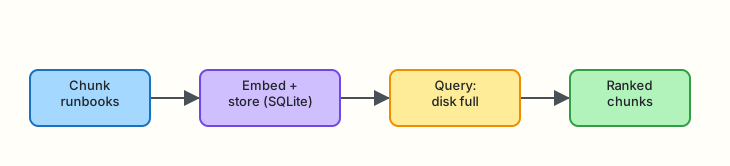
Chunk runbooks → embed → store in SQLite → query returns ranked chunks.
Theory
What it is
A vector store saves embeddings with metadata (path, chunk id, text). At query time it embeds the question and returns the nearest chunks.
Chunking splits long documents so retrieval returns a focused paragraph, not a 20-page wiki dump.
Why it matters
RAG quality is mostly retrieval quality. Bad chunks → bad answers. Ops runbooks need stable IDs and paths for citations and audit.
How it works
- Split Markdown into chunks (by heading or character window).
- Embed each chunk.
INSERTinto SQLite:id,path,text,vector_json.- On query: embed question, score all rows (fine for lab scale), return top-k.
Key concepts and comparisons
| Store | When to use |
|---|---|
| In-memory list | Unit tests, tiny demos |
| SQLite + JSON vectors | Pilots, laptops, CI (this lab) |
| pgvector / OpenSearch | Team platforms, larger corpora |
| Managed vector DB | Less ops toil, vendor lock-in trade-off |
| Chunking | Trade-off |
|---|---|
| Too large | Noisy context, weak ranking |
| Too small | Missing sentences, broken meaning |
| By heading | Natural for runbooks |
Common pitfalls
- Re-indexing without deleting stale chunks
- Storing vectors without source paths
- Changing embedder without rebuilding the index
- Assuming approximate nearest neighbour (ANN) is required for 100 docs
Hands-on Lab
Objective
Index chunked runbooks into SQLite under ~/rebash-ai/module-06 and prove a “disk full” query returns capacity-related chunks with scores.
Prerequisites
- Python 3.10+
- Completed Module 5 concepts (embed + cosine)
Lab environment
Workspace: ~/rebash-ai/module-06
mkdir -p ~/rebash-ai/module-06/runbooks && cd ~/rebash-ai/module-06
python3 --version | tee python-version.txt
Expected output
Python 3.10+ recorded in python-version.txt.
Real-world scenario
Platform engineering wants a searchable runbook index for an incident bot. Until legal approves a SaaS vector database, you ship SQLite on the jump host with the same chunk metadata the future service will need.
Step-by-step tasks
Task 1 – Corpus and embedder
Create runbooks/disk-capacity.md:
# Disk capacity

## Quick checks
Use df -h and df -i when the alert says disk full or no space left.

## Cleanup
Rotate application logs under /var/log with approval. Do not delete database files.
Create runbooks/inode-exhaustion.md:
# Inode exhaustion

## Symptoms
Cannot create files while byte capacity remains.

## Diagnosis
Inspect df -i and find directories with millions of tiny files.
Create runbooks/ssh-bastion.md:
# SSH bastion

## Access
Use short-lived certificates through the bastion. Never paste private keys into chat tools.
Create embedder.py (same hashing approach as Module 5):
"""Deterministic hashing embeddings — stdlib only."""
from __future__ import annotations

import hashlib
import math
import re

DIM = 128
TOKEN_RE = re.compile(r"[a-z0-9]+", re.IGNORECASE)


def tokenize(text: str) -> list[str]:
    return TOKEN_RE.findall(text.lower())


def embed(text: str, dim: int = DIM) -> list[float]:
    vec = [0.0] * dim
    tokens = tokenize(text)
    if not tokens:
        return vec
    for tok in tokens:
        h = hashlib.sha256(tok.encode("utf-8")).digest()
        idx = int.from_bytes(h[:4], "big") % dim
        sign = 1.0 if h[4] % 2 == 0 else -1.0
        vec[idx] += sign
    norm = math.sqrt(sum(v * v for v in vec))
    if norm == 0:
        return vec
    return [v / norm for v in vec]


def cosine(a: list[float], b: list[float]) -> float:
    return sum(x * y for x, y in zip(a, b))
Task 2 – SQLite store, index, and query
Create store.py:
"""SQLite vector store for ops runbook chunks."""
from __future__ import annotations

import json
import sqlite3
from pathlib import Path

from embedder import cosine, embed


SCHEMA = """
CREATE TABLE IF NOT EXISTS chunks (
  id TEXT PRIMARY KEY,
  path TEXT NOT NULL,
  text TEXT NOT NULL,
  vector_json TEXT NOT NULL
);
"""


def connect(db_path: Path) -> sqlite3.Connection:
    conn = sqlite3.connect(db_path)
    conn.execute(SCHEMA)
    return conn


def chunk_markdown(path: Path, text: str, max_chars: int = 280) -> list[tuple[str, str]]:
    """Split on ## headings, then window long sections."""
    parts = []
    current = []
    for line in text.splitlines():
        if line.startswith("## ") and current:
            parts.append("\n".join(current).strip())
            current = [line]
        else:
            current.append(line)
    if current:
        parts.append("\n".join(current).strip())

    chunks: list[tuple[str, str]] = []
    for i, part in enumerate(parts):
        if not part:
            continue
        if len(part) <= max_chars:
            chunks.append((f"{path.name}#{i}", part))
            continue
        for j in range(0, len(part), max_chars):
            window = part[j : j + max_chars].strip()
            if window:
                chunks.append((f"{path.name}#{i}.{j}", window))
    return chunks


def index_runbooks(conn: sqlite3.Connection, root: Path, max_chars: int = 280) -> int:
    conn.execute("DELETE FROM chunks")
    count = 0
    for path in sorted(root.glob("*.md")):
        text = path.read_text(encoding="utf-8")
        for chunk_id, chunk_text in chunk_markdown(path, text, max_chars=max_chars):
            vec = embed(chunk_text)
            conn.execute(
                "INSERT INTO chunks (id, path, text, vector_json) VALUES (?, ?, ?, ?)",
                (chunk_id, str(path), chunk_text, json.dumps(vec)),
            )
            count += 1
    conn.commit()
    return count


def query(conn: sqlite3.Connection, question: str, k: int = 3) -> list[dict]:
    qv = embed(question)
    rows = conn.execute("SELECT id, path, text, vector_json FROM chunks").fetchall()
    scored = []
    for chunk_id, path, text, vector_json in rows:
        score = cosine(qv, json.loads(vector_json))
        scored.append(
            {
                "id": chunk_id,
                "path": path,
                "score": round(score, 4),
                "text": text,
            }
        )
    scored.sort(key=lambda r: r["score"], reverse=True)
    return scored[:k]
Create index_cli.py:
"""Build the SQLite vector index from runbooks/."""
from __future__ import annotations

import argparse
from pathlib import Path

from store import connect, index_runbooks


def main() -> int:
    parser = argparse.ArgumentParser()
    parser.add_argument("--db", type=Path, default=Path("runbooks.db"))
    parser.add_argument("--runbooks", type=Path, default=Path("runbooks"))
    parser.add_argument("--max-chars", type=int, default=280)
    args = parser.parse_args()

    conn = connect(args.db)
    n = index_runbooks(conn, args.runbooks, max_chars=args.max_chars)
    conn.close()
    print(f"indexed_chunks={n} db={args.db}")
    return 0 if n > 0 else 2


if __name__ == "__main__":
    raise SystemExit(main())
Create query_cli.py:
"""Query the SQLite vector index."""
from __future__ import annotations

import argparse
import json
from pathlib import Path

from store import connect, query


def main() -> int:
    parser = argparse.ArgumentParser()
    parser.add_argument("--db", type=Path, default=Path("runbooks.db"))
    parser.add_argument("--query", required=True)
    parser.add_argument("--k", type=int, default=3)
    parser.add_argument("--out", type=Path, default=Path("query-results.json"))
    args = parser.parse_args()

    conn = connect(args.db)
    hits = query(conn, args.query, k=args.k)
    conn.close()
    args.out.write_text(json.dumps({"query": args.query, "hits": hits}, indent=2) + "\n")
    for h in hits:
        print(f"{h['score']:.4f}\t{h['id']}\t{h['path']}")
    return 0


if __name__ == "__main__":
    raise SystemExit(main())
cd ~/rebash-ai/module-06
python3 index_cli.py --db runbooks.db
python3 query_cli.py --query "disk full no space left" --k 3 --out query-disk.json
python3 - <<'PY'
import json
from pathlib import Path
hits = json.loads(Path("query-disk.json").read_text())["hits"]
assert hits, "expected hits"
top_paths = " ".join(h["path"] for h in hits[:2])
assert "disk-capacity" in top_paths or "inode" in top_paths, hits
assert "ssh-bastion" not in hits[0]["path"]
print("disk_full_query=OK", hits[0]["id"])
PY
Expected output
indexed_chunks > 0. Top hit path includes disk-capacity or inode. Prints disk_full_query=OK.
Task 3 – Break: empty index and tiny chunks
cd ~/rebash-ai/module-06
rm -f empty.db
python3 - <<'PY'
from pathlib import Path
from store import connect, query
conn = connect(Path("empty.db"))
hits = query(conn, "disk full", k=3)
assert hits == []
print("empty_index_ok")
conn.close()
PY
# Pathological tiny chunks still index, but may rank poorly — rebuild sane size
python3 index_cli.py --db runbooks.db --max-chars 40
python3 query_cli.py --query "disk full" --db runbooks.db --out query-tiny.json
python3 index_cli.py --db runbooks.db --max-chars 280
python3 query_cli.py --query "disk full" --db runbooks.db --out query-fixed.json
python3 - <<'PY'
import json
from pathlib import Path
fixed = json.loads(Path("query-fixed.json").read_text())["hits"]
assert fixed and ("disk" in fixed[0]["path"] or "inode" in fixed[0]["path"])
print("reindex_fixed=OK")
PY
Expected output
Empty index returns no hits. After rebuilding with sane max-chars, disk query ranks storage chunks again.
Validation steps
-
runbooks.dbcontains chunks after indexing - “disk full” query returns storage-related chunk IDs
- SSH bastion is not the top hit
- Empty DB returns zero hits without crashing
Common errors and fixes
| Error | Cause | Fix |
|---|---|---|
indexed_chunks=0 | Wrong --runbooks path | Point at directory with .md files |
| Stale results | Old DB not rebuilt | Re-run index_cli.py (it deletes then inserts) |
| JSON decode errors | Corrupted DB | Delete runbooks.db and re-index |
Challenge exercise
Add a fourth runbook about log rotation filling disks. Re-index and prove “logs filling /var” returns that chunk in top-k.
Learning outcomes
- You persisted embeddings with citation-ready paths
- You practised chunking trade-offs
- You can explain SQLite as a pilot vector store
Cleanup
Validation
- Lab asserts passed
- Can explain chunking and why paths matter
- Can compare SQLite versus pgvector at a high level
- Know to rebuild after embedder changes
Code Walkthrough
- Delete then insert on re-index to avoid stale chunks.
- Store path + text + vector together.
- Score in Python for small corpora; ANN later if needed.
- Tune chunk size with real queries, not guesses.
- Keep embedder version documented next to the DB.
Security Considerations
- Runbook DBs may be sensitive — encrypt at rest on shared hosts
- Query logs can leak incident details
- Do not index secrets files
- Separate prod and lab indexes
- Access-control the DB file like any ops datastore
Common Mistakes
Appending forever without deleting old chunks
Fix: Rebuild atomically or upsert by stable chunk IDs.
Chunking only by fixed bytes through mid-sentence forever
Fix: Prefer heading-aware splits for runbooks, then window leftovers.
Best Practices
- Include source path in every hit
- Keep a golden query list for ranking regressions
- Version embedder + chunker together
- Start with SQLite; migrate when scale or multi-writer needs appear
- Document rebuild procedure for on-call
Troubleshooting
| Symptom | Likely cause | Fix |
|---|---|---|
| Always same top hit | Tiny corpus / weak query | Add docs; use incident language |
| DB locked | Concurrent writers | Single indexer job |
| Huge DB | Storing duplicate indexes | One DB path; rebuild cleanly |
Summary
Vector stores make embeddings durable and queryable. Chunked SQLite indexes are enough to learn ops retrieval — and to feed RAG next.
Next: Retrieval-Augmented Generation for Ops.
Interview Questions
1. What problem does a vector store solve beyond in-memory lists?
Reveal answer
Persistence, re-indexing, shared metadata (paths/IDs), and repeatable queries as the corpus grows — without reloading every file into a process each time.
2. Why chunk runbooks before embedding?
Reveal answer
So retrieval returns a focused section the model can use, instead of an entire unrelated document that wastes context and confuses answers.
3. What metadata must you store with each vector for ops?
Reveal answer
Stable chunk ID, source path, and the chunk text (or a pointer) so answers can cite evidence.
4. When is SQLite a reasonable vector store?
Reveal answer
Pilots, local tools, CI, and corpora small enough to score in Python. Move to ANN/pgvector when scale or concurrency demands it.
5. What happens if you change the embedding model without re-indexing?
Reveal answer
Query vectors and stored vectors live in different spaces; rankings become nonsense. Rebuild the index with one embedder version.
6. How do you detect a bad chunk size in production?
Reveal answer
Golden queries return irrelevant sections, citations look random, or answers miss critical steps that were split away — fix by re-chunking and re-evaluating.
7. Why delete-all-then-insert on lab re-index?
Reveal answer
It prevents stale chunks from deleted or renamed runbooks lingering and polluting rankings.
Related Tutorials
- Previous: Embeddings and Semantic Search
- Next: Retrieval-Augmented Generation for Ops
- Course: AI for DevOps Overview