Embeddings and Semantic Search
Overview
Keyword search fails when on-call types “disk full” but the runbook says “filesystem capacity” or “inode exhaustion”. Embeddings map text into vectors so similar meaning sits nearby — even when the words differ. That is the foundation of semantic search for runbooks, tickets, and post-mortems.
Plain problem: grep -i disk misses the inode runbook. A semantic index ranks it correctly next to capacity guidance.
This tutorial builds offline, stdlib-only embeddings (hashing bag-of-words) and a top-k search CLI. Production teams often swap in a managed embedding API later; the shape of the pipeline stays the same.
This is Tutorial 5 in Module 5: Embeddings of the REBASH Academy AI for DevOps Engineers series — practical AI for Cloud and DevOps work.
Prerequisites
- Evaluation and Reliability
- Python 3.10+ (stdlib only — no
numpyor vendor SDKs required) - Comfort reading short Markdown runbooks
Learning Objectives
By the end of this tutorial, you will be able to:
- Explain what an embedding is and why ops needs semantic search
- Compare keyword search versus vector similarity for runbooks
- Implement a pure-Python embedder and cosine similarity
- Rank runbook snippets with top-k search for an incident query
- Defend trade-offs of local hashing embeddings versus API models in interview
Architecture
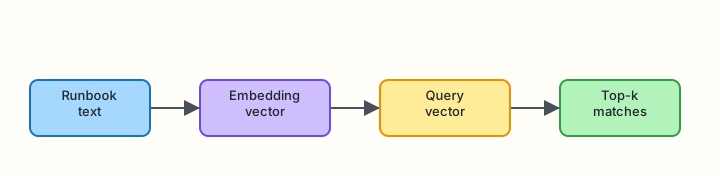
Runbook text becomes vectors; a query vector ranks the nearest documents.
Theory
What it is
An embedding is a list of numbers representing text. Semantic search ranks documents by vector similarity (usually cosine similarity) instead of exact string match.
| Term | Plain meaning |
|---|---|
| Vector | Ordered list of floats (the embedding) |
| Dimension | Length of the vector |
| Cosine similarity | Angle-based score between −1 and 1 (higher = more similar) |
| Top-k | Return the k highest-scoring documents |
| Hashing embedder | Deterministic local vectors from token hashes (lab-friendly) |
Interview one-liner: Embeddings let “disk full” find “inode exhaustion” without sharing keywords.
Why it matters
Ops knowledge is messy: tribal Slack threads, Markdown runbooks, and ticket titles. Assistants that only grep miss synonyms. Semantic search is how Retrieval-Augmented Generation (RAG) finds the right paragraph before the model answers (Module 7).
How it works
- Split text into tokens (words).
- Map tokens into a fixed-size vector (here: hash each token into a bucket and add weight).
- Normalise or use cosine so length does not dominate.
- Embed the query the same way.
- Score every document; return top-k.
# Cosine similarity (pure Python)
dot = sum(a * b for a, b in zip(va, vb))
na = sum(a * a for a in va) ** 0.5
nb = sum(b * b for b in vb) ** 0.5
score = dot / (na * nb) if na and nb else 0.0
Key concepts and comparisons
| Approach | Strength | Weakness |
|---|---|---|
Keyword / grep | Fast, exact IDs | Misses synonyms |
| Hashing embeddings (lab) | Offline, free, deterministic | Weaker than neural models |
| API embeddings (prod) | Stronger semantics | Cost, network, data residency |
| Hybrid (keyword + vector) | Best of both | More moving parts |
Common pitfalls
- Comparing vectors from different embedding models
- Forgetting to use the same embedder for query and documents
- Ranking on raw dot product without normalisation when magnitudes differ
- Embedding secrets or personal data into a shared index
Hands-on Lab
Objective
Build an offline semantic search tool under ~/rebash-ai/module-05 that embeds runbook snippets and ranks “disk full” / inode queries above unrelated SSH content.
Prerequisites
- Python 3.10+
- Write access under your home directory
Lab environment
Workspace: ~/rebash-ai/module-05
mkdir -p ~/rebash-ai/module-05/runbooks && cd ~/rebash-ai/module-05
set -euo pipefail
python3 --version | tee python-version.txt
Expected output
python-version.txt shows Python 3.10+.
Real-world scenario
Your SRE wiki has dozens of runbooks. On-call pastes alert text into a bot. Security forbids sending the whole wiki to a vendor embedding API during the pilot. You prove semantic ranking locally first, then decide whether to upgrade the embedder later.
Step-by-step tasks
Task 1 – Runbook corpus
Create runbooks/disk-capacity.md:
# Disk and filesystem capacity

When alerts mention disk full, filesystem capacity, or no space left on device:
1. Run `df -h` and `df -i` to check bytes and inodes.
2. Find large files under `/var` and application log dirs.
3. Rotate or truncate logs only with change approval.
Create runbooks/inode-exhaustion.md:
# Inode exhaustion

Symptoms: cannot create new files though `df -h` shows free bytes.
Check `df -i`. Many tiny files in `/var/spool` or container layers often cause inode exhaustion.
Cleanup requires identifying the directory with the highest inode count.
Create runbooks/ssh-bastion.md:
# SSH bastion access

Use the corporate bastion with short-lived certificates.
Do not share private keys. Prefer `ProxyJump` and disable password authentication.
This runbook is unrelated to storage capacity incidents.
Create runbooks/latency-timeout.md:
# Upstream latency and timeouts

Check p95 latency, error rate, and dependency health.
Restarting pods rarely fixes a saturated database.
cd ~/rebash-ai/module-05
test -f runbooks/disk-capacity.md
test -f runbooks/inode-exhaustion.md
test -f runbooks/ssh-bastion.md
wc -l runbooks/*.md | tee corpus-stats.txt
Expected output
Four runbook files listed; corpus-stats.txt shows line counts.
Task 2 – Embedder and search CLI
Create embedder.py:
"""Deterministic hashing embeddings — stdlib only."""
from __future__ import annotations

import hashlib
import math
import re
from typing import Iterable

DIM = 128
TOKEN_RE = re.compile(r"[a-z0-9]+", re.IGNORECASE)


def tokenize(text: str) -> list[str]:
    return TOKEN_RE.findall(text.lower())


def embed(text: str, dim: int = DIM) -> list[float]:
    vec = [0.0] * dim
    tokens = tokenize(text)
    if not tokens:
        return vec
    for tok in tokens:
        h = hashlib.sha256(tok.encode("utf-8")).digest()
        idx = int.from_bytes(h[:4], "big") % dim
        sign = 1.0 if h[4] % 2 == 0 else -1.0
        vec[idx] += sign
    # L2 normalise for stable cosine
    norm = math.sqrt(sum(v * v for v in vec))
    if norm == 0:
        return vec
    return [v / norm for v in vec]


def cosine(a: list[float], b: list[float]) -> float:
    return sum(x * y for x, y in zip(a, b))


def top_k(
    query: str,
    docs: Iterable[tuple[str, str]],
    k: int = 3,
) -> list[tuple[str, float, str]]:
    """docs: iterable of (doc_id, text). Returns (doc_id, score, text)."""
    qv = embed(query)
    scored: list[tuple[str, float, str]] = []
    for doc_id, text in docs:
        score = cosine(qv, embed(text))
        scored.append((doc_id, score, text))
    scored.sort(key=lambda row: row[1], reverse=True)
    return scored[:k]
Create search_cli.py:
"""Top-k semantic search over local runbooks."""
from __future__ import annotations

import argparse
import json
from pathlib import Path

from embedder import top_k


def load_docs(root: Path) -> list[tuple[str, str]]:
    docs: list[tuple[str, str]] = []
    for path in sorted(root.glob("*.md")):
        docs.append((path.name, path.read_text(encoding="utf-8")))
    return docs


def main() -> int:
    parser = argparse.ArgumentParser(description="Semantic runbook search")
    parser.add_argument("--query", required=True)
    parser.add_argument("--runbooks", type=Path, default=Path("runbooks"))
    parser.add_argument("--k", type=int, default=3)
    parser.add_argument("--out", type=Path, default=Path("search-results.json"))
    args = parser.parse_args()

    docs = load_docs(args.runbooks)
    hits = top_k(args.query, docs, k=args.k)
    payload = {
        "query": args.query,
        "results": [
            {"doc": doc_id, "score": round(score, 4)}
            for doc_id, score, _ in hits
        ],
    }
    args.out.write_text(json.dumps(payload, indent=2) + "\n", encoding="utf-8")
    for doc_id, score, _ in hits:
        print(f"{score:.4f}\t{doc_id}")
    return 0


if __name__ == "__main__":
    raise SystemExit(main())
cd ~/rebash-ai/module-05
python3 search_cli.py --query "disk full no space left" --k 3 --out search-disk.json
python3 - <<'PY'
import json
from pathlib import Path
r = json.loads(Path("search-disk.json").read_text())
top = [x["doc"] for x in r["results"]]
assert top[0] in {"disk-capacity.md", "inode-exhaustion.md"}, top
assert "ssh-bastion.md" not in top[:2], top
print("disk_query_ranks_storage=OK", top)
PY
Expected output
Top hit is a storage runbook (disk-capacity.md or inode-exhaustion.md). ssh-bastion.md is not in the top two. Prints disk_query_ranks_storage=OK.
Task 3 – Break and fix: empty corpus
cd ~/rebash-ai/module-05
mkdir -p empty-runbooks
python3 search_cli.py --query "disk full" --runbooks empty-runbooks --out search-empty.json
python3 - <<'PY'
import json
from pathlib import Path
r = json.loads(Path("search-empty.json").read_text())
assert r["results"] == []
print("empty_corpus_ok")
PY
# restore confidence with real corpus
python3 search_cli.py --query "inode exhaustion cannot create files" --k 2 --out search-inode.json
python3 - <<'PY'
import json
from pathlib import Path
top = json.loads(Path("search-inode.json").read_text())["results"][0]["doc"]
assert top == "inode-exhaustion.md", top
print("inode_query_ok")
PY
Expected output
Empty corpus returns no results. Inode query ranks inode-exhaustion.md first.
Validation steps
- Four runbooks exist under
runbooks/ - Disk-capacity query ranks storage docs above SSH
- Inode query returns
inode-exhaustion.mdfirst - You can explain cosine similarity without jargon overload
Common errors and fixes
| Error | Cause | Fix |
|---|---|---|
| All scores ~0 | Empty text / wrong path | Check --runbooks and file contents |
| SSH ranked first | Query too generic | Use incident-shaped queries (“disk full”) |
ModuleNotFoundError | Wrong directory | cd ~/rebash-ai/module-05 |
Challenge exercise
Add runbooks/log-rotation.md about journald and logrotate. Prove a “logs filling disk” query ranks it in the top two.
Learning outcomes
- You built a portable embedder with no paid API
- You proved semantic ranking for capacity incidents
- You have JSON evidence for interviews
Cleanup
echo "Keep ~/rebash-ai/module-05 for portfolio evidence or remove manually"
# rm -rf ~/rebash-ai/module-05
Validation
- Lab completed with passing asserts
- Can explain embeddings versus keyword search
- Know when hashing embeddings are enough for a pilot
- Can name one production risk (data residency / model drift)
Code Walkthrough
- Same embedder for documents and queries.
- Normalise vectors so cosine is meaningful.
- Top-k evidence as JSON for audits.
- Offline first — swap model later without changing CLI shape.
- Never embed secrets into shared indexes.
Security Considerations
- Indexes may contain sensitive runbook paths — control access
- Do not embed customer PII from tickets without policy
- Vendor embedding APIs see your text — check residency
- Version the embedder; mixing models corrupts ranking
- Treat search results as untrusted context for later RAG
Common Mistakes
Using a different model for queries than for documents
Fix: Pin one embedder version for the whole index; re-embed on upgrade.
Declaring semantic search solved after one demo query
Fix: Keep a small golden query set (Module 4 style) for ranking regressions.
Best Practices
- Start local; measure quality before paying for embeddings
- Prefer hybrid search when IDs and error codes must match exactly
- Store document IDs and source paths with every vector
- Log queries (redacted) for tuning
- Re-index when runbooks change
Troubleshooting
| Symptom | Likely cause | Fix |
|---|---|---|
| Unstable rankings | Non-deterministic embedder | Use hashing as in the lab |
| Tiny score gaps | Corpus too similar | Add distinctive section titles |
| Import errors | Nested runs | Run from module-05 |
Summary
Embeddings turn ops text into comparable vectors so synonyms surface. Your offline top-k search is the retrieval half of RAG.
Next: Vector Stores for Ops.
Interview Questions
1. What is an embedding in one sentence?
Reveal answer
A numeric vector representation of text that places similar meanings close together so you can rank documents by similarity.
2. Why can semantic search beat grep for runbooks?
Reveal answer
Operators describe incidents with different words than authors used. Vectors capture related meaning; exact string match does not.
3. What is cosine similarity?
Reveal answer
A score based on the angle between two vectors. Higher cosine means more similar direction, which we treat as more similar meaning.
4. Why use the same embedder for queries and documents?
Reveal answer
Different models live in different vector spaces. Mixing them makes similarity scores meaningless.
5. When are hashing embeddings acceptable?
Reveal answer
Pilots, CI, air-gapped labs, and teaching the pipeline. Upgrade to neural/API embeddings when quality metrics demand it.
6. What should you store alongside each vector?
Reveal answer
Document ID, source path, chunk text (or pointer), and embedder version — so you can cite and re-index.
7. Name a security concern with embedding pipelines.
Reveal answer
Sending sensitive runbooks or ticket text to a third-party embedding API without data-residency and retention controls.
Related Tutorials
- Previous: Evaluation and Reliability
- Next: Vector Stores for Ops
- Course: AI for DevOps Overview