Agents for Ops Workflows
Overview
An agent loops: plan → act (tools) → observe → decide again. For incidents that is powerful — and dangerous if the loop can mutate production. Production-grade ops agents stop when the next step needs approval.
Plain problem: A demo agent “fixes” CrashLoopBackOff by deleting pods in a loop. Your agent must classify, gather evidence, suggest checks, then STOP with APPROVAL_REQUIRED before restart/delete.
This lab builds that stoppable loop under ~/rebash-ai/module-10.
This is Tutorial 10 in Module 10: Agents of the REBASH Academy AI for DevOps Engineers series — practical AI for Cloud and DevOps work.
Prerequisites
Learning Objectives
By the end of this tutorial, you will be able to:
- Describe a plan → act → observe agent loop for incidents
- Implement classify → tool checks → stop-before-mutate
- Record a step trace for interview evidence
- Explain stop conditions and max-step budgets
- Contrast advisory agents with autonomous remediators
Architecture
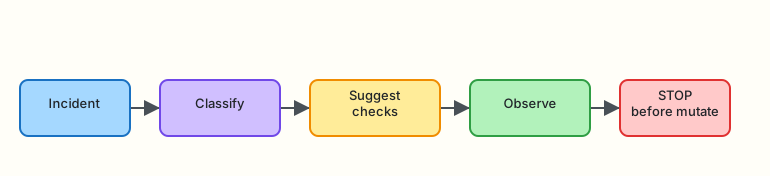
Incident in → classify → suggest checks → observe tools → STOP before mutate.
Theory
What it is
An ops agent is software that repeatedly:
- Chooses a next action (usually a tool)
- Executes via a gated host
- Observes the result
- Stops, asks a human, or continues
Stop conditions matter more than clever planning: max steps, approval gates, empty evidence, or forbidden tools.
Why it matters
Incidents are multi-step. Humans forget checklists under stress. Agents that only advise (and stop cleanly) reduce mean time to understanding without owning blast radius.
How it works
Never auto-loop on delete/restart in this course.
Key concepts and comparisons
| Design | Behaviour |
|---|---|
| Single-shot tool call | One propose/execute (Module 8) |
| Agent loop | Multiple steps with memory/trace |
| Autonomous remediator | Mutates without human — out of scope here |
| Advisory agent | Evidence + recommendations + stop |
Common pitfalls
- No max-step budget (infinite loops)
- Mutating inside the loop “just this once”
- No trace for audit
- Treating agent confidence as approval
Hands-on Lab
Objective
Build an incident agent under ~/rebash-ai/module-10 that classifies a CrashLoop alert, runs read-only mock tools, and stops with APPROVAL_REQUIRED before restart.
Prerequisites
- Python 3.10+
Lab environment
mkdir -p ~/rebash-ai/module-10/fixtures && cd ~/rebash-ai/module-10
python3 --version | tee python-version.txt
Expected output
Python 3.10+ recorded.
Real-world scenario
SRE wants a Slack agent for first-five-minutes triage. Change Advisory Board forbids automatic restarts. You deliver classify → evidence → stop.
Step-by-step tasks
Task 1 – Fixtures and read-only tools
Create fixtures/pods.json:
[
  {"name": "payments-api-7f8b", "namespace": "payments", "phase": "Running"},
  {"name": "payments-api-2c1a", "namespace": "payments", "phase": "CrashLoopBackOff"}
]
Create fixtures/payments-api.log:
ERROR timeout upstream=ledger
ERROR timeout upstream=ledger
WARN retry budget exhausted
Create tools.py:
"""Read-only tools + explicit mutate stub that must never be auto-called."""
from __future__ import annotations

import json
from pathlib import Path
from typing import Any

ROOT = Path(__file__).resolve().parent
ALLOWLIST = {"list_pods", "read_log"}


def list_pods(namespace: str = "payments") -> dict[str, Any]:
    pods = json.loads((ROOT / "fixtures" / "pods.json").read_text(encoding="utf-8"))
    return {"ok": True, "pods": [p for p in pods if p["namespace"] == namespace]}


def read_log(service: str = "payments-api") -> dict[str, Any]:
    lines = (ROOT / "fixtures" / f"{service}.log").read_text(encoding="utf-8").splitlines()
    return {"ok": True, "lines": lines}


def restart_deployment(name: str) -> dict[str, Any]:
    return {"ok": False, "error": "MUTATE_NOT_IMPLEMENTED_IN_AGENT_LOOP", "name": name}


DISPATCH = {
    "list_pods": lambda args: list_pods(str(args.get("namespace", "payments"))),
    "read_log": lambda args: read_log(str(args.get("service", "payments-api"))),
}


def execute(tool: str, args: dict[str, Any] | None = None) -> dict[str, Any]:
    args = args or {}
    if tool not in ALLOWLIST:
        return {"ok": False, "error": "DENIED", "tool": tool}
    return DISPATCH[tool](args)
Task 2 – Agent loop with stop condition
Create agent.py:
"""Advisory incident agent — stops before mutate."""
from __future__ import annotations

from dataclasses import dataclass, field
from typing import Any

from tools import execute


@dataclass
class AgentResult:
    classification: str
    steps: list[dict[str, Any]] = field(default_factory=list)
    recommendation: str = ""
    status: str = "RUNNING"


def classify(incident: str) -> str:
    lower = incident.lower()
    if "crashloop" in lower or "crash" in lower:
        return "workload_crash"
    if "disk" in lower or "inode" in lower:
        return "capacity"
    return "general"


def run_agent(incident: str, max_steps: int = 4) -> AgentResult:
    result = AgentResult(classification=classify(incident))
    plan = ["list_pods", "read_log", "restart_deployment"]

    for tool in plan:
        if len(result.steps) >= max_steps:
            result.status = "STOP_MAX_STEPS"
            break

        if tool == "restart_deployment":
            result.steps.append(
                {
                    "tool": tool,
                    "args": {"name": "payments-api"},
                    "result": {
                        "ok": False,
                        "error": "APPROVAL_REQUIRED",
                        "reason": "mutating action blocked in advisory agent",
                    },
                }
            )
            result.recommendation = (
                "Evidence gathered. Restart payments-api only with human approval "
                "after confirming upstream ledger health."
            )
            result.status = "STOP_APPROVAL_REQUIRED"
            break

        args = {"namespace": "payments"} if tool == "list_pods" else {"service": "payments-api"}
        observation = execute(tool, args)
        result.steps.append({"tool": tool, "args": args, "result": observation})

    if result.status == "RUNNING":
        result.status = "STOP_COMPLETE"
    return result
Create agent_cli.py:
"""CLI for the advisory incident agent."""
from __future__ import annotations

import argparse
import json
from pathlib import Path

from agent import run_agent


def main() -> int:
    parser = argparse.ArgumentParser()
    parser.add_argument(
        "--incident",
        default="ALERT CrashLoopBackOff payments-api namespace=payments",
    )
    parser.add_argument("--out", type=Path, default=Path("agent-trace.json"))
    args = parser.parse_args()

    result = run_agent(args.incident)
    payload = {
        "incident": args.incident,
        "classification": result.classification,
        "status": result.status,
        "recommendation": result.recommendation,
        "steps": result.steps,
    }
    args.out.write_text(json.dumps(payload, indent=2) + "\n", encoding="utf-8")
    print(f"classification={result.classification}")
    print(f"status={result.status}")
    print(f"steps={len(result.steps)}")
    print(result.recommendation)
    return 0 if result.status == "STOP_APPROVAL_REQUIRED" else 1


if __name__ == "__main__":
    raise SystemExit(main())
cd ~/rebash-ai/module-10
python3 agent_cli.py --out agent-trace.json
python3 - <<'PY'
import json
from pathlib import Path
p = json.loads(Path("agent-trace.json").read_text())
assert p["classification"] == "workload_crash"
assert p["status"] == "STOP_APPROVAL_REQUIRED"
tools = [s["tool"] for s in p["steps"]]
assert tools[:2] == ["list_pods", "read_log"]
assert tools[-1] == "restart_deployment"
assert p["steps"][-1]["result"]["error"] == "APPROVAL_REQUIRED"
assert not any(s["result"].get("restarted") for s in p["steps"])
print("agent_stop_before_mutate=OK")
PY
Expected output
Status STOP_APPROVAL_REQUIRED. Trace shows list_pods, read_log, then blocked restart. Prints agent_stop_before_mutate=OK.
Task 3 – Break: prove mutate tool cannot sneak in via execute
Create break_mutate.py:
"""Attempt to execute restart via tools.execute — must DENY."""
from __future__ import annotations

import json
from pathlib import Path

from tools import execute

result = execute("restart_deployment", {"name": "payments-api"})
Path("break-mutate.json").write_text(json.dumps(result, indent=2) + "\n", encoding="utf-8")
print(json.dumps(result))
raise SystemExit(0 if result.get("error") == "DENIED" else 1)
cd ~/rebash-ai/module-10
python3 break_mutate.py
python3 - <<'PY'
import json
from pathlib import Path
r = json.loads(Path("break-mutate.json").read_text())
assert r["error"] == "DENIED"
print("execute_deny_ok")
PY
Expected output
execute_deny_ok — restart_deployment is not allowlisted in tools.execute.
Validation steps
- Agent classifies CrashLoop as
workload_crash - Trace includes read-only tool observations
- Final status is
STOP_APPROVAL_REQUIRED - Mutate cannot run through
tools.execute
Common errors and fixes
| Error | Cause | Fix |
|---|---|---|
| Status not STOP_APPROVAL | Plan order wrong | Keep restart last with explicit stop |
| Empty log observation | Missing fixture | Ensure fixtures/payments-api.log |
Challenge exercise
Add a capacity path: incident text about disk full → classify capacity → only read_log skipped / different plan → still never mutate.
Learning outcomes
- You built an advisory multi-step agent
- You enforced stop-before-mutate in two layers (agent + tool allowlist)
- You produced an audit trace JSON
Cleanup
Validation
- Lab passed
- Can explain agent loops vs single tool calls
- Can name three stop conditions
- Can refuse “fully autonomous remediation” demos safely
Code Walkthrough
- Classify first — pick a playbook path.
- Read-only tools only in the automated loop.
- Budget steps —
max_stepsexists for a reason. - Stop explicitly — status enum, not silent exit.
- Trace everything — interview and audit gold.
Security Considerations
- Agents amplify tool risk — smaller toolboxes
- Prompt injection can push “just restart” — code must ignore
- Separate identities for advisory vs break-glass remediations
- Retain traces with retention policy
- Never store long-lived prod tokens in the agent process for labs
Common Mistakes
Closing the loop with automatic restart when confidence is high
Fix: Confidence is not approval. Keep APPROVAL_REQUIRED.
No max steps
Fix: Cap iterations; fail to STOP_MAX_STEPS and alert a human.
Best Practices
- Advisory by default
- Human gate for every mutate
- Golden incident traces in CI
- Combine with RAG (Module 7) for runbook steps
- Prefer MCP/read-only servers for observations
Troubleshooting
| Symptom | Likely cause | Fix |
|---|---|---|
| Agent exits 1 unexpectedly | Status not approval stop | Check classification path |
| Missing CrashLoop pod | Fixture edit | Restore pods.json |
Summary
Ops agents earn trust by stopping. Classify, gather evidence, recommend, and require approval before blast radius. Modules 11+ apply these patterns to CI and observability copilots.
Next: AI in CI/CD.
Interview Questions
1. What is an AI agent in an ops context?
Reveal answer
Software that iteratively plans, calls tools, observes results, and decides to continue, stop, or ask a human — used for triage and advisory workflows.
2. Why must ops agents have stop conditions?
Reveal answer
Without them, loops can thrash production (restarts/deletes) or run forever. Stops protect blast radius and cost.
3. What should happen when the next action is a restart?
Reveal answer
Exit the automated loop with APPROVAL_REQUIRED, show evidence gathered, and wait for a human (or dual control).
4. How is an agent different from a single tool call?
Reveal answer
A single call is one propose/execute. An agent sequences multiple observations and decisions with memory/trace.
5. Name three good stop conditions.
Reveal answer
Approval required for mutate, max steps reached, and no useful tools left / empty evidence.
6. How do you keep an agent from calling a dangerous tool?
Reveal answer
Host allowlists (and denylists), omit mutate tools from the plan, and unit-test deny paths.
7. Why keep a step trace?
Reveal answer
Auditing, incident review, and interviews — you must show what the agent saw and why it stopped.
8. When would you allow autonomous remediation?
Reveal answer
Only for narrowly scoped, well-tested runbooks with strong guardrails, blast-radius limits, and rollback — not as the default for a general incident agent.
Related Tutorials
- Previous: Model Context Protocol (MCP) for DevOps
- Course: AI for DevOps Overview
- Next: AI in CI/CD