Observability Copilots
Overview
Alerts arrive as dense JSON: labels, annotations, silence URLs. An observability copilot turns that into a short narrative, a runbook link, and a first-five-minutes checklist — still advisory.
Plain problem: On-call opens a page full of labels and freezes. Enrichment that auto-restarts services makes outages worse. Your copilot only prepares the human.
This lab enriches alert JSON under ~/rebash-ai/module-12.
This is Tutorial 12 in Module 12: Observability of the REBASH Academy AI for DevOps Engineers series — practical AI for Cloud and DevOps work.
Prerequisites
- AI in CI/CD
- Familiarity with alert labels (Prometheus-style is enough)
- Python 3.10+
Learning Objectives
By the end of this tutorial, you will be able to:
- Map alert labels to a runbook identifier
- Produce a checklist artefact with a mock LLM narrative
- Keep remediation suggestions read-only by default
- Explain alert enrichment vs auto-remediation
- Defend on-call UX improvements without giving AI pages
Architecture
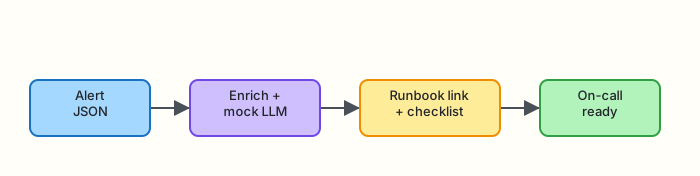
Alert JSON → enrich + mock LLM → runbook link + checklist → on-call.
Theory
What it is
An observability copilot assists humans during detection and triage: summarise alerts, attach runbooks, suggest checks. It does not own paging policy or mutate systems.
Why it matters
Mean time to understanding dominates many incidents. Better first messages beat clever autonomous restarts.
How it works
- Ingest alert JSON (webhook or file).
- Map
alertname/ labels to a runbook key. - Draft narrative + checklist (mock/API).
- Emit artefact for Slack/ticket — no execute.
Key concepts and comparisons
| Capability | Safe? |
|---|---|
| Summarise alert | Yes |
| Link runbook | Yes |
Suggest df -h | Yes (read-only) |
| Auto-silence / auto-restart | No (needs separate control plane) |
Common pitfalls
- Enrichment storms (AI on every flapping alert)
- Wrong runbook mapping
- Hiding the raw alert behind prose
- Auto-acking pages
Hands-on Lab
Objective
Enrich a sample alert into enrichment.json + checklist.md with runbook link under ~/rebash-ai/module-12.
Prerequisites
- Python 3.10+
Lab environment
mkdir -p ~/rebash-ai/module-12/fixtures && cd ~/rebash-ai/module-12
python3 --version | tee python-version.txt
Expected output
Python 3.10+ recorded.
Real-world scenario
The NOC wants Slack messages that include “open this runbook” and three checks. SRE forbids webhook handlers that call cloud APIs to remediate. You ship enrichment only.
Step-by-step tasks
Task 1 – Alert fixture and runbook map
Create fixtures/alert.json:
{
  "status": "firing",
  "alertname": "KubePodCrashLooping",
  "labels": {
    "namespace": "payments",
    "pod": "payments-api-2c1a",
    "severity": "critical"
  },
  "annotations": {
    "summary": "Pod is CrashLoopBackOff",
    "description": "payments-api restarted more than 5 times in 10m"
  }
}
Create runbooks.json:
{
  "KubePodCrashLooping": {
    "title": "Pod CrashLoop triage",
    "url": "https://wiki.example.local/runbooks/pod-crashloop",
    "checks": [
      "kubectl describe pod (read-only) for events",
      "Read recent container logs for stack traces",
      "Check upstream dependency health before restart"
    ]
  },
  "NodeDiskPressure": {
    "title": "Disk pressure",
    "url": "https://wiki.example.local/runbooks/disk-pressure",
    "checks": [
      "df -h and df -i on the node",
      "Identify largest log directories",
      "Escalate before deleting application data"
    ]
  }
}
Create enrich.py:
"""Alert enrichment with mock LLM narrative."""
from __future__ import annotations

import json
from pathlib import Path
from typing import Any


def mock_narrative(alert: dict[str, Any], runbook: dict[str, Any]) -> str:
    labels = alert.get("labels", {})
    return (
        f"Firing alert `{alert.get('alertname')}` in namespace "
        f"`{labels.get('namespace', 'unknown')}` for pod `{labels.get('pod', 'n/a')}`. "
        f"Follow runbook: {runbook['title']}. Do not restart until logs and dependencies are checked."
    )


def enrich(alert_path: Path, runbooks_path: Path) -> dict[str, Any]:
    alert = json.loads(alert_path.read_text(encoding="utf-8"))
    runbooks = json.loads(runbooks_path.read_text(encoding="utf-8"))
    key = alert.get("alertname", "")
    rb = runbooks.get(key)
    if not rb:
        return {
            "ok": False,
            "error": "no_runbook_mapping",
            "alertname": key,
        }
    narrative = mock_narrative(alert, rb)
    return {
        "ok": True,
        "alertname": key,
        "severity": alert.get("labels", {}).get("severity", "unknown"),
        "runbook_url": rb["url"],
        "runbook_title": rb["title"],
        "narrative": narrative,
        "checklist": rb["checks"],
        "remediation_allowed": False,
    }


def write_checklist(payload: dict[str, Any], path: Path) -> None:
    lines = [
        f"# Checklist — {payload.get('alertname')}\n",
        f"Runbook: {payload.get('runbook_url')}\n\n",
        f"{payload.get('narrative')}\n\n",
        "## First checks\n",
    ]
    for item in payload.get("checklist", []):
        lines.append(f"- [ ] {item}\n")
    lines.append("\n**Auto-remediation:** disabled\n")
    path.write_text("".join(lines), encoding="utf-8")
Create enrich_cli.py:
from __future__ import annotations

import argparse
import json
from pathlib import Path

from enrich import enrich, write_checklist


def main() -> int:
    parser = argparse.ArgumentParser()
    parser.add_argument("--alert", type=Path, default=Path("fixtures/alert.json"))
    parser.add_argument("--runbooks", type=Path, default=Path("runbooks.json"))
    parser.add_argument("--out", type=Path, default=Path("enrichment.json"))
    parser.add_argument("--checklist", type=Path, default=Path("checklist.md"))
    args = parser.parse_args()

    payload = enrich(args.alert, args.runbooks)
    args.out.write_text(json.dumps(payload, indent=2) + "\n", encoding="utf-8")
    if not payload.get("ok"):
        print(json.dumps(payload))
        return 2
    write_checklist(payload, args.checklist)
    print(f"runbook={payload['runbook_url']}")
    print(f"remediation_allowed={payload['remediation_allowed']}")
    return 0


if __name__ == "__main__":
    raise SystemExit(main())
cd ~/rebash-ai/module-12
python3 enrich_cli.py
test -f enrichment.json
test -f checklist.md
grep -q 'pod-crashloop' enrichment.json
grep -q 'Auto-remediation' checklist.md
grep -q 'disabled' checklist.md
grep -q '"remediation_allowed": false' enrichment.json
echo "enrich_ok"
Expected output
enrich_ok with runbook URL and remediation disabled.
Task 2 – Break: unknown alertname
Create fixtures/alert-unknown.json:
{
  "status": "firing",
  "alertname": "TotallyNewAlert",
  "labels": {"severity": "warning"},
  "annotations": {"summary": "unknown"}
}
cd ~/rebash-ai/module-12
python3 enrich_cli.py --alert fixtures/alert-unknown.json --out enrichment-unknown.json; echo rc=$?
python3 - <<'PY'
import json
from pathlib import Path
p = json.loads(Path("enrichment-unknown.json").read_text())
assert p["ok"] is False and p["error"] == "no_runbook_mapping"
print("unknown_alert_ok")
PY
Expected output
Non-zero exit; unknown_alert_ok.
Validation steps
- Known alert maps to runbook URL
- Checklist lists first checks
-
remediation_allowedis false - Unknown alert fails closed
Common errors and fixes
| Error | Cause | Fix |
|---|---|---|
| KeyError labels | Malformed alert | Validate JSON schema at ingress |
| Wrong runbook | alertname mismatch | Keep map keys exact |
Challenge exercise
Add NodeDiskPressure alert fixture and prove it maps to the disk runbook.
Learning outcomes
- You enriched alerts without remediating
- You failed closed on missing mappings
- You produced on-call-ready checklist artefacts
Cleanup
Validation
- Lab passed
- Can contrast enrichment vs auto-remediation
- Know to keep raw alert fields accessible
- Can discuss alert flapping + AI cost
Code Walkthrough
- Map then narrate — deterministic runbook key first.
- Checklist as artefact — portable to Slack/tickets.
- Fail closed on unknown alerts.
- Never set remediation true in this module.
- Keep severity from labels.
Security Considerations
- Webhooks need authentication
- Do not echo secrets from annotations into public channels
- Rate-limit enrichment on flapping alerts
- Separate identities for notify vs remediate systems
- Audit mapping changes
Common Mistakes
Auto-restart from the enrichment webhook
Fix: Enrichment services must lack mutate credentials.
Replacing the alert with only AI prose
Fix: Always keep deep links to the raw alert and runbook.
Best Practices
- Deterministic runbook IDs
- Short checklists (3–5 items)
- Human-readable narrative + machine JSON
- Suppress AI on known noisy alerts
- Measure time-to-first-useful-action
Troubleshooting
| Symptom | Likely cause | Fix |
|---|---|---|
| Empty checklist | Missing checks in map | Edit runbooks.json |
| rc=2 on happy path | Wrong alert path | Use fixtures/alert.json |
Summary
Observability copilots shorten the path from page to plan. They do not take the page’s place — and they do not press the restart button.
Next: Security, Cost, and Governance.
Interview Questions
1. What does an observability copilot do?
Reveal answer
It enriches alerts with narrative, runbook links, and checklists to help on-call triage faster — without owning remediation.
2. Why is auto-remediation from alert webhooks risky?
Reveal answer
Flapping and mis-labelled alerts can trigger destructive loops. Remediation needs separate controls and approvals.
3. What should happen when alertname has no runbook mapping?
Reveal answer
Fail closed: return an error, page with raw alert, and ask humans to add a mapping — do not invent a runbook.
4. How do you prevent enrichment from spamming Slack?
Reveal answer
Deduplicate, rate-limit, and skip known noisy alerts before calling the model.
5. Should remediation_allowed ever be true in this design?
Reveal answer
Not in the enrichment service. Mutate paths belong to gated control planes with explicit policy.
6. What fields from an alert must remain visible after AI narrative?
Reveal answer
alertname, severity, namespace/resource identifiers, and links back to the monitoring system.
7. How does this relate to RAG?
Reveal answer
Enrichment can retrieve runbook chunks (Module 7) for checklist text; mapping IDs still provide deterministic links.
Related Tutorials
- Previous: AI in CI/CD
- Next: Security, Cost, and Governance
- Course: AI for DevOps Overview