AI for DevOps Foundations
Overview
On-call engineers drown in alerts, logs, and half-finished runbooks. Large Language Models (LLMs) can draft checks, summarise noise, and suggest next steps — that is useful. The same models, given cloud keys and shell access, can also delete the wrong namespace in seconds.
AI for DevOps means using AI as an assistant inside operations: it proposes; people and policy dispose. It is not “replace the SRE with a chatbot”, and it is not the same as training machine-learning models for product features (that sits closer to Machine Learning Operations, or MLOps).
Plain problem: A well-meaning “auto-remediate” bot that restarts pods whenever latency rises will eventually restart the wrong workload during a dependency outage — and make the incident worse.
This tutorial answers, in order:
- What AI for DevOps is and is not
- The human-in-the-loop risk model
- How AI-assisted ops differs from MLOps and plain automation
- How you prove a policy gate before any bot is trusted
This is Tutorial 1 in Module 1: Foundations of the REBASH Academy AI for DevOps Engineers series — practical AI for Cloud and DevOps work.
Prerequisites
- Comfort with a terminal and Python 3.10+
- Linux, Shell, Python, and Git fundamentals (career-path order)
- No paid AI API required
Learning Objectives
By the end of this tutorial, you will be able to:
- Explain AI for DevOps versus MLOps and versus unchecked automation
- Describe the propose → validate → act → audit loop with a human or policy gate
- Classify ops actions as read-only, approval-required, or forbidden
- Build a policy-gate CLI that blocks unsafe auto-remediation and writes threat notes
- Defend in interview why AI must not hold long-lived production credentials
Architecture
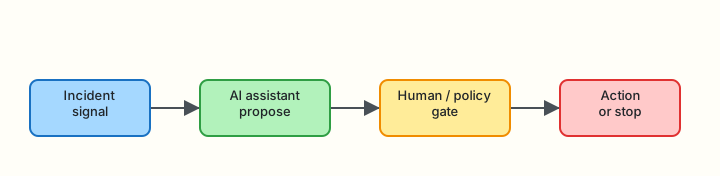
Incident signals feed an assistant that only proposes. A human or policy gate decides whether any action runs.
Theory
What it is
AI for DevOps is the practice of applying LLMs and related tooling to software delivery and operations: triage, documentation, CI feedback, and controlled automation. The unit of value is a safer, faster decision — not a longer chat transcript.
| Term | Plain meaning |
|---|---|
| LLM | Model that predicts text/tokens from prompts |
| Assistant | Software that calls a model and presents suggestions |
| Agent | Assistant that can call tools in a loop (still needs gates) |
| Human-in-the-loop | A person (or strict policy) must approve side effects |
| Guardrail | Code/policy that blocks secrets, mutations, or unsafe tools |
Interview one-liner: AI drafts the runbook step; the platform and the on-call engineer own the blast radius.
Why it matters
Teams adopt AI because:
- Incidents produce more text than humans can read quickly
- Junior engineers need structured next checks
- Tickets and pull requests benefit from clear summaries
Teams regret AI when:
- Models invent commands that look plausible
- Secrets leak into prompts and vendor logs
- Auto-execution runs
kubectl deletefrom a hallucinated name
How it works
A healthy loop looks like this:
- Signal — alert, log slice, ticket, or failing CI job
- Propose — model returns checks, labels, or a draft change
- Validate — policy, tests, or a human review the proposal
- Act — only allowlisted tools run; mutations need approval
- Audit — store who approved what, with redacted evidence
- Improve — golden tests catch prompt regressions (Module 4)
Key concepts and comparisons
| Approach | Goal | Typical risk |
|---|---|---|
| Scripted automation | Deterministic runbooks | Brittle; limited language understanding |
| AI for DevOps | Language + judgement assist | Hallucination; prompt injection |
| MLOps | Train/deploy/monitor ML products | Data pipelines, model drift |
| “Fully autonomous ops” | No human in loop | Unacceptable blast radius for most orgs |
| Action class | Examples | Default policy |
|---|---|---|
| Read-only | kubectl get, read logs, aws describe | Allow after allowlist |
| Approval-required | restart, scale, apply Terraform | Print APPROVAL_REQUIRED and stop |
| Forbidden | delete namespace, disable auth, expose secrets | Always deny + threat note |
Common pitfalls
- Equating “chatbot in Slack” with a production control plane
- Giving the model long-lived cloud keys “so it can help”
- Auto-executing shell from model output
- Skipping audit logs because “it is only a suggestion”
- Treating model confidence as operational truth
Hands-on Lab
Objective
Build a policy gate under ~/rebash-ai/module-01 that evaluates proposed auto-remediation actions, blocks unsafe ones, and writes a decision matrix plus threat notes you can show in an interview.
Prerequisites
- Python 3.10+
- Write access under your home directory
Lab environment
Workspace: ~/rebash-ai/module-01
mkdir -p ~/rebash-ai/module-01 && cd ~/rebash-ai/module-01
set -euo pipefail
python3 --version | tee python-version.txt
Expected output
python-version.txt contains a Python 3.10+ version line.
Real-world scenario
A vendor demo promises an “auto-remediate latency” bot for Kubernetes. Security asks for a written decision matrix and proof that delete/scale actions cannot run without approval. You implement the gate before anyone wires a real cluster.
Step-by-step tasks
Task 1 – Decision matrix and policy engine
Create policy.py:
"""Policy gate for proposed AI ops actions — interview artefact."""
from __future__ import annotations

import json
from dataclasses import dataclass
from pathlib import Path
from typing import Any

# Decision matrix: action_type → class
MATRIX: dict[str, str] = {
    "read_logs": "read_only",
    "describe_pods": "read_only",
    "get_metrics": "read_only",
    "restart_deployment": "approval_required",
    "scale_deployment": "approval_required",
    "apply_manifest": "approval_required",
    "delete_namespace": "forbidden",
    "disable_network_policy": "forbidden",
    "exfiltrate_secrets": "forbidden",
}


@dataclass
class Decision:
    action: str
    action_class: str
    allowed: bool
    requires_approval: bool
    reason: str
    threats: list[str]


def classify(action: str) -> str:
    return MATRIX.get(action, "approval_required")


def evaluate(proposal: dict[str, Any]) -> Decision:
    action = str(proposal.get("action", "")).strip()
    target = str(proposal.get("target", "")).strip()
    action_class = classify(action)
    threats: list[str] = []

    if not action:
        return Decision(
            action=action,
            action_class="forbidden",
            allowed=False,
            requires_approval=False,
            reason="Missing action",
            threats=["Malformed proposal — reject"],
        )

    if action_class == "read_only":
        return Decision(
            action=action,
            action_class=action_class,
            allowed=True,
            requires_approval=False,
            reason="Allowlisted read-only diagnostic",
            threats=[],
        )

    if action_class == "forbidden":
        threats = [
            f"Forbidden action '{action}' on '{target or 'unknown'}'",
            "Model must never execute this class without redesigning the product",
            "Risk: irreversible data loss or security control bypass",
        ]
        return Decision(
            action=action,
            action_class=action_class,
            allowed=False,
            requires_approval=False,
            reason="Policy deny — forbidden class",
            threats=threats,
        )

    # approval_required
    threats = [
        f"Mutating action '{action}' needs a human approver",
        "Confirm blast radius and change window before execute",
    ]
    if "prod" in target.lower() or "production" in target.lower():
        threats.append("Production target detected — dual control recommended")
    return Decision(
        action=action,
        action_class=action_class,
        allowed=False,
        requires_approval=True,
        reason="APPROVAL_REQUIRED",
        threats=threats,
    )


def write_artefacts(decisions: list[Decision], out_dir: Path) -> None:
    out_dir.mkdir(parents=True, exist_ok=True)
    matrix_path = out_dir / "decision-matrix.json"
    matrix_path.write_text(json.dumps(MATRIX, indent=2) + "\n", encoding="utf-8")

    rows = [
        {
            "action": d.action,
            "class": d.action_class,
            "allowed": d.allowed,
            "requires_approval": d.requires_approval,
            "reason": d.reason,
            "threats": d.threats,
        }
        for d in decisions
    ]
    (out_dir / "gate-results.json").write_text(
        json.dumps(rows, indent=2) + "\n", encoding="utf-8"
    )

    lines = ["# Threat notes — fake auto-remediate bot\n"]
    for d in decisions:
        if not d.threats and d.allowed:
            continue
        lines.append(f"## `{d.action}` ({d.action_class})\n")
        lines.append(f"- Decision: **{d.reason}**\n")
        for t in d.threats:
            lines.append(f"- {t}\n")
        lines.append("\n")
    (out_dir / "threat-notes.md").write_text("".join(lines), encoding="utf-8")
Create gate_cli.py:
"""CLI: evaluate AI-proposed ops actions against the policy matrix."""
from __future__ import annotations

import argparse
import json
import sys
from pathlib import Path

from policy import evaluate, write_artefacts


def main() -> int:
    parser = argparse.ArgumentParser(description="AI ops policy gate")
    parser.add_argument(
        "--proposals",
        type=Path,
        default=Path("proposals.json"),
        help="JSON list of {action, target, rationale}",
    )
    parser.add_argument(
        "--out",
        type=Path,
        default=Path("out"),
        help="Output directory for matrix and threat notes",
    )
    args = parser.parse_args()

    proposals = json.loads(args.proposals.read_text(encoding="utf-8"))
    if not isinstance(proposals, list):
        print("proposals.json must be a JSON list", file=sys.stderr)
        return 2

    decisions = [evaluate(p) for p in proposals]
    write_artefacts(decisions, args.out)

    blocked = sum(1 for d in decisions if not d.allowed)
    print(f"evaluated={len(decisions)} blocked_or_pending={blocked}")
    print(f"wrote {args.out}/decision-matrix.json")
    print(f"wrote {args.out}/gate-results.json")
    print(f"wrote {args.out}/threat-notes.md")

    # Non-zero if any forbidden slipped through as allowed (should never happen)
    if any(d.allowed and d.action_class == "forbidden" for d in decisions):
        return 3
    return 0


if __name__ == "__main__":
    raise SystemExit(main())
Create proposals.json:
[
  {
    "action": "read_logs",
    "target": "payments-api",
    "rationale": "Latency alert — inspect recent errors"
  },
  {
    "action": "restart_deployment",
    "target": "payments-api/prod",
    "rationale": "Vendor bot wants to bounce pods"
  },
  {
    "action": "delete_namespace",
    "target": "payments-api",
    "rationale": "Hallucinated cleanup step"
  },
  {
    "action": "scale_deployment",
    "target": "checkout/staging",
    "rationale": "Scale out for load test"
  }
]
cd ~/rebash-ai/module-01
python3 gate_cli.py --proposals proposals.json --out out
test -f out/decision-matrix.json
test -f out/threat-notes.md
grep -q 'delete_namespace' out/threat-notes.md
grep -q 'APPROVAL_REQUIRED' out/gate-results.json
Expected output
CLI prints evaluated=4 blocked_or_pending=3. threat-notes.md mentions delete_namespace. gate-results.json contains APPROVAL_REQUIRED for restart/scale.
Task 2 – Break and fix: unknown action defaults safely
Create proposals-break.json:
[
  {
    "action": "run_shell",
    "target": "bastion",
    "rationale": "Model invented a free-form shell tool"
  }
]
cd ~/rebash-ai/module-01
python3 gate_cli.py --proposals proposals-break.json --out out-break
python3 - <<'PY'
import json
from pathlib import Path
rows = json.loads(Path("out-break/gate-results.json").read_text())
assert rows[0]["requires_approval"] is True
assert rows[0]["allowed"] is False
print("unknown_action_defaults_to_approval_required=OK")
PY
Expected output
unknown_action_defaults_to_approval_required=OK
Unknown actions must not default to allow.
Task 3 – Interview evidence pack
cd ~/rebash-ai/module-01
python3 gate_cli.py --proposals proposals.json --out out
{
  echo "### Policy gate evidence"
  echo "- decision-matrix keys: $(python3 -c 'import json;print(len(json.load(open(\"out/decision-matrix.json\"))))')"
  echo "- forbidden blocked: $(grep -c delete_namespace out/threat-notes.md || true)"
  echo "- approval lines: $(grep -c APPROVAL_REQUIRED out/gate-results.json)"
} | tee evidence.txt
Expected output
evidence.txt summarises matrix size, forbidden block, and approval counts.
Validation steps
-
out/decision-matrix.jsonlists read-only, approval-required, and forbidden actions -
delete_namespaceis denied and appears inthreat-notes.md -
restart_deploymenton production requires approval and is not auto-allowed - Unknown actions default to approval-required, not allow
- You can explain the propose → gate → act loop without slides
Common errors and fixes
| Error | Cause | Fix |
|---|---|---|
ModuleNotFoundError: policy | Wrong directory | cd ~/rebash-ai/module-01 |
JSONDecodeError | Trailing comma in JSON | Validate with python3 -m json.tool |
| Forbidden action marked allowed | Matrix typo | Re-check MATRIX classes |
Challenge exercise
Extend MATRIX with cordon_node (approval-required) and revoke_iam_admin (forbidden). Add proposals and prove both outcomes in out/gate-results.json.
Learning outcomes
- You own a written decision matrix for AI-proposed ops actions
- You can show threat notes that security reviewers expect
- You practised fail-closed defaults for unknown tools
Cleanup
# Keep the lab if you want portfolio evidence; otherwise:
# rm -rf ~/rebash-ai/module-01
echo "Lab artefacts remain under ~/rebash-ai/module-01 unless you remove them"
Validation
- Lab path completed successfully
- Can explain AI for DevOps versus MLOps in one minute
- Can name three action classes and an example of each
- Can describe one production failure mode of auto-remediation
Code Walkthrough
- Inspect proposals as data — never trust free-form shell from a model.
- Classify before execute — matrix beats vibes.
- Fail closed — unknown action → approval, not allow.
- Write evidence — matrix + threat notes for audits and interviews.
- Separate propose from act — the gate has no cloud credentials on purpose.
Security Considerations
- Do not give LLMs long-lived production credentials
- Treat model output as untrusted input (prompt injection appears in Module 13)
- Log decisions; redact secrets from any stored prompt
- Prefer read-only diagnostics as the default tool set
- Require dual control for production mutations
Common Mistakes
Auto-execute because the demo looked good
Fix: Ship the policy gate first. Wire tools only after deny/allow tests pass.
Only documenting policy in a Confluence page
Fix: Encode the matrix in code and generate threat notes from real proposals.
Assuming AI for DevOps means training models
Fix: Separate MLOps (model lifecycle) from ops assistants (LLMs + gates).
Best Practices
- Start with read-only assistants; add mutations last
- Keep a written blast-radius story for every tool
- Prefer offline-first labs so CI never depends on a vendor
- Audit approvals with identity (who clicked approve)
- Rehearse the interview line: propose → validate → act → audit
Troubleshooting
| Symptom | Likely cause | Fix |
|---|---|---|
| All actions allowed | Matrix empty or wrong file loaded | Print MATRIX keys in CLI |
| Threat notes empty | Only read-only proposals | Include forbidden/mutate samples |
| Import errors in CI | Relative imports | Run from module-01 directory |
Summary
AI for DevOps is assisted operations with accountability: models propose, policy and humans decide. Your lab artefact — decision matrix, gate results, and threat notes — is the foundation for every later module.
Next: LLM and API Fundamentals.
Interview Questions
1. What is AI for DevOps, in one sentence?
Reveal answer
Using LLMs and related tools to assist delivery and operations — summarise, suggest checks, draft changes — while humans and policy remain accountable for side effects.
2. How does AI for DevOps differ from MLOps?
Reveal answer
MLOps focuses on training, deploying, and monitoring machine-learning products. AI for DevOps focuses on using models as assistants inside DevOps workflows (triage, CI, runbooks), usually without training a custom model.
3. Why should an auto-remediate bot not hold long-lived cloud admin keys?
Reveal answer
Hallucinations and prompt injection can turn a helpful bot into a high-privilege attacker. Prefer short-lived credentials, least privilege, and human approval for mutations.
4. What are the three action classes in a sensible ops policy matrix?
Reveal answer
Read-only (allow after allowlist), approval-required (mutations), and forbidden (never auto-run — for example delete namespace or disable security controls).
5. A vendor says their agent is “fully autonomous”. What do you ask next?
Reveal answer
Ask what tools it can call, how approvals work, how secrets are handled, how actions are audited, and what happens on hallucination. Demand a deny-by-default demo.
6. Why default unknown actions to approval-required instead of allow?
Reveal answer
Models invent tool names. Fail-closed defaults prevent a novel run_shell action from executing before security review.
7. Where does the human sit in the propose → validate → act loop?
Reveal answer
At the validate/gate step for anything with blast radius. Read-only diagnostics may be automated; production mutations need an explicit approver (or equivalent dual control).
Related Tutorials
- Course: AI for DevOps Overview
- Next: LLM and API Fundamentals
- Related: Python — OpenAI, MCP, and LangChain