Retrieval-Augmented Generation for Ops
Overview
Large Language Models (LLMs) invent confident nonsense when they lack your runbooks. Retrieval-Augmented Generation (RAG) fixes the usual failure mode: retrieve relevant chunks first, then ask the model to answer only from that evidence — and cite the source paths.
Plain problem: A chat bot says “delete /var/lib/docker” with no citation. A RAG assistant must show which runbook chunk justified each step — or refuse.
This lab wires Module 5–6 retrieval to a mock LLM, enforces citations, then breaks grounding on purpose and fixes it.
This is Tutorial 7 in Module 7: RAG of the REBASH Academy AI for DevOps Engineers series — practical AI for Cloud and DevOps work.
Prerequisites
- Vector Stores for Ops
- Embeddings and Semantic Search
- Python 3.10+ (stdlib only)
Learning Objectives
By the end of this tutorial, you will be able to:
- Describe the retrieve → prompt → generate → cite loop
- Build a RAG CLI that answers from SQLite chunks with source paths
- Detect ungrounded answers when citations are removed
- Explain when RAG beats fine-tuning for runbook knowledge
- Defend citation checks as a production guardrail in interview
Architecture
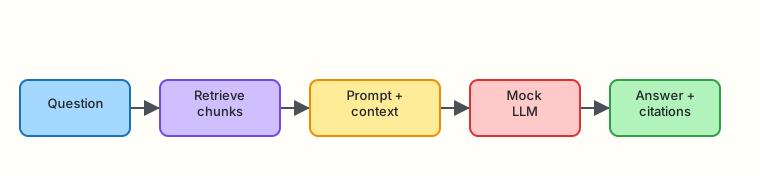
Question → retrieve chunks → prompt with context → mock LLM → answer with citations.
Theory
What it is
RAG combines:
- Retrieval — find relevant chunks (vector store)
- Augmentation — put chunks into the prompt
- Generation — model drafts an answer grounded in those chunks
Citations link answer claims back to path / chunk IDs so humans can verify.
Why it matters
Runbooks change weekly. Fine-tuning a model on last quarter’s wiki is expensive and stale. RAG keeps knowledge in documents you already own and updates by re-indexing.
How it works
Guardrails:
- If retrieval returns nothing, refuse (“no runbook evidence”).
- Require the answer to list source paths that appeared in context.
- Never execute remediation from the model — propose only (Module 1).
Key concepts and comparisons
| Approach | Best for | Cost of updates |
|---|---|---|
| RAG over runbooks | Changing ops knowledge | Re-index docs |
| Fine-tuning | Stable style/format behaviour | Retrain |
| Long context dump | Tiny corpora | Token cost, noise |
| Pure chat (no retrieval) | Brainstorming only | Hallucination risk |
Common pitfalls
- Retrieving chunks but not putting them in the prompt
- Accepting answers with missing or invented citations
- Stuffing 50 chunks into context (noise)
- Skipping refusal when retrieval is empty
Hands-on Lab
Objective
Build a RAG CLI under ~/rebash-ai/module-07 that answers disk incidents from indexed runbooks with citations, then prove that removing context breaks the citation check.
Prerequisites
- Python 3.10+
- Concepts from Modules 5–6
Lab environment
Workspace: ~/rebash-ai/module-07
mkdir -p ~/rebash-ai/module-07/runbooks && cd ~/rebash-ai/module-07
python3 --version | tee python-version.txt
Expected output
Python 3.10+ in python-version.txt.
Real-world scenario
Your incident bot must never invent cleanup steps. Security wants every suggestion tied to a runbook path. You ship RAG with a citation gate before any Slack integration.
Step-by-step tasks
Task 1 – Corpus, embedder, and store
Create runbooks/disk-capacity.md:
# Disk capacity

## Quick checks
When the alert says disk full or no space left, run df -h and df -i.

## Safe cleanup
Rotate application logs under /var/log with change approval. Do not delete database directories.
Create runbooks/inode-exhaustion.md:
# Inode exhaustion

## Symptoms
Cannot create new files even when df -h shows free bytes.

## Diagnosis
Use df -i and locate directories with huge file counts.
Create runbooks/ssh-bastion.md:
# SSH bastion

Use short-lived certificates. Never paste private keys into assistants.
Create embedder.py:
"""Deterministic hashing embeddings — stdlib only."""
from __future__ import annotations

import hashlib
import math
import re

DIM = 128
TOKEN_RE = re.compile(r"[a-z0-9]+", re.IGNORECASE)


def tokenize(text: str) -> list[str]:
    return TOKEN_RE.findall(text.lower())


def embed(text: str, dim: int = DIM) -> list[float]:
    vec = [0.0] * dim
    tokens = tokenize(text)
    if not tokens:
        return vec
    for tok in tokens:
        h = hashlib.sha256(tok.encode("utf-8")).digest()
        idx = int.from_bytes(h[:4], "big") % dim
        sign = 1.0 if h[4] % 2 == 0 else -1.0
        vec[idx] += sign
    norm = math.sqrt(sum(v * v for v in vec))
    if norm == 0:
        return vec
    return [v / norm for v in vec]


def cosine(a: list[float], b: list[float]) -> float:
    return sum(x * y for x, y in zip(a, b))
Create store.py:
"""Minimal SQLite chunk store for RAG."""
from __future__ import annotations

import json
import sqlite3
from pathlib import Path

from embedder import cosine, embed

SCHEMA = """
CREATE TABLE IF NOT EXISTS chunks (
  id TEXT PRIMARY KEY,
  path TEXT NOT NULL,
  text TEXT NOT NULL,
  vector_json TEXT NOT NULL
);
"""


def connect(db_path: Path) -> sqlite3.Connection:
    conn = sqlite3.connect(db_path)
    conn.execute(SCHEMA)
    return conn


def chunk_markdown(path: Path, text: str) -> list[tuple[str, str]]:
    parts: list[str] = []
    current: list[str] = []
    for line in text.splitlines():
        if line.startswith("## ") and current:
            parts.append("\n".join(current).strip())
            current = [line]
        else:
            current.append(line)
    if current:
        parts.append("\n".join(current).strip())
    out: list[tuple[str, str]] = []
    for i, part in enumerate(parts):
        if part:
            out.append((f"{path.name}#{i}", part))
    return out


def index_runbooks(conn: sqlite3.Connection, root: Path) -> int:
    conn.execute("DELETE FROM chunks")
    n = 0
    for path in sorted(root.glob("*.md")):
        for chunk_id, chunk_text in chunk_markdown(path, path.read_text(encoding="utf-8")):
            conn.execute(
                "INSERT INTO chunks (id, path, text, vector_json) VALUES (?, ?, ?, ?)",
                (chunk_id, str(path), chunk_text, json.dumps(embed(chunk_text))),
            )
            n += 1
    conn.commit()
    return n


def retrieve(conn: sqlite3.Connection, question: str, k: int = 3) -> list[dict]:
    qv = embed(question)
    rows = conn.execute("SELECT id, path, text, vector_json FROM chunks").fetchall()
    scored = []
    for chunk_id, path, text, vector_json in rows:
        score = cosine(qv, json.loads(vector_json))
        scored.append({"id": chunk_id, "path": path, "score": round(score, 4), "text": text})
    scored.sort(key=lambda r: r["score"], reverse=True)
    return scored[:k]
cd ~/rebash-ai/module-07
python3 - <<'PY'
from pathlib import Path
from store import connect, index_runbooks
conn = connect(Path("runbooks.db"))
n = index_runbooks(conn, Path("runbooks"))
print(f"indexed_chunks={n}")
assert n >= 3
conn.close()
PY
Expected output
indexed_chunks is at least 3.
Task 2 – Mock LLM RAG with citation gate
Create mock_llm.py:
"""Mock LLM that only restates retrieved ops evidence."""
from __future__ import annotations


def complete(prompt: str) -> str:
    """Produce a short answer. Citations must be added by the RAG host."""
    lower = prompt.lower()
    steps: list[str] = []
    if "df -h" in lower or "disk full" in lower or "no space" in lower:
        steps.append("Check filesystem capacity with df -h and inodes with df -i.")
    if "inode" in lower:
        steps.append("If bytes are free but creates fail, investigate inode exhaustion.")
    if "/var/log" in lower or "rotate" in lower:
        steps.append("Rotate application logs under /var/log only with approval.")
    if not steps:
        steps.append("No specific remediation found in the provided context.")
    steps.append("Do not delete database directories without explicit human approval.")
    return " ".join(steps)
Create rag_cli.py:
"""RAG CLI with mandatory citations from retrieved paths."""
from __future__ import annotations

import argparse
import json
import sys
from pathlib import Path

from mock_llm import complete
from store import connect, index_runbooks, retrieve


def build_prompt(question: str, chunks: list[dict], include_context: bool) -> str:
    lines = [
        "You are a DevOps assistant. Use ONLY the context. Suggest read-only checks first.",
        f"Question: {question}",
    ]
    if include_context and chunks:
        lines.append("Context:")
        for c in chunks:
            lines.append(f"- source: {c['path']}\n  text: {c['text']}")
    elif include_context:
        lines.append("Context: (empty)")
    return "\n".join(lines)


def citation_check(answer: str, chunks: list[dict]) -> tuple[bool, list[str]]:
    paths = sorted({c["path"] for c in chunks})
    cited = [p for p in paths if p in answer]
    return (bool(paths) and len(cited) == len(paths), cited)


def main() -> int:
    parser = argparse.ArgumentParser(description="Ops RAG with citations")
    parser.add_argument("--question", required=True)
    parser.add_argument("--db", type=Path, default=Path("runbooks.db"))
    parser.add_argument("--runbooks", type=Path, default=Path("runbooks"))
    parser.add_argument("--k", type=int, default=3)
    parser.add_argument("--reindex", action="store_true")
    parser.add_argument("--no-context", action="store_true", help="Break grounding on purpose")
    parser.add_argument("--out", type=Path, default=Path("rag-answer.json"))
    args = parser.parse_args()

    conn = connect(args.db)
    if args.reindex or not args.db.exists():
        index_runbooks(conn, args.runbooks)

    chunks = [] if args.no_context else retrieve(conn, args.question, k=args.k)
    conn.close()

    if not args.no_context and not chunks:
        payload = {
            "ok": False,
            "error": "no_runbook_evidence",
            "answer": "",
            "sources": [],
        }
        args.out.write_text(json.dumps(payload, indent=2) + "\n", encoding="utf-8")
        print("RAG_REFUSE: no_runbook_evidence")
        return 2

    prompt = build_prompt(args.question, chunks, include_context=not args.no_context)
    answer_body = complete(prompt)

    sources = sorted({c["path"] for c in chunks})
    if args.no_context:
        # Deliberately ungrounded: model-ish text without sources
        answer = answer_body
        ok = False
        cited: list[str] = []
    else:
        # Host attaches citations — production pattern: tool/host owns provenance
        cite_lines = "Sources:\n" + "\n".join(f"- {p}" for p in sources)
        answer = f"{answer_body}\n\n{cite_lines}"
        ok, cited = citation_check(answer, chunks)

    payload = {
        "ok": ok,
        "question": args.question,
        "answer": answer,
        "sources": sources,
        "cited": cited,
        "ungrounded": bool(args.no_context) or not ok,
        "retrieved": [{"id": c["id"], "path": c["path"], "score": c["score"]} for c in chunks],
    }
    args.out.write_text(json.dumps(payload, indent=2) + "\n", encoding="utf-8")
    print(answer)
    print(f"citation_ok={ok}")
    return 0 if ok else 1


if __name__ == "__main__":
    raise SystemExit(main())
cd ~/rebash-ai/module-07
python3 rag_cli.py --reindex --question "disk full no space left on device" --out rag-ok.json
python3 - <<'PY'
import json
from pathlib import Path
p = json.loads(Path("rag-ok.json").read_text())
assert p["ok"] is True
assert p["sources"]
assert "df" in p["answer"].lower()
assert all(s in p["answer"] for s in p["sources"])
print("rag_grounded=OK")
PY
Expected output
Answer mentions df checks, lists Sources: paths, citation_ok=True, prints rag_grounded=OK.
Task 3 – Break citations, then fix
cd ~/rebash-ai/module-07
python3 rag_cli.py --question "disk full" --no-context --out rag-broken.json; broken_rc=$?
python3 - <<'PY'
import json
from pathlib import Path
p = json.loads(Path("rag-broken.json").read_text())
assert p["ungrounded"] is True
assert p["ok"] is False
print("ungrounded_detected=OK")
PY
# Fix: run with context again
python3 rag_cli.py --question "disk full" --out rag-fixed.json
python3 - <<'PY'
import json
from pathlib import Path
p = json.loads(Path("rag-fixed.json").read_text())
assert p["ok"] is True and p["ungrounded"] is False
print("rag_fixed=OK")
PY
Expected output
--no-context yields ungrounded_detected=OK and non-zero citation status. Normal run prints rag_fixed=OK.
Validation steps
- Index contains runbook chunks
- Grounded answer includes every retrieved source path
-
--no-contextis marked ungrounded / fails citation gate - You can explain RAG versus fine-tuning for runbooks
Common errors and fixes
| Error | Cause | Fix |
|---|---|---|
no_runbook_evidence | Empty DB | Pass --reindex |
citation_ok=False with context | Sources not appended | Ensure host adds Sources: block |
| SSH runbook cited for disk | Weak retrieval | Check index contents; tighten query |
Challenge exercise
Add a golden question file with three questions and expected source path substrings (disk-capacity or inode). Write eval_rag.py that fails if citations miss.
Learning outcomes
- You connected retrieval to generation with provenance
- You proved a citation gate catches ungrounded answers
- You have JSON artefacts for interview storytelling
Cleanup
Validation
- Lab break/fix cycle passed
- Can draw retrieve → augment → generate on a whiteboard
- Can argue RAG over fine-tuning for changing runbooks
- Know to refuse when retrieval is empty
Code Walkthrough
- Retrieve before generate — never prompt without a plan for evidence.
- Host-owned citations — do not trust the model to invent paths.
- Fail closed on empty retrieval.
- JSON evidence for every answer.
- Propose-only remediation language.
Security Considerations
- Retrieved text may contain sensitive hostnames — control access
- Prompt injection can hide inside runbooks (Module 13)
- Citation forge attempts: only accept paths from the retrieved set
- Do not auto-run shell from RAG answers
- Redact secrets before indexing
Common Mistakes
Letting the model invent source filenames
Fix: Attach citations in your code from the retrieval result set only.
Calling it RAG when you only stuff a random wiki page into the prompt
Fix: Rank chunks per question; measure retrieval with golden queries.
Best Practices
- Keep top-k small (2–5) for ops answers
- Show sources in the UI next to the answer
- Re-index on runbook merge to main
- Combine with Module 4 evals for answer quality
- Refuse clearly when evidence is missing
Troubleshooting
| Symptom | Likely cause | Fix |
|---|---|---|
| Always ungrounded | Always passing --no-context | Omit the flag |
| Wrong runbook cited | Retrieval quality | Improve chunks/titles; add synonyms |
| Empty sources list | Index empty | --reindex |
Summary
RAG makes ops answers checkable: retrieve, generate, cite. Your citation gate is the difference between a helpful assistant and a confident liability.
Next: Tool Calling and Function APIs.
Interview Questions
1. What is RAG in one sentence?
Reveal answer
Retrieve relevant documents, put them into the prompt, and generate an answer grounded in that evidence — ideally with citations.
2. Why is RAG often better than fine-tuning for runbooks?
Reveal answer
Runbooks change frequently. Re-indexing documents is cheaper and fresher than retraining a model every time a procedure updates.
3. What should happen when retrieval returns zero chunks?
Reveal answer
Refuse or ask for clarification — do not let the model answer from parametric memory as if it had evidence.
4. Who should attach citations — the model or the host application?
Reveal answer
Prefer the host: take paths from the retrieved set and attach them. Models may hallucinate filenames.
5. How do you detect an ungrounded answer in a pipeline?
Reveal answer
Fail the job if required source paths are missing from the answer, or if retrieval was empty / skipped.
6. What is a typical top-k for ops RAG and why not 50?
Reveal answer
Small k (about 2–5) keeps context focused. Too many chunks add noise, cost, and conflicting instructions.
7. How does RAG relate to the Module 1 policy gate?
Reveal answer
RAG improves what the assistant proposes; the policy gate still decides whether any mutating action may run. Citations do not equal approval to execute.
8. Name one RAG failure mode besides hallucination.
Reveal answer
Retrieval failure: the right runbook exists but ranking never surfaces it, so the answer is incomplete even if the model is careful.
Related Tutorials
- Previous: Vector Stores for Ops
- Course: AI for DevOps Overview
- Next: Tool Calling and Function APIs