Production GCP Landing Zones
Overview
A landing zone is the opinionated starting foundation for workloads: how projects are organised, how networks are shared, how identities and guardrails work, and how logs/billing flow. Without one, every team invents a snowflake project and security becomes archaeology.
This is Tutorial 1 in Module 15: Production GCP of the REBASH Academy Google Cloud for Cloud & DevOps Engineers series — the course capstone sketch. Personal Free Trial accounts often lack an organisation; the lab still produces architecture artefacts, inventories what you can see, and a runbook you can defend in interviews.
Org admin required for some APIs
Creating folders or org policies needs Organisation Administrator (or equivalent). If you only have a personal project, complete the sketch + inventory + runbook path — do not invent fake org IDs.
Prerequisites
- Cost Optimisation
- IAM
- VPC Networking
- Comfortable writing Markdown architecture notes in an editor
Learning Objectives
By the end of this tutorial, you will be able to:
- Explain organisation → folder → project → resources
- Sketch a Shared VPC host/service project layout
- List org policies you would enforce on day one
- Produce an ops runbook for a new environment
- Inventory your real Resource Manager view with
gcloud
Architecture
Company organisation roots Resource Manager. Folders group environments or business units. Projects host workloads. A host project holds Shared VPC; service projects attach. Org policies and logging sinks apply guardrails centrally. Billing rolls to one or more billing accounts.
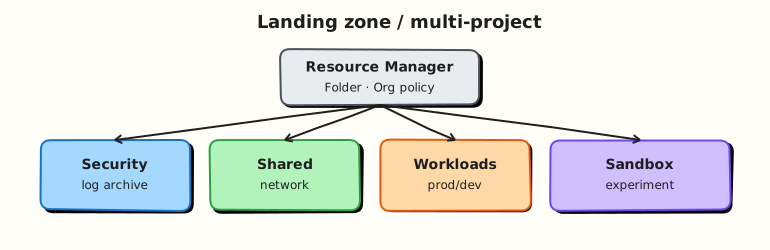
Theory
What it is
A landing zone is not a single product SKU. It is a pattern (often implemented with Terraform) covering resource hierarchy, network, identity, security guardrails, logging, and billing.
Why it matters
Architect interviews ask: “How would you set up Google Cloud for a company with three teams?” If you only answer “make three projects”, you miss Shared VPC, org policies, and log aggregation.
How it works
- Establish organisation (Cloud Identity / Workspace).
- Create folders (
prod,nonprod,sandboxor per-business-unit). - Create projects with labels and liaison owners.
- Deploy host networking (Shared VPC) and attach service projects.
- Enforce org policies (public IP, public buckets, location constraints).
- Centralise log sinks and security findings.
- Bootstrap via IaC (Module 12 patterns at scale).
Shared VPC (sketch)
| Project | Role |
|---|---|
net-host | Subnets, firewalls, NAT, interconnect |
app-prod | Workloads attached to host subnets |
app-dev | Separate attachment / quotas |
Day-one org policies (examples)
- Enforce Public Access Prevention on Cloud Storage
- Restrict Cloud SQL public IP
- Restrict resource locations (data residency)
- Disable service account key creation (prefer WIF)
Common pitfalls
- One shared “prod” project for every team
- Shared VPC without clear host ownership
- Org policies so tight nothing can deploy (no break-glass)
- No billing export / no log sink
Hands-on Lab
Objective
Inventory your Resource Manager reality, write a landing-zone architecture sketch and org-policy wishlist, produce an environment runbook, and optionally create a folder if your account allows it.
Prerequisites
| Tool | Notes |
|---|---|
gcloud | Authenticated |
| Editor | For Markdown artefacts |
| Optional | Organisation Admin for folder create |
Lab environment
mkdir -p ~/rebash-gcp/module-15 && cd ~/rebash-gcp/module-15
export PROJECT_ID="${PROJECT_ID:-$(gcloud config get-value project)}"
gcloud config set project "$PROJECT_ID"
Real-world scenario
A startup just won funding. Leadership asks for a one-page landing zone: hierarchy, network, guardrails, and “how we operate Monday morning”. You deliver artefacts even if the org is not fully online yet.
Step-by-step tasks
Task 1 – Inventory what exists
cd ~/rebash-gcp/module-15
gcloud projects describe "$PROJECT_ID" --format=json | tee project.json
gcloud organizations list --format=json 2>/dev/null | tee orgs.json || printf '[]\n' | tee orgs.json
ORG_ID=$(python3 -c "import json; d=json.load(open('orgs.json')); print((d[0].get('name','').split('/')[-1] if d else ''))")
if [[ -n "$ORG_ID" ]]; then
  gcloud resource-manager folders list --organization="$ORG_ID" --format=json 2>/dev/null | tee folders.json || printf '[]\n' | tee folders.json
else
  printf '[]\n' | tee folders.json
fi
gcloud projects get-ancestors "$PROJECT_ID" --format=json 2>/dev/null | tee ancestors.json || true
test -s project.json
Expected output
project.json populated. orgs.json may be [] on personal accounts — that is acceptable.
Task 2 – Optional folder create
cd ~/rebash-gcp/module-15
ORG_ID=$(python3 -c "import json; d=json.load(open('orgs.json')); print((d[0].get('name','').split('/')[-1] if d else ''))")
if [[ -n "${ORG_ID}" ]]; then
  gcloud resource-manager folders create \
    --display-name="rebash-m15-lab" \
    --organization="$ORG_ID" \
    --format=json 2>&1 | tee folder-create.json || \
    printf '%s\n' '{"fallback":"folder-create-denied"}' | tee folder-create.json
else
  printf '%s\n' '{"fallback":"no-organization-on-this-account"}' | tee folder-create.json
fi
Task 3 – Architecture sketch + policy wishlist
Create these files in your editor (no heredocs):
landing-zone.md — include:
- Hierarchy diagram in text (org → folders → projects)
- Host vs service projects for Shared VPC
- Where Cloud Run / GKE land
- Central log sink destination (BigQuery or Cloud Storage)
- Billing account note
org-policies.md — at least five constraints you would enable, each with one sentence “why”.
cd ~/rebash-gcp/module-15
test -s landing-zone.md
test -s org-policies.md
wc -l landing-zone.md org-policies.md | tee sketch-proof.txt
Task 4 – Ops runbook (capstone artefact)
Create runbook-new-env.md covering:
- Request path for a new project
- Required labels
- Network attachment steps (Shared VPC)
- Budget creation
- Break-glass Owner access
- First deploy checklist (CI → AR → Run/GKE)
- Cleanup / decommission steps
cd ~/rebash-gcp/module-15
test -s runbook-new-env.md
# Break/fix thinking: intentionally omit budget in a draft, then add it
grep -qi budget runbook-new-env.md
echo "landing zone artefacts OK" | tee evidence.txt
Validation steps
- Inventory JSON captured
-
landing-zone.md,org-policies.md,runbook-new-env.mdexist - Runbook mentions budget and decommission
- Folder created or fallback documented
Common errors and fixes
| Error you see | Plain meaning | What to do |
|---|---|---|
ORGANIZATION_INVALID | No org | Use fallback path; artefacts still count |
| Folder permission denied | Not org admin | Document blocker in folder-create.json |
| Python missing | Rare on lab laptops | Install Python 3 or parse orgs.json manually |
Challenge exercise
Add shared-vpc-faq.txt with answers to: Who owns firewall rules? Who can create subnets? How do service projects get compute.networkUser?
Learning outcomes
- You can draw a Google Cloud landing zone without ClickOps mythology
- You separated “my Free Trial project” from “company foundation”
- You have portfolio artefacts for architect interviews
Cleanup
cd ~/rebash-gcp/module-15
# Delete lab folder if you created one and are allowed:
# FOLDER_ID=... ; gcloud resource-manager folders delete "$FOLDER_ID" --quiet
rm -f project.json orgs.json folders.json ancestors.json folder-create.json \
  sketch-proof.txt evidence.txt
# Keep landing-zone.md org-policies.md runbook-new-env.md shared-vpc-faq.txt
Validation
- Lab folder
~/rebash-gcp/module-15used - Three Markdown artefacts ready to discuss aloud
- No fake org IDs claimed as real
Code Walkthrough
- Inventory first — design against reality.
- Optional folder — only when org admin exists.
- Sketch files — architecture is a deliverable.
- Runbook — operations closes the loop.
- Keep artefacts — portfolio > deleting Markdown.
Security Considerations
- Org policies without monitoring become tribal knowledge — document exceptions.
- Host project IAM is high value — treat like production network gear.
- Break-glass accounts need logging and time limits.
Common Mistakes
Landing zone = one big Shared VPC for the universe
Segment environments. Blast radius matters.
Org policy will fix culture
Policies enforce baselines; teams still need paved roads (IaC modules, CI templates).
Folders are optional cosmetics
At company scale they are how you delegate admin and apply policy inheritance.
Best Practices
- IaC for hierarchy and network
- Separate billing visibility per environment
- Central security + decentralised app deploy
- Explicit network ownership
- Regular landing-zone reviews (new services, new constraints)
Troubleshooting
| Symptom | Likely cause | Fix |
|---|---|---|
| Service project cannot use subnet | Missing networkUser | Grant on host subnet/project |
| Policy blocks Cloud Build | Constraint too broad | Scoped exception / alternate pipeline |
| Ancestors empty | Personal account | Expected — note in sketch |
Summary
Landing zones turn Google Cloud from a pile of projects into a governed platform: hierarchy, Shared VPC sketch, org policies, logging, billing, and runbooks. Next: troubleshooting — the triage skills that keep the platform alive.
Interview Questions
1. What is a landing zone?
Reveal answer
A foundational cloud setup — resource hierarchy, network, identity, security guardrails, logging, and billing — that teams build workloads on top of consistently.
2. Why use folders?
Reveal answer
Folders group projects for delegation and policy inheritance (for example non-prod vs prod), so you do not manage every project as a one-off.
3. What is Shared VPC?
Reveal answer
A model where a host project owns the VPC/subnets and service projects attach workloads to those subnets, centralising network control.
4. Name two org policies you would enable early.
Reveal answer
Examples: enforce Public Access Prevention on Cloud Storage; restrict public IPs on Cloud SQL; restrict resource locations; disable service account key creation.
5. Who should own the host project?
Reveal answer
Typically a platform/network team with clear change control — not every application squad as Owner.
6. How does billing relate to the hierarchy?
Reveal answer
Projects link to billing accounts. Hierarchy helps attribution with labels and folder structure, but bills still need exports and budgets to be actionable.
7. What belongs in an environment runbook?
Reveal answer
How to request projects, required labels, network attach steps, budgets, break-glass, first deploy path, and decommission — operational steps, not only diagrams.
8. Can you build a landing zone on a personal Free Trial?
Reveal answer
You can practise patterns and artefacts. Full org folders/policies need an organisation. Interviewers accept that distinction if your sketch is solid.
Related Tutorials
- Previous: Cost Optimisation on Google Cloud
- Next: Troubleshooting Google Cloud
- IaC on Google Cloud
- Parallel: AWS landing zones