Pipeline Syntax (.gitlab-ci.yml)
Overview
Write clear .gitlab-ci.yml using variables, workflow and job rules, and understand needs vs dependencies for ordering and artefact flow.
GitLab reads .gitlab-ci.yml (or an alternate CI config path) to define pipelines. Prefer rules over legacy only / except. Use workflow:rules to decide whether a pipeline is created at all. Use needs for DAG edges; use dependencies to control which job artefacts download.
This is a core tutorial in Module 4 · Pipeline Syntax of the REBASH Academy GitLab CI/CD for Cloud & DevOps Engineers series — written for Cloud, DevOps, Platform, and SRE engineers.
Prerequisites
Learning Objectives
By the end of this tutorial, you will be able to:
- Structure stages, default, variables, and jobs
- Prefer
rulesoveronly/except - Control pipeline creation with
workflow - Contrast
needs(ordering) withdependencies(artefacts)
Architecture
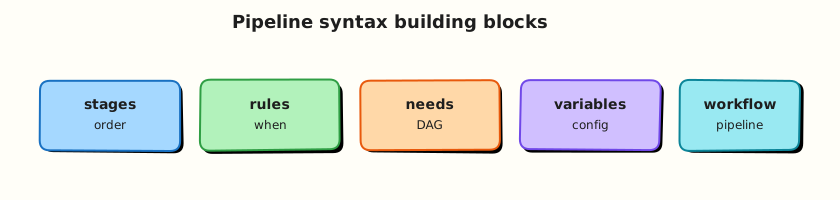
This topic’s control points and relationships are shown below.
Theory
What it is
Top-level keys commonly include stages, default, variables, workflow, include, and job names. A job needs at least a script (or trigger / trigger:include patterns covered later). Predefined variables such as $CI_COMMIT_SHA, $CI_PIPELINE_SOURCE, and $CI_DEFAULT_BRANCH are injected by GitLab — prefer them over hard-coded branch names where possible.
| Keyword | Role |
|---|---|
variables | Pipeline or job env (plus UI/group vars) |
rules | When a job is added to the pipeline |
workflow:rules | Whether any pipeline is created |
needs | Start job early; optional artefact download |
dependencies | Which prior jobs’ artefacts to fetch (stage model) |
Why it matters
Ambiguous YAML creates ghost pipelines (double branch + MR pipelines), skipped deploy jobs, or jobs that download every artefact and waste minutes. Precise rules and lean dependencies cut cost and confusion. Reviewers can reason about production risk from the YAML alone.
How it works
- GitLab loads YAML (and includes).
workflow:rulesdecide if this event creates a pipeline.- For each job,
rulesdecide inclusion; variables expand. - Default graph: all jobs in a stage finish before the next stage starts.
needscan start a job as soon as listed jobs finish (DAG), optionally withartifacts: true/false.- Without
dependencies, jobs may download all artefacts from previous stages; setdependencies: []or an explicit list to stay lean.
Migrate away from only / except — they still work but compose poorly with complex sources.
Key concepts and comparisons
| Approach | Prefer when |
|---|---|
| Stage ordering only | Simple linear build → test → deploy |
needs DAG | Long pipelines; parallel fans; skip empty stages |
dependencies | Control artefact download under stage ordering |
| Legacy | Modern |
|---|---|
only: [main] | rules: [{ if: $CI_COMMIT_BRANCH == $CI_DEFAULT_BRANCH }] |
except: [schedules] | rules with when: never for that source |
Common pitfalls
- Combining
onlyandruleson the same job — pick one model (rules). - Forgetting
workflowand paying for duplicate MR + branch pipelines. - Using
needsbut still assuming stage barriers apply the same way. - Putting secrets in YAML
variables:— use masked/protected UI vars or OIDC (Module 6).
Hands-on Lab
Objective
Author a rich .gitlab-ci.yml demonstrating workflow, rules, variables, and an artefacts stub — then validate structure offline and simulate job output locally.
Prerequisites
- Python 3 with PyYAML (
pip install pyyaml) - Optional: GitLab project to observe pipeline source variables in job logs
Lab environment
Workspace: ~/rebash-gitlab/module-04
File-first lab. Push to GitLab only when you want to inspect $CI_* values on a runner.
Real-world scenario
Reviewers rejected your team's pipeline because feature branches triggered deploy jobs and secrets appeared in YAML. You rewrite the file with explicit workflow:rules, per-job rules, non-secret variables, and a lint artefact passed to test via needs.
Step-by-step tasks
Task 1 – Create the application
Create src/app.py:
Run locally:
cd ~/rebash-gitlab/module-04
python3 src/app.py | tee app-name.txt
grep -q 'rebash-syntax-lab' app-name.txt
Expected output
app-name.txt contains rebash-syntax-lab.
Task 2 – Author the full pipeline syntax file
Create .gitlab-ci.yml:
workflow:
  rules:
    - if: $CI_PIPELINE_SOURCE == "merge_request_event"
    - if: $CI_COMMIT_BRANCH == $CI_DEFAULT_BRANCH

variables:
  APP_NAME: rebash-syntax-lab
  PYTHON_IMAGE: python:3.12-alpine
  LINT_REPORT: lint-report.txt

stages:
  - lint
  - test

lint:
  stage: lint
  image: $PYTHON_IMAGE
  rules:
    - if: $CI_PIPELINE_SOURCE == "merge_request_event"
    - if: $CI_COMMIT_BRANCH == $CI_DEFAULT_BRANCH
  script:
    - python -m py_compile src/app.py
    - echo "lint ok for $APP_NAME" > "$LINT_REPORT"
  artifacts:
    paths:
      - lint-report.txt
    expire_in: 1 day

test:
  stage: test
  image: $PYTHON_IMAGE
  needs:
    - job: lint
      artifacts: true
  rules:
    - if: $CI_PIPELINE_SOURCE == "merge_request_event"
    - if: $CI_COMMIT_BRANCH == $CI_DEFAULT_BRANCH
  script:
    - test -f lint-report.txt
    - python src/app.py
Validate offline:
cd ~/rebash-gitlab/module-04
python3 -c "
import yaml
d = yaml.safe_load(open('.gitlab-ci.yml'))
assert d['variables']['APP_NAME'] == 'rebash-syntax-lab'
assert d['lint']['artifacts']['paths'] == ['lint-report.txt']
assert d['test']['needs'][0]['artifacts'] is True
print('OK syntax lab')
"
Expected output
Prints OK syntax lab.
Task 3 – Simulate lint artefact and test locally
Reproduce the artefact hand-off without a runner:
cd ~/rebash-gitlab/module-04
python3 -m py_compile src/app.py
echo "lint ok for rebash-syntax-lab" > lint-report.txt
test -f lint-report.txt
python3 src/app.py | tee test-out.txt
grep -q 'rebash-syntax-lab' test-out.txt
Expected output
lint-report.txt exists; test-out.txt contains rebash-syntax-lab.
Validation steps
-
workflow:ruleslimits pipelines to MRs and default branch - Non-secret config lives under top-level
variables -
lintpublisheslint-report.txtas an artefact -
testusesneedswithartifacts: true - Local simulation creates and consumes the lint report
Common errors and fixes
| Error | Cause | Fix |
|---|---|---|
| Duplicate MR + branch pipelines | Missing workflow:rules | Add explicit workflow rules before stages |
test cannot find artefact | needs missing artifacts: true | Add artifacts: true under the lint need entry |
Variable not expanded in image: | Wrong key scope | Use $PYTHON_IMAGE at job level or default: |
| Deploy job on feature branch | Over-broad rules: - when: always | Restrict deploy jobs to protected refs |
Challenge exercise
Add interruptible: true to lint and test so newer pipeline runs cancel outdated MR jobs. Re-validate YAML.
Learning outcomes
- Combined
workflow, jobrules, andvariablesin one reviewable file - Passed artefacts between jobs with
needsand explicit artefact download - Kept secrets out of YAML by using non-secret variables only
- Validated pipeline syntax offline before pushing
Cleanup
rm -f ~/rebash-gitlab/module-04/app-name.txt ~/rebash-gitlab/module-04/lint-report.txt ~/rebash-gitlab/module-04/test-out.txt
# Keep src/ and .gitlab-ci.yml for module 05
Validation
- Lab commands run under
~/rebash-gitlab/module-04/ - You can explain each Theory section in your own words
- You used modern tooling where it applies to this topic
- You can describe one production failure mode for this topic
Code Walkthrough
Production practice for Pipeline Syntax (.gitlab-ci.yml) always combines:
- Inspect before you change (status, plan, logs, dry-run)
- Prefer reversible, documented changes (Git, IaC, drop-ins, version pins)
- Capture evidence (command output, pipeline logs) for handovers
- Prefer current tools and APIs over legacy shortcuts
- Least privilege — escalate credentials only when required
Keep runbooks short enough to follow under pressure. Automate checks; keep humans for judgement.
Security Considerations
- Treat credentials and tokens for gitlab as privileged — never commit them
- Prefer short-lived auth (OIDC, roles, SSO) over long-lived keys
- Validate blast radius before apply/deploy/delete operations
- Restrict who can approve production changes
- Collect audit logs; limit who can read sensitive traces
Common Mistakes
Combining only and rules on the same job — pick one model (rules).
Validate assumptions against the Theory section and official docs before changing production.
Forgetting workflow and paying for duplicate MR + branch pipelines.
Lab shortcuts (open security groups, admin roles, skip approvals) must not ship unchanged.
Changing production without a rollback path
Always know how to revert (previous artefact, prior release, state rollback, DNS failback).
Best Practices
- Encode Pipeline Syntax (.gitlab-ci.yml) changes as code and review them in pull requests
- Pin versions (images, modules, actions, provider plugins)
- Separate environments with clear promotion gates
- Alert on symptoms with runbooks attached
- Destroy lab resources; tag everything with owner and expiry where possible
Troubleshooting
| Symptom | Likely cause | Fix |
|---|---|---|
| Auth / permission denied | Wrong identity, policy, or scope | Check caller identity, roles, and least-privilege policies |
| Timeout / no route | Network, DNS, security group, or endpoint | Trace path, DNS, and allow-lists before retrying |
| Drift / unexpected plan | Manual change or wrong state/workspace | Reconcile desired vs actual; avoid click-ops on managed resources |
| Pipeline/job red | Flaky step, cache, or missing secret | Read failing step logs; bisect recent workflow/config changes |
| Cost spike | Idle load balancer, NAT, oversized compute | Inventory billable resources; stop/delete labs promptly |
Summary
Pipeline Syntax (.gitlab-ci.yml) is essential for Cloud and DevOps engineers working with gitlab. Practise the lab until the inspection and change path is muscle memory, then continue the track.
Interview Questions
- What does needs change compared with stage-only ordering?
- How do rules differ from only/except, and why prefer rules?
- When is parallel matrix the right tool?
- How can a malicious merge request abuse overly broad rules?
- What is workflow rules for at the pipeline level?
Sample answer — question 2
Confirm whether the job was skipped by rules, blocked by needs on a failed dependency, or never created because workflow rules prevented the pipeline.
Sample answer — question 4
Prefer least-privilege rules: block pipelines from untrusted forks where secrets are available, keep production deploys manual on the default branch.