GitLab Runners and Executors
Overview
Distinguish shared, group, and project runners; pick an executor for isolation; and use job tags so the right capacity picks up production work.
A GitLab Runner is the agent that executes jobs. The executor decides how isolation works (host shell, Docker container, Kubernetes Pod, and others). Scope (instance/shared, group, project) decides who can use the runner. Tags bind jobs to capable fleets.
This is a core tutorial in Module 3 · GitLab Runners of the REBASH Academy GitLab CI/CD for Cloud & DevOps Engineers series — written for Cloud, DevOps, Platform, and SRE engineers.
Prerequisites
Learning Objectives
By the end of this tutorial, you will be able to:
- Contrast shared vs group vs project runners
- Choose shell, Docker, or Kubernetes executors for a workload
- Use
tagsso jobs land on the right fleet - Outline why autoscaling exists (cost and queue depth)
Architecture
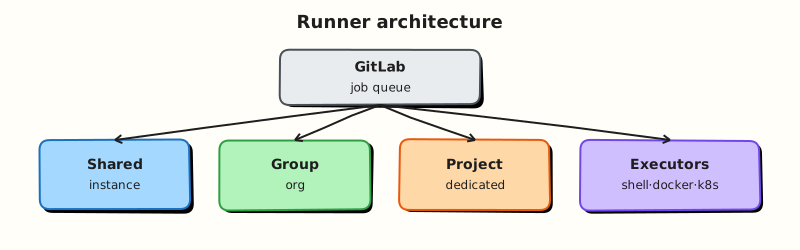
This topic’s control points and relationships are shown below.
Theory
What it is
GitLab schedules jobs; runners claim them over the Runner API. Registration associates a runner with an instance, group, or project (modern registration uses authentication tokens and runner types). The executor plugin runs the job:
| Executor | Isolation | Typical use |
|---|---|---|
| Shell | Process on the runner host | Legacy / carefully locked hosts |
| Docker | Container per job | Most SaaS and self-managed CI |
| Kubernetes | Pod per job | Cluster-backed platforms |
| Docker Machine / autoscaler | Ephemeral VMs | Burst capacity (evolving tooling) |
Shared (instance) runners serve many projects (GitLab.com shared runners). Group runners serve all projects in a group. Project runners are scoped to one project — useful for privileged or regulated workloads.
Why it matters
Wrong executor choices create security and reliability debt: shell executors share a host filesystem; untagged “any runner” jobs can land on laptops registered as runners; missing capacity creates hour-long queues. Platform teams treat runners as product infrastructure — sized, tagged, monitored, and patched like any other fleet.
How it works
- Admin registers a runner with GitLab (token / runner authentication).
- Runner polls for jobs that match its tags and access scope.
- For Docker: pull
image:(or default), mount the build directory, runscript. - For Kubernetes: create a build Pod in a configured namespace, stream logs, clean up.
- Status and artefacts return to GitLab; autoscalers add/remove runner capacity from queue metrics.
Job authors select capacity with tags: [docker, linux] (example). Without tags, any untagged runner in scope may take the job — usually undesirable in production.
You can study YAML without owning runners: GitLab.com free tier provides shared runners; gitlab-ci-local runs many jobs on your laptop; glab ci lint validates syntax.
Key concepts and comparisons
| Scope | Who can use it | Ops note |
|---|---|---|
| Shared / instance | Broad set of projects | Minute quotas, noisy neighbour |
| Group | Projects under the group | Standard platform fleet |
| Project | One project | Privileged / air-gapped builds |
Autoscaling overview: idle VMs or cluster nodes cost money; static fleets waste capacity. Autoscaling adds runners when the pending queue grows and removes them when idle — design for warm pools if cold starts hurt MR feedback.
Common pitfalls
- Registering a personal laptop as an unprotected shared runner.
- Using the shell executor for untrusted open-source MRs.
- Forgetting tags so GPU or privileged jobs never run (or run everywhere).
- Equating “Docker executor” with “Docker-in-Docker” — DinD is a separate, higher-risk pattern.
Hands-on Lab
Objective
Document runner capacity in runner-tags.yaml, author a .gitlab-ci.yml where jobs target specific runner tags, and validate executor choices offline with PyYAML.
Prerequisites
- Python 3 with PyYAML (
pip install pyyaml) - Optional: GitLab project with group or project runners registered
Lab environment
Workspace: ~/rebash-gitlab/module-03
File-first lab. Push to GitLab only when tagged runners exist to claim jobs.
Real-world scenario
Your platform team operates two runner fleets: docker-linux runners for containerised builds and shell-legacy runners for a locked-down deployment host. Untagged jobs caused production deploys to land on developer laptops. You encode the runner matrix in YAML and tag every job explicitly.
Step-by-step tasks
Task 1 – Document the runner fleet matrix
Create runner-tags.yaml:
runners:
  - name: shared-docker-linux
    scope: group
    executor: docker
    tags:
      - docker-linux
    image_default: docker:27-cli
    notes: "Default fleet for build and test jobs"
  - name: deploy-shell-host
    scope: project
    executor: shell
    tags:
      - shell-legacy
    notes: "Single locked host — never use for untrusted MRs"
policy:
  require_tags_on_production_jobs: true
  forbid_untagged_jobs: true
Validate:
cd ~/rebash-gitlab/module-03
python3 -c "
import yaml
m = yaml.safe_load(open('runner-tags.yaml'))
assert m['runners'][0]['executor'] == 'docker'
assert m['runners'][1]['executor'] == 'shell'
print('OK executors', [r['executor'] for r in m['runners']])
"
Expected output
Prints OK executors ['docker', 'shell'].
Task 2 – Create tagged pipeline jobs
Create src/check.py:
Create .gitlab-ci.yml:
stages:
  - build
  - deploy

docker_build:
  stage: build
  tags:
    - docker-linux
  image: docker:27-cli
  script:
    - docker version
    - python3 -c "print('build on docker executor')"

shell_deploy_stub:
  stage: deploy
  tags:
    - shell-legacy
  script:
    - echo "Deploy stub — shell executor on locked host"
    - uname -a
  rules:
    - if: $CI_COMMIT_BRANCH == $CI_DEFAULT_BRANCH

# Anti-pattern example — commented for review; do not enable in production
# untagged_job:
#   stage: build
#   script:
#     - echo "Any runner may claim this — avoid"
Validate offline:
cd ~/rebash-gitlab/module-03
python3 -c "
import yaml
d = yaml.safe_load(open('.gitlab-ci.yml'))
assert d['docker_build']['tags'] == ['docker-linux']
assert d['shell_deploy_stub']['tags'] == ['shell-legacy']
print('OK tagged jobs')
"
Expected output
Prints OK tagged jobs.
Task 3 – Simulate docker-stage logic locally
Run the build script path without a runner:
cd ~/rebash-gitlab/module-03
python3 src/check.py | tee runner-out.txt
python3 -c "print('build on docker executor')" | tee -a runner-out.txt
grep -q 'runner-tags ok' runner-out.txt
Expected output
runner-out.txt contains both runner-tags ok and build on docker executor.
Validation steps
-
runner-tags.yamllists docker and shell executors with tags -
docker_buildrequires tagdocker-linux -
shell_deploy_stubrequires tagshell-legacyand runs only on default branch - No production job is left untagged
- Local simulation of build output succeeds
Common errors and fixes
| Error | Cause | Fix |
|---|---|---|
Job stuck pending | No runner with matching tag | Register a runner with docker-linux or shell-legacy tags |
| Job runs on wrong host | Tag typo | Match tags exactly between runner config and .gitlab-ci.yml |
| Shell executor on public MR | Untrusted code on host filesystem | Use Docker or Kubernetes executors for MR pipelines |
docker: command not found in job | Shell executor used for docker job | Ensure docker_build lands on a Docker executor runner |
Challenge exercise
Add a lint_mr job tagged docker-linux with rules: [{ if: $CI_PIPELINE_SOURCE == "merge_request_event" }] so MR feedback never uses the shell executor.
Learning outcomes
- Documented runner capacity and executor types in version-controlled YAML
- Routed jobs to tagged runners instead of accepting any available runner
- Understood when shell versus Docker executors are appropriate
- Validated pipeline and matrix YAML offline
Cleanup
rm -f ~/rebash-gitlab/module-03/runner-out.txt
# Keep runner-tags.yaml and .gitlab-ci.yml for module 04
Validation
- Lab commands run under
~/rebash-gitlab/module-03/ - You can explain each Theory section in your own words
- You used modern tooling where it applies to this topic
- You can describe one production failure mode for this topic
Code Walkthrough
Production practice for GitLab Runners and Executors always combines:
- Inspect before you change (status, plan, logs, dry-run)
- Prefer reversible, documented changes (Git, IaC, drop-ins, version pins)
- Capture evidence (command output, pipeline logs) for handovers
- Prefer current tools and APIs over legacy shortcuts
- Least privilege — escalate credentials only when required
Keep runbooks short enough to follow under pressure. Automate checks; keep humans for judgement.
Security Considerations
- Treat credentials and tokens for gitlab as privileged — never commit them
- Prefer short-lived auth (OIDC, roles, SSO) over long-lived keys
- Validate blast radius before apply/deploy/delete operations
- Restrict who can approve production changes
- Collect audit logs; limit who can read sensitive traces
Common Mistakes
Registering a personal laptop as an unprotected shared runner.
Validate assumptions against the Theory section and official docs before changing production.
Using the shell executor for untrusted open-source MRs.
Lab shortcuts (open security groups, admin roles, skip approvals) must not ship unchanged.
Changing production without a rollback path
Always know how to revert (previous artefact, prior release, state rollback, DNS failback).
Best Practices
- Encode GitLab Runners and Executors changes as code and review them in pull requests
- Pin versions (images, modules, actions, provider plugins)
- Separate environments with clear promotion gates
- Alert on symptoms with runbooks attached
- Destroy lab resources; tag everything with owner and expiry where possible
Troubleshooting
| Symptom | Likely cause | Fix |
|---|---|---|
| Auth / permission denied | Wrong identity, policy, or scope | Check caller identity, roles, and least-privilege policies |
| Timeout / no route | Network, DNS, security group, or endpoint | Trace path, DNS, and allow-lists before retrying |
| Drift / unexpected plan | Manual change or wrong state/workspace | Reconcile desired vs actual; avoid click-ops on managed resources |
| Pipeline/job red | Flaky step, cache, or missing secret | Read failing step logs; bisect recent workflow/config changes |
| Cost spike | Idle load balancer, NAT, oversized compute | Inventory billable resources; stop/delete labs promptly |
Summary
GitLab Runners and Executors is essential for Cloud and DevOps engineers working with gitlab. Practise the lab until the inspection and change path is muscle memory, then continue the track.
Interview Questions
- Compare shell, Docker, and Kubernetes executors for isolation and cost.
- Jobs stuck in pending — what runner factors do you verify first?
- Why tag runners instead of relying on shared untagged runners?
- What security risk does a privileged Docker runner introduce?
- How do protected runners interact with protected branches/variables?
Sample answer — question 2
Check runner online status, matching tags, concurrent job limits, and whether the project may use that runner. Pending almost always means no eligible runner.
Sample answer — question 4
Privileged mode and Docker socket mounts can let jobs escape to the host. Prefer unprivileged executors and dedicated tags for production.