Workflow Syntax: Matrix, Conditionals, and Reusable Workflows
Overview
Production pipelines rarely run one configuration. You test on multiple Node versions, deploy only from main, skip docs-only changes, and share a standard deploy workflow across fifty repositories. Matrix builds, conditionals, inputs/outputs, and reusable workflows are the power tools that keep YAML DRY without sacrificing clarity.
This module teaches syntax you will use daily: fan-out testing with strategy.matrix, guard rails with if:, pass data between jobs via outputs, and call central workflows with workflow_call.
This is Tutorial 4 in Module 4: Workflow Syntax of the REBASH Academy GitHub Actions for Cloud & DevOps Engineers series. The lab builds matrix and reusable workflow stubs validated offline under ~/rebash-github-actions/module-04.
Prerequisites
- GitHub-hosted and Self-hosted Runners
- GitHub Actions Basics
- Python 3 with PyYAML
Learning Objectives
By the end of this tutorial, you will be able to:
- Configure
strategy.matrixfor multi-version or multi-OS testing - Use
if:conditions on jobs and steps safely - Pass job outputs to downstream jobs with
needsandoutputs - Author a reusable workflow (
on: workflow_call) and call it from a caller workflow - Validate matrix and reusable YAML structure locally
Architecture
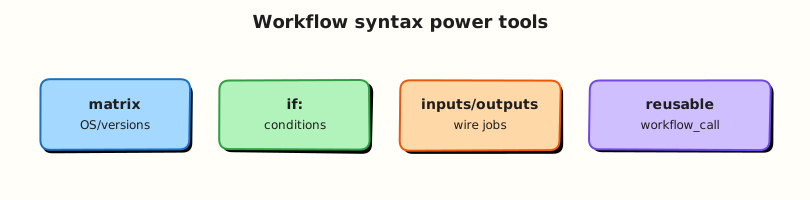
Caller workflows invoke reusable callees; matrix jobs fan out; conditionals filter execution; outputs chain jobs.
Theory
What it is
Matrix strategy duplicates a job across combinations:
Each combination becomes a separate job instance. Access values with the matrix context expression for matrix.node (dollar-brace-brace form in real workflow YAML).
Conditionals skip jobs or steps when expressions are false:
Job outputs export values to dependent jobs:
jobs:
  build:
    outputs:
      version: ${{ steps.meta.outputs.version }}
    steps:
      - id: meta
        run: echo "version=1.2.3" >> "$GITHUB_OUTPUT"
  deploy:
    needs: build
    steps:
      - run: echo "Deploying ${{ needs.build.outputs.version }}"
Reusable workflows — callee defines on: workflow_call with inputs and secrets; caller uses uses: org/repo/.github/workflows/deploy.yml@v1.
Why it matters
Without matrices, teams copy-paste jobs per Node version — fixes miss a copy. Without conditionals, deploy jobs fire on every pull request. Without reusable workflows, platform standards drift across repositories.
Enterprise platform teams publish one callee workflow (build, scan, deploy) and let product repos maintain thin caller files — twenty lines instead of four hundred.
How it works
Matrix exclusions and includes:
strategy:
  matrix:
    node: [18, 20]
    os: [ubuntu-latest, windows-latest]
    exclude:
      - node: 18
        os: windows-latest
    include:
      - node: 22
        os: ubuntu-latest
        experimental: true
fail-fast: when true (default), one failing matrix leg cancels siblings. Set false to see all failures — useful for compatibility testing.
Reusable workflow callee skeleton:
on:
  workflow_call:
    inputs:
      environment:
        required: true
        type: string
    secrets:
      DEPLOY_TOKEN:
        required: true
jobs:
  deploy:
    runs-on: ubuntu-latest
    environment: ${{ inputs.environment }}
    steps:
      - run: echo "Deploy to ${{ inputs.environment }}"
Caller:
jobs:
  call-deploy:
    uses: my-org/pipelines/.github/workflows/deploy.yml@v2
    with:
      environment: staging
    secrets:
      DEPLOY_TOKEN: ${{ secrets.DEPLOY_TOKEN }}
Key concepts and comparisons
| Feature | Scope | Typical use |
|---|---|---|
| Matrix | One job definition, many instances | Test Node 18/20/22 |
if: | Job or step | Skip deploy on PR |
outputs | Job-to-job data | Pass version tag to deploy |
| Reusable workflow | Workflow-to-workflow | Central platform pipeline |
| Anti-pattern | Better approach |
|---|---|
| Copy-paste three identical jobs | Matrix |
Shell if inside one giant step | Job-level if: for clarity |
| Monolithic 800-line workflow | Reusable callee + thin caller |
Common pitfalls
- Matrix variables in
runs-onrequire matching runner labels for each OS axis. if:expressions use GitHub expression syntax, not bare shell tests in theif:field.- Reusable workflows cannot be nested more than one level deep in some enterprise policies — check org rules.
- Forgetting
secrets:mapping on caller — callee secrets are not inherited automatically. - Actions expressions inside workflow YAML — wrap tutorial fences in raw Jinja blocks so MkDocs does not interpret expressions.
Hands-on Lab
Objective
Build a matrix CI workflow, a conditional deploy stub, and a reusable workflow pair (callee + caller) under ~/rebash-github-actions/module-04, validated with Python asserts.
Prerequisites
- Modules 1–3
- Python 3 with PyYAML
Lab environment
mkdir -p ~/rebash-github-actions/module-04/.github/workflows && cd ~/rebash-github-actions/module-04
set -euo pipefail
Real-world scenario
Platform engineering wants a standard test matrix (Node 18 and 20) and a reusable deploy workflow product teams can call with one job. You prototype both patterns offline before publishing to the platform-pipelines repository.
Step-by-step tasks
Task 1 – Matrix CI workflow
Create .github/workflows/matrix-ci.yml:
name: Matrix CI
on:
  pull_request:
  workflow_dispatch:
permissions:
  contents: read
jobs:
  test:
    runs-on: ubuntu-latest
    strategy:
      fail-fast: false
      matrix:
        node: [18, 20]
    steps:
      - uses: actions/checkout@v4
      - name: Simulate Node ${{ matrix.node }}
        run: |
          set -euo pipefail
          echo "node-version=${{ matrix.node }}" > node-${{ matrix.node }}.txt
          test -s node-${{ matrix.node }}.txt
          grep -q "${{ matrix.node }}" node-${{ matrix.node }}.txt
Validate offline:
cd ~/rebash-github-actions/module-04
set -euo pipefail
grep -q 'strategy:' .github/workflows/matrix-ci.yml
grep -q 'matrix:' .github/workflows/matrix-ci.yml
python3 -c "import yaml; d=yaml.safe_load(open('.github/workflows/matrix-ci.yml')); assert 'node' in d['jobs']['test']['strategy']['matrix']; print('matrix OK')"
Expected output
matrix OK
Task 2 – Conditional deploy stub
Create .github/workflows/conditional-deploy.yml:
name: Conditional deploy stub
on:
  push:
    branches: [main]
  workflow_dispatch:
permissions:
  contents: read
jobs:
  deploy:
    if: github.ref == 'refs/heads/main' && github.event_name == 'push'
    runs-on: ubuntu-latest
    steps:
      - name: Deploy stub
        run: |
          set -euo pipefail
          echo "deploy-main-only" > deploy.txt
          test -s deploy.txt
  notify-skipped:
    if: github.event_name == 'workflow_dispatch'
    runs-on: ubuntu-latest
    steps:
      - run: echo "Manual dispatch — deploy job skipped by design"
Validate offline:
cd ~/rebash-github-actions/module-04
set -euo pipefail
grep -q "if: github.ref ==" .github/workflows/conditional-deploy.yml
python3 -c "import yaml; yaml.safe_load(open('.github/workflows/conditional-deploy.yml')); print('conditional OK')"
Expected output
conditional OK
Task 3 – Reusable workflow callee and caller
Create .github/workflows/reusable-deploy.yml:
name: Reusable deploy (callee)
on:
  workflow_call:
    inputs:
      target_env:
        required: true
        type: string
    outputs:
      deploy_status:
        description: Result marker
        value: ${{ jobs.deploy.outputs.status }}
jobs:
  deploy:
    runs-on: ubuntu-latest
    outputs:
      status: ${{ steps.mark.outputs.status }}
    steps:
      - id: mark
        run: |
          echo "status=ok-${{ inputs.target_env }}" >> "$GITHUB_OUTPUT"
          echo "status=ok-${{ inputs.target_env }}" > callee-out.txt
Create .github/workflows/caller-pipeline.yml:
name: Caller pipeline
on:
  workflow_dispatch:
permissions:
  contents: read
jobs:
  invoke-deploy:
    uses: ./.github/workflows/reusable-deploy.yml
    with:
      target_env: staging
Validate offline:
cd ~/rebash-github-actions/module-04
set -euo pipefail
grep -q 'workflow_call' .github/workflows/reusable-deploy.yml
grep -q 'uses: ./.github/workflows/reusable-deploy.yml' .github/workflows/caller-pipeline.yml
python3 -c "
import yaml
callee = yaml.safe_load(open('.github/workflows/reusable-deploy.yml'))
caller = yaml.safe_load(open('.github/workflows/caller-pipeline.yml'))
assert 'workflow_call' in callee['on']
assert callee['on']['workflow_call']['inputs']['target_env']['required'] is True
job = caller['jobs']['invoke-deploy']
assert job['uses'].endswith('reusable-deploy.yml')
assert job['with']['target_env'] == 'staging'
print('reusable OK')
"
Expected output
reusable OK
Task 4 – Simulate matrix outputs locally and archive
cd ~/rebash-github-actions/module-04
set -euo pipefail

for v in 18 20; do
  echo "node-version=${v}" > "node-${v}.txt"
  grep -q "${v}" "node-${v}.txt"
done
echo "ok-staging" > callee-out.txt
grep -q 'ok-staging' callee-out.txt

tar -czf module-04-evidence.tgz .github/workflows/ node-*.txt callee-out.txt
ls -l module-04-evidence.tgz | tee evidence.txt
Expected output
Tarball created; greps succeed.
Validation steps
- Matrix workflow defines Node 18 and 20 axes
- Conditional workflow uses
if:on deploy job - Reusable callee exposes
workflow_callinputs - Caller references local reusable path with
with:mapping - Python asserts pass for all three patterns
Common errors and fixes
| Error | Cause | Fix |
|---|---|---|
workflow_call not recognised | Typo in on: key | Must be exact workflow_call: at workflow root |
| Caller secrets missing | Callee declares required secrets | Add secrets: block on caller job |
| Matrix job cancelled early | fail-fast: true | Set fail-fast: false for full signal |
Invalid if: syntax | Shell syntax in expression field | Use github.ref == 'refs/heads/main' form |
Challenge exercise
Add a job output chain: a version job writes 1.0.0 to GITHUB_OUTPUT, a package job with needs: version reads it via needs.version.outputs. Validate with Python that outputs keys exist.
Learning outcomes
- Authored matrix CI with multiple Node versions
- Applied job-level conditionals for main-only deploy
- Created reusable callee and local caller workflows
- Validated structure without GitHub push
Cleanup
Validation
- Lab completed under
~/rebash-github-actions/module-04/ - You can explain
fail-fastbehaviour in matrix jobs - You can describe how caller passes secrets to callee
- You can name when reusable workflows beat composite actions
Code Walkthrough
- Matrix for variation — OS, language version, shard index; keep axes meaningful.
- Conditionals at job level — clearer Actions UI than nested shell
if. - Outputs for handoff — version, artefact name, plan result — typed strings only.
- Reusable for standards — one callee maintained by platform team.
- Validate locally — Python YAML load plus grep for matrix expression patterns before push.
Security Considerations
- Matrix deploy combinations can accidentally deploy experimental axes — exclude prod from experimental includes.
- Reusable workflows from external repos (
uses: foreign-org/...) execute with caller permissions — pin commit SHA. - Conditional
if:on secrets usage does not hide secrets from malicious steps in the same job — split trust boundaries by job. - Limit
workflow_callinputs — validate allowed environment names against an allow-list expression. - Organisation rulesets can restrict reusable workflow sources — align with InfoSec policy.
Common Mistakes
Using matrix without fail-fast consideration
One broken leg can hide other failures when fail-fast: true. Fix: Set fail-fast: false during compatibility work; enable true only when legs are redundant checks.
Caller forgets to pass required secrets
Callee fails at parse time or runtime. Fix: Mirror callee secrets: declarations exactly on the caller job.
Deploy conditional on wrong event
pull_request merge ref may not match push to main semantics. Fix: Use if: github.ref == 'refs/heads/main' && github.event_name == 'push' for post-merge deploys, or workflow_run for chain triggers.
Best Practices
- Keep matrix axes small — combinatorial explosion costs minutes and attention.
- Document reusable workflow inputs in a table in the platform repository README.
- Version reusable workflows with tags (
@v1) — callers pin intentionally. - Use
include:for one-off combinations instead of expanding entire matrix. - Export only stable outputs — version strings, artefact IDs, not log fragments.
Troubleshooting
| Symptom | Likely cause | Fix |
|---|---|---|
| Matrix job missing | Excluded by exclude: rule | Review strategy.matrix.exclude |
| Reusable workflow not found | Wrong path or ref | Same-repo calls use ./.github/workflows/name.yml |
| Output empty in downstream job | Step did not write GITHUB_OUTPUT | Use echo "key=value" >> "$GITHUB_OUTPUT" |
| Conditional job skipped unexpectedly | Expression false | Log github.* context in prior step |
| Too many concurrent matrix jobs | Org concurrency limit | Reduce matrix or use max-parallel |
Summary
Matrix, conditionals, outputs, and reusable workflows turn repetitive YAML into maintainable platform patterns. Module 4’s lab gives you offline-validated stubs for each. Continue to Secrets, Variables, and OIDC for secure credential handling.
Interview Questions
1. How does a matrix strategy affect billing and parallelism?
Reveal answer
Each matrix combination spawns a separate job, each consuming runner minutes concurrently (subject to concurrency limits). A 3×2 matrix creates six parallel jobs — fast feedback but six times the minute cost of a single job. Use max-parallel to throttle and exclude/include to avoid useless combinations.
2. When would you use a reusable workflow instead of a composite action?
Reveal answer
Reusable workflows orchestrate multiple jobs, environments, and permissions — full pipeline segments. Composite actions bundle steps within one job. Choose reusable workflows for org-standard CI/CD templates; composite actions for shared step sequences (lint setup, tool install).
3. Explain job outputs versus step outputs.
Reveal answer
Step outputs come from echo "name=value" >> "$GITHUB_OUTPUT" and are referenced as steps.<id>.outputs.name. Job outputs expose selected step outputs at the job boundary via jobs.<id>.outputs, then downstream jobs read needs.<job>.outputs.name. Job outputs are the handoff mechanism between jobs.
4. What is fail-fast in matrix builds?
Reveal answer
When true, the first failing matrix leg cancels all in-progress and pending siblings. When false, all legs run to completion — useful to see every broken Node version rather than stopping at the first failure.
5. Can a reusable workflow call another reusable workflow?
Reveal answer
Yes, a callee can include a job that uses: another reusable workflow, but organisations may restrict nesting depth or external sources via rulesets. Prefer a flat design — one platform callee — unless nesting clearly reduces duplication.
6. How do you skip CI for documentation-only changes?
Reveal answer
Use path filters on on.push and on.pull_request (paths / paths-ignore), or a job-level if: checking git diff output from a paths-filter action. Path filters at the trigger level avoid starting the workflow entirely — cheaper than starting and skipping jobs.
7. Why pin reusable workflow refs to tags or SHAs?
Reveal answer
@main on a reusable workflow can change behaviour for every caller without their review — a supply-chain and stability risk. Pin @v1 or a commit SHA so platform changes roll out through explicit caller bumps and changelogs.