Testing in GitHub Actions
Overview
Continuous Integration (CI) without tests is packaging, not integration. GitHub Actions runs unit, integration, and end-to-end (E2E) jobs — often in parallel matrix builds across language versions or browsers — and fails the workflow before deploy when quality gates break.
This is Tutorial 12 in Module 12: Testing of the REBASH Academy GitHub Actions for Cloud & DevOps Engineers series — written for Cloud, DevOps, Platform, SRE, and software engineers.
Prerequisites
- Security Scanning and Supply Chain
- Artifacts and Caching
- Python 3 or Node.js for local test execution in the lab
Learning Objectives
By the end of this tutorial, you will be able to:
- Structure separate jobs for unit, integration, and E2E tests
- Use matrix strategy for parallel version/browser coverage
- Upload test reports and coverage as artefacts
- Chain jobs with
needs:so deploy waits on tests - Diagnose flaky tests vs infrastructure failures
Architecture
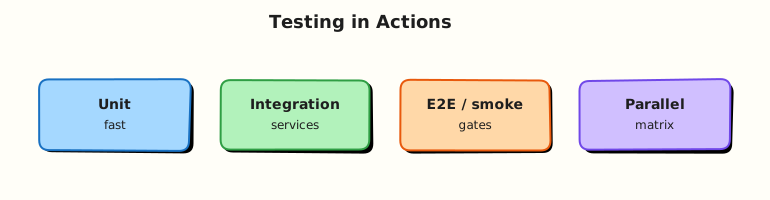
Build produces artefacts; test jobs run in parallel; deploy depends on all gates passing.
Theory
What it is
| Layer | Scope | Typical tools | Speed |
|---|---|---|---|
| Unit | Functions/modules in isolation | pytest, Jest, Go test | Seconds |
| Integration | Services + databases/APIs | pytest + Testcontainers, supertest | Minutes |
| E2E | Full user flows in browser/API | Playwright, Cypress | Minutes–tens of minutes |
| Smoke | Post-deploy health | curl, kubectl, synthetic check | Seconds |
Matrix builds run the same job with different strategy.matrix values (Python 3.11/3.12, Node 20/22) — failures pinpoint version-specific breaks.
Why it matters
Deploying without tests shifts failures to production where rollback is expensive. Parallel matrices shorten feedback while increasing coverage. Clear job boundaries (unit → integration → e2e) keep fast tests failing first so developers do not wait twenty minutes for a typo.
How it works
- Unit job — checkout, install deps, run
pytest tests/unitornpm test. - Integration job —
needs: unit, start dependencies (Docker Compose service containers or Testcontainers), run integration suite. - E2E job —
needs: integration, run Playwright against staging URL or ephemeral preview. - Matrix —
strategy.matrix.python-version: ['3.11','3.12']generates one runner per version. - Artefacts — upload JUnit XML, coverage HTML, Playwright traces for debugging failed runs.
Example matrix snippet (documentation):
strategy:
  fail-fast: false
  matrix:
    python-version: ['3.11', '3.12']
runs-on: ubuntu-latest
steps:
  - uses: actions/setup-python@v5
    with:
      python-version: ${{ matrix.python-version }}
Key concepts and comparisons
| Pattern | When to use | Trade-off |
|---|---|---|
| Single job all tests | Tiny repos | Slow feedback; hard to parallelise |
| Job per layer | Most services | More YAML; clearer failures |
| Matrix | Multi-version/browser | Runner minutes multiply |
| Reusable test workflow | Many repos | Central policy updates |
Common pitfalls
- E2E on every pull request without caching browsers — slow and flaky.
continue-on-error: trueon test steps — green pipeline with failing tests.- Integration tests hitting production APIs — data corruption and cost.
- No artefact upload on failure — cannot download Playwright trace.
- Matrix without
fail-fast: false— one version failure hides others.
Hands-on Lab
Objective
Build a Python sample app with unit and integration tests, author a matrix test workflow with job dependencies, and validate tests locally plus YAML offline.
Prerequisites
- Python 3.11+
pipandpytest
Lab environment
Workspace: ~/rebash-github-actions/module-12
mkdir -p ~/rebash-github-actions/module-12/{app,tests/unit,tests/integration,.github/workflows} && cd ~/rebash-github-actions/module-12
set -euo pipefail
python3 --version | tee python-version.txt
Real-world scenario
A platform team requires unit tests on every push, integration tests after unit pass, and a Python version matrix (3.11 and 3.12) before merge to main.
Step-by-step tasks
Task 1 – Sample app and tests
Create app/calc.py:
Create tests/unit/test_calc.py:
Create tests/integration/test_api_stub.py:
Create requirements-dev.txt:
Run tests locally:
cd ~/rebash-github-actions/module-12
set -euo pipefail
python3 -m pip install -q -r requirements-dev.txt
PYTHONPATH=. pytest tests/unit -q | tee unit-local.txt
PYTHONPATH=. pytest tests/integration -q | tee integration-local.txt
Expected output
Both pytest runs pass; output captured in unit-local.txt and integration-local.txt.
Task 2 – Matrix test workflow with job chain
Create .github/workflows/test.yml:
name: Test
on:
  push:
    branches: [main]
  pull_request:
  workflow_dispatch:

permissions:
  contents: read

jobs:
  unit:
    runs-on: ubuntu-latest
    strategy:
      fail-fast: false
      matrix:
        python-version: ['3.11', '3.12']
    steps:
      - uses: actions/checkout@v4
      - uses: actions/setup-python@v5
        with:
          python-version: ${{ matrix.python-version }}
      - run: pip install -r requirements-dev.txt
      - run: PYTHONPATH=. pytest tests/unit --junitxml=unit-junit.xml -q
      - uses: actions/upload-artifact@v4
        if: always()
        with:
          name: unit-junit-${{ matrix.python-version }}
          path: unit-junit.xml

  integration:
    needs: unit
    runs-on: ubuntu-latest
    steps:
      - uses: actions/checkout@v4
      - uses: actions/setup-python@v5
        with:
          python-version: '3.12'
      - run: pip install -r requirements-dev.txt
      - run: PYTHONPATH=. pytest tests/integration --junitxml=integration-junit.xml -q
      - uses: actions/upload-artifact@v4
        if: always()
        with:
          name: integration-junit
          path: integration-junit.xml

  e2e-stub:
    needs: integration
    runs-on: ubuntu-latest
    steps:
      - run: echo "E2E stub — replace with Playwright against preview URL"
      - run: test 0 -eq 0
Validate offline:
cd ~/rebash-github-actions/module-12
set -euo pipefail
python3 -c "import yaml; yaml.safe_load(open('.github/workflows/test.yml')); print('test workflow OK')"
grep -q 'matrix:' .github/workflows/test.yml
grep -q 'needs: unit' .github/workflows/test.yml
Expected output
test workflow OK; matrix and needs present.
Task 3 – Local workflow structure checks
Create validate-tests.sh:
#!/usr/bin/env bash
set -euo pipefail
PYTHONPATH=. pytest tests/unit tests/integration -q
python3 -c "import yaml; d=yaml.safe_load(open('.github/workflows/test.yml')); assert 'unit' in d['jobs']; assert 'integration' in d['jobs']"
grep -q 'upload-artifact' .github/workflows/test.yml
echo 'module-12 test lab passed'
Run it:
cd ~/rebash-github-actions/module-12
set -euo pipefail
chmod +x validate-tests.sh
./validate-tests.sh | tee validation.txt
Expected output
module-12 test lab passed
Task 4 – Evidence archive
cd ~/rebash-github-actions/module-12
set -euo pipefail
tar -czf module-12-evidence.tgz app tests requirements-dev.txt .github/workflows/test.yml *.txt validate-tests.sh
ls -l module-12-evidence.tgz | tee evidence.txt
Expected output
Evidence tarball listed.
Validation steps
- Unit and integration tests pass locally
- Workflow YAML parses; matrix covers two Python versions
- Integration job
needs: unit; E2E stubneeds: integration - JUnit artefacts uploaded with
if: always()
Common errors and fixes
| Error | Cause | Fix |
|---|---|---|
ModuleNotFoundError: app | PYTHONPATH | Set PYTHONPATH=. in test step |
| Matrix job all red | One version incompatible | Use fail-fast: false; fix per version |
| Integration cannot reach DB | Service not started | Add services: postgres/redis container |
| Flaky E2E | Timing/network | Retries with limits; upload traces |
| Deploy ran despite test fail | Missing needs: | Gate deploy job on test jobs |
Challenge exercise
Add a services: block with postgres:16 and rewrite the integration test to connect with psycopg (or document connection string from services host). Fail if database is unreachable.
Learning outcomes
- Created unit/integration tests with local proof
- Authored matrix workflow with job dependencies
- Uploaded test reports as artefacts
- Understood E2E as final gated stage
Cleanup
rm -rf ~/rebash-github-actions/module-12/__pycache__ ~/rebash-github-actions/module-12/**/__pycache__ 2>/dev/null || true
ls ~/rebash-github-actions/module-12
Validation
- Lab completed under
~/rebash-github-actions/module-12/ - You can explain unit vs integration vs E2E boundaries
- You can configure a matrix without fail-fast hiding versions
- You can describe one flaky-test mitigation
Code Walkthrough
- Fast tests first — unit before integration before E2E.
- Matrix with fail-fast false — see all version failures.
- Artefacts on failure —
if: always()for JUnit/traces. - Service containers — integration deps on localhost ports.
- Deploy needs tests — no shortcut around red jobs.
Security Considerations
- Do not run untrusted fork code with secrets in test jobs — restrict permissions.
- Integration tests must not use production databases or credentials.
- Sanitise test fixtures — no real Personal Identifiable Information (PII) in CI logs.
- Pin test action versions (Module 11) like deploy actions.
- Limit E2E credentials to ephemeral preview environments.
Common Mistakes
One giant test job
Twenty-minute feedback for typos. Fix: split unit/integration/E2E jobs.
continue-on-error on pytest
Broken main branch. Fix: fail the step; waivers only with tracked exceptions.
E2E against production
Data loss and audit issues. Fix: ephemeral preview or staging with synthetic data.
No test artefacts
Cannot debug CI-only failures. Fix: upload JUnit, coverage, Playwright traces.
Best Practices
- Cache dependencies (
actions/cache) keyed on lockfiles. - Tag flaky tests; quarantine with ticket, do not silence permanently.
- Require test workflow success in branch protection rules.
- Keep integration tests deterministic — fixed seeds, isolated databases.
- Report test timing trends to catch slow suites early.
Troubleshooting
| Symptom | Likely cause | Fix |
|---|---|---|
| Passes locally, fails CI | Version mismatch | Align matrix with local Python |
| Integration timeout | Service not healthy | Add health check wait loop |
| Matrix duplicates work | Too many dimensions | Split smoke vs full matrix nightly |
| Empty JUnit artefact | Wrong output path | Verify --junitxml path matches upload |
| E2E flaky on CI only | Resource/time limits | Increase timeout; reduce parallelism |
Summary
Testing in GitHub Actions layers unit, integration, and E2E jobs with matrices for parallel coverage and artefacts for debugging. Gate deploy on green tests. Next: Release Management and Versioning.
Interview Questions
1. Why split unit, integration, and E2E into separate jobs?
Reveal answer
Failures surface faster (unit fails in seconds), runner resources match test type, and deploy can depend on explicit gates rather than one opaque job result.
2. What does strategy.matrix do?
Reveal answer
It expands one job definition into multiple parallel jobs — one per matrix combination (e.g. Python 3.11 and 3.12) — increasing coverage without duplicating YAML.
3. When should you set fail-fast: false on a matrix?
Reveal answer
When you want all matrix combinations to run even if one fails — so you see every broken version rather than stopping at the first failure.
4. How do service containers help integration tests?
Reveal answer
GitHub Actions starts Docker sidecars (e.g. Postgres) on localhost ports for the job, giving real dependencies without external infrastructure.
5. Why upload test artefacts with if: always()?
Reveal answer
Failed tests still produce JUnit XML or Playwright traces needed for debugging — uploading only on success hides evidence when you need it most.
6. How should E2E tests relate to deploy jobs?
Reveal answer
E2E should run against staging or preview after build; deploy to production should need E2E (and unit/integration) success unless a documented exception exists.
7. What is the difference between smoke tests and E2E?
Reveal answer
Smoke tests are minimal post-deploy health checks (one endpoint up); E2E exercises full user journeys — smoke is faster and runs immediately after deploy.
8. How do you reduce flaky E2E in Actions?
Reveal answer
Stable selectors, isolated test data, limited retries with alerting, artefact traces on failure, and not running full E2E on every commit if a nightly job suffices.